
The Tomb of Joshua is a traditional site associated with the burial of Joshua, the successor of Moses and one of the most prominent leaders in the Old Testament. Though its identification rests on longstanding tradition rather than definitive archaeological evidence, the site has been revered for centuries by those who honor Joshua’s role in leading the Israelites into the Promised Land.
Joshua’s life is recorded primarily in the biblical books of Exodus, Numbers, and Joshua. As Moses’ trusted assistant, he was one of the twelve spies sent to explore Canaan. Alongside Caleb, Joshua stood firm in faith, encouraging the people to trust in God’s promise rather than fear the inhabitants of the land. After Moses’ death, Joshua was appointed to lead the Israelites. Under his leadership, they crossed the Jordan River and began the conquest and settlement of Canaan. His life came to symbolize obedience, courage, and steadfast reliance on God.
According to biblical tradition, Joshua was buried in the territory allotted to him, in a place called Timnath-serah in the hill country of Ephraim. Over time, various locations have been identified with this site. The village of Kifl Haris, in the central West Bank, became widely accepted in local tradition as the resting place of Joshua. The Tomb of Joshua there is part of a cluster of shrines also associated with other biblical figures, adding to the spiritual significance of the area.
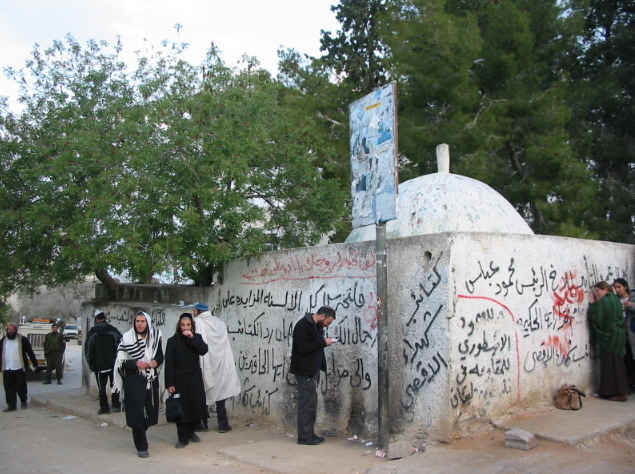
The structure marking the tomb is modest yet dignified. It typically consists of a simple stone building, often featuring a domed roof in keeping with regional architectural traditions. Inside, a cenotaph—an above-ground marker—indicates the supposed burial place. The interior is a quiet, enclosed space, conducive to prayer and reflection. Over the centuries, the site has been maintained and visited by different communities, reflecting the shared reverence for biblical figures across religious traditions.
The Tomb of Joshua is not merely a historical marker; it is a place of remembrance and inspiration. Joshua’s legacy as a leader who faithfully carried out God’s commands has made him a model of obedience and perseverance. Visitors to the site often reflect on his well-known declaration, “As for me and my house, we will serve the Lord,” a statement that continues to resonate with believers today.
Pilgrimage to the tomb has been part of local religious practice for generations. Though access to the site has varied over time due to political and security considerations, it remains an important destination for those seeking to connect with biblical history. Visitors may come to pray, read Scripture, or simply stand in a place long associated with one of the great figures of the Old Testament.
As with many traditional burial sites in the Holy Land, the precise historical accuracy of the Tomb of Joshua cannot be confirmed with certainty. Archaeological evidence does not definitively identify this location as Joshua’s burial place. Nevertheless, the power of tradition and the continuity of reverence give the site its enduring significance. It represents not only a connection to the past but also a living expression of faith and memory.
In the broader landscape of biblical sites, the Tomb of Joshua occupies a quiet yet meaningful place. It does not possess the grandeur of more famous shrines, but its simplicity reflects the character of the man it commemorates. Joshua’s life was marked by faithful service rather than personal glory, and the modest nature of the tomb mirrors that legacy.
Ultimately, the Tomb of Joshua stands as a reminder of leadership rooted in faith. It invites visitors to consider the qualities that defined Joshua’s life—courage, obedience, and trust in God—and to carry those lessons into their own lives.
♦ _____ ♦
From Wikipedia:
According to Joshua 24:30, Joshua was buried in Timnath-serah,[21] which is considered by Orthodox Jews to be the current location of Kifl Haris, where a Jewish tradition also places the tombs of Caleb and Nun.[22] Thousands make the pilgrimage to the tombs on the annual commemoration of Joshua’s death,[22] 26th of Nisan on the Hebrew calendar.[21]
According to a Samaritan tradition, noted in 1877, the tombs of Joshua and Caleb were in Kifl Haris.[23]
The mausoleum at Kifl Haris seen by Jews as the Tomb of Joshua, is known to Muslims as the Maqam of Yusha’ ibn Nun (مقام يوشع بن نون; Shrine of Joshua, son of Nun) and as the Maqam of the Servant of Salah ad-Din (Arabic: مقام خادم صلاح الدين; Shrine of the Servant of Saladin).[24] The current structure of the Shrine of Joshua is known to be an Islamic shrine built by Sultan Saladin, which contained on its wall an inscribed plaque stating that “Jawhar bin Abdullah is one of the servants of the shrine.”[24] About this man, Palestinian historian Murad Mustafa Dabbagh wrote in his work Biladuna Filastin (Our Country Palestine; 1965) that he performed the pilgrimage on behalf of his master, the martyr Najm al-Din Ayyub, son of Sultan Al-Adil I, and that the Hajj took place in the year 610 AH (1213/14 CE), which places him and the time the shrine was built during the Ayyubid period.[24]
_____
Image Source/Credit:
• Photo from Shuki, CC 2.5
Related
Sorry, no records were found. Please adjust your search criteria and try again.
Sorry, unable to load the Maps API.