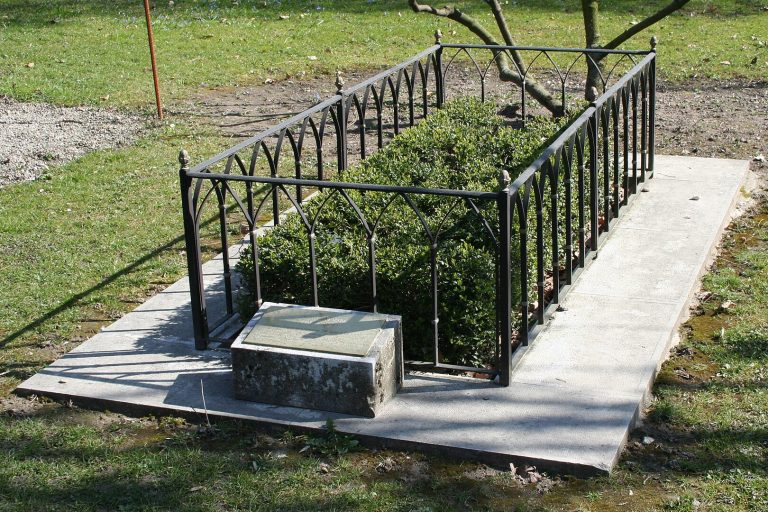
The traditional grave of John Calvin in Geneva is one of the most modest yet meaningful memorials associated with the Protestant Reformation. Located in the Cimetière des Rois (Cemetery of Kings), the site is marked simply by a plain stone bearing the initials “J.C.” This understated marker reflects both the character of the man it commemorates and the theological convictions he so strongly upheld.
John Calvin died on May 27, 1564, after years of intense labor as a pastor, theologian, and reformer. His influence in Geneva and far beyond was immense, shaping the development of Reformed theology and church practice across Europe. Yet despite his prominence, Calvin requested a simple burial with no elaborate monument. This desire was consistent with his rejection of practices that he believed could lead to undue veneration of individuals rather than proper focus on God.
As a result, Calvin was buried in an unmarked grave in a common cemetery. The exact location was not officially recorded, in keeping with his wishes. Over time, however, a traditional site came to be associated with his burial. The present marker in the Cimetière des Rois is therefore not a confirmed grave in the strict historical sense but a memorial placed in recognition of his life and legacy. It has become widely accepted as the place where visitors may reflect on his contribution to the Reformation.
The simplicity of the grave stands in striking contrast to the significance of Calvin’s work. From his base in Geneva, he helped establish a system of church governance, education, and discipline that influenced Protestant communities across many nations. His writings, especially the Institutes of the Christian Religion, provided a clear and systematic expression of Reformed theology. Students trained in Geneva carried these teachings to France, the Netherlands, Scotland, and beyond, often at great personal risk.
The modest nature of Calvin’s grave also serves as a quiet testimony to one of the central principles of the Reformation: that glory belongs to God alone. By avoiding a grand tomb or monument, Calvin sought to prevent the kind of hero worship that he believed had obscured true faith in earlier centuries. In this way, the grave itself becomes an extension of his teaching, embodying the humility and restraint that characterized his ministry.
Over the years, the site has drawn visitors from around the world. Pilgrims, historians, and students of theology come not to admire a grand structure but to stand before a simple stone and consider the legacy of a man whose ideas shaped the course of Christian history. The grave invites reflection rather than spectacle, encouraging a thoughtful engagement with the past.
Today, the traditional grave of John Calvin remains an important symbol within Geneva’s Reformation heritage. Though its exact historical authenticity may be uncertain, its meaning is clear. It represents a life devoted to faith, study, and service, as well as a commitment to principles that continue to influence churches and communities to this day.
In its quiet simplicity, the grave speaks powerfully. It reminds us that lasting influence is not measured by monuments of stone, but by the enduring impact of ideas, convictions, and faithful labor carried out in the service of God.
♦ _____ ♦
From Wikipedia:
Calvin died on 27 May 1564 aged 54. At first his body lay in state, but since so many people came to see it, the reformers were afraid that they would be accused of fostering a new saint’s cult. On the following day, he was buried in an unmarked grave in the Cimetière des Rois.[81] The exact location of the grave is unknown; a stone was added in the 19th century to mark a grave traditionally thought to be Calvin’s.[82]
_____
Image Source/Credit (in order):
• Photo by User:Schutz – CC BY-SA 4.0
Related
Sorry, no records were found. Please adjust your search criteria and try again.
Sorry, unable to load the Maps API.