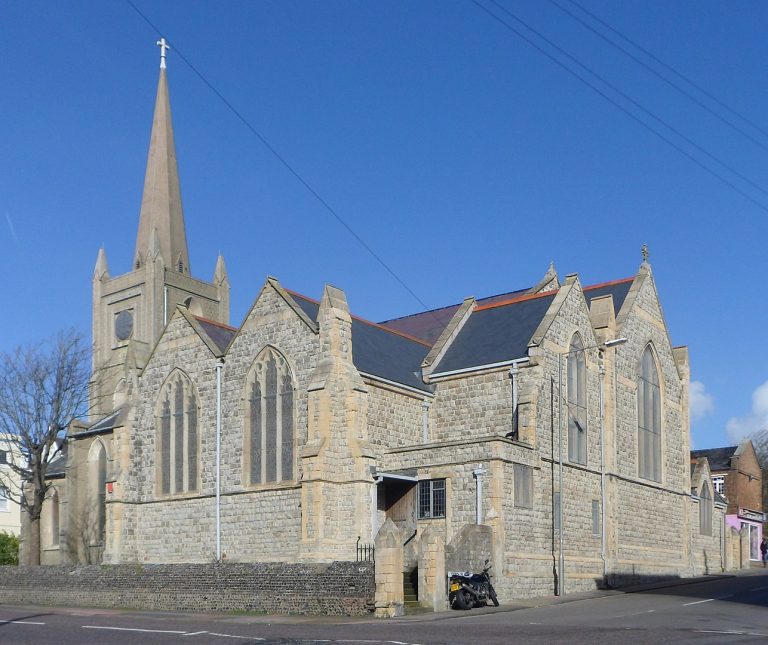
A past vicar, Rev. E.B. Elliott, was the father of Emily Elizabeth Steele Elliott. Emily wrote the popular Christmas hymn “Thou didst leave Thy throne” for the use of the church.
Among Christmas hymns designed for children, two popular ones were written by Elliott. One begins with the line, “There came a little child to earth,” which was popular in England, but was not known to many singing congregations in the U.S.. The second hymn was just as suitable for adults as for youth. It was privately printed in 1864 for the use of the choir and school of St. Mark’s Church, Brighton. The hymn has passed into almost every standard hymnal published in the U.S. at the turn of the 20th century. It starts with, “Thou didst leave Thy throne and Thy kingly crown”, and is usually sung to the music by Barnby or Matthews.[4]
♦ _____ ♦
The St Mark’s Church Brighton holds an important place in the religious and social history of Brighton. Known in its early years as a “free church,” it became a significant center for evangelical Anglican worship in the nineteenth century, reflecting a broader movement to make church life more accessible to the growing urban population.
St Mark’s Church was built in the 1830s during a period of rapid expansion in Brighton, which had developed from a small seaside town into a fashionable resort. With population growth came a pressing need for additional places of worship. Many traditional parish churches were unable to accommodate the increasing numbers, and there was also concern that pew rents—common at the time—excluded poorer residents from regular attendance.
The founding of St Mark’s was closely connected with these concerns. The church was established as a “free church,” meaning that all seating was unreserved and open to anyone, regardless of social or economic status. This was a significant departure from common practice and reflected the influence of evangelical leaders who sought to emphasize the inclusive nature of the Gospel. The project was supported by prominent church figures, including Charles Simeon, whose influence helped shape its theological direction.
Architecturally, St Mark’s Church was designed in the Gothic Revival style, which was popular in the nineteenth century for ecclesiastical buildings. Its structure featured pointed arches, a simple yet dignified interior, and an emphasis on the centrality of the pulpit. Unlike some more ornate churches of the period, St Mark’s maintained a relatively restrained design, consistent with its evangelical focus on preaching and Scripture rather than elaborate ritual.
From its earliest days, the church became known for its strong emphasis on biblical teaching and earnest preaching. Services were centered on the exposition of Scripture, and there was a clear commitment to personal conversion and spiritual growth. This approach resonated with many in Brighton, drawing large congregations and establishing the church as a key center of evangelical life in the town.
St Mark’s also played an active role in the social and charitable work of the community. Like many churches of its kind, it supported outreach to the poor, education initiatives, and missionary efforts both at home and abroad. Its members were often involved in efforts to address the practical needs of the rapidly growing population, reflecting a belief that faith should be expressed in action as well as in worship.
Over time, the church experienced changes in both its congregation and its role within the city. As Brighton continued to develop, new churches were established, and patterns of worship evolved. Nevertheless, St Mark’s retained its historical significance as one of the early examples of a free and open Anglican church.
The legacy of St Mark’s Church lies in its contribution to the movement for accessible worship and its commitment to evangelical principles. By removing financial barriers to attendance, it helped set a precedent for greater inclusivity within the Church of England. Its emphasis on preaching and personal faith also influenced other congregations and contributed to the wider evangelical revival of the nineteenth century.
Today, the memory of St Mark’s Church continues to be associated with these ideals. Though the building itself has undergone changes in use over the years, its history remains a testament to a time when the church sought to meet the needs of a changing society with practical solutions and a clear focus on the message of the Gospel.
_____
Image Source/Credit:
• Hassocks5489, CC0, via Wikimedia Commons
Related

Sorry, no records were found. Please adjust your search criteria and try again.
Sorry, unable to load the Maps API.