
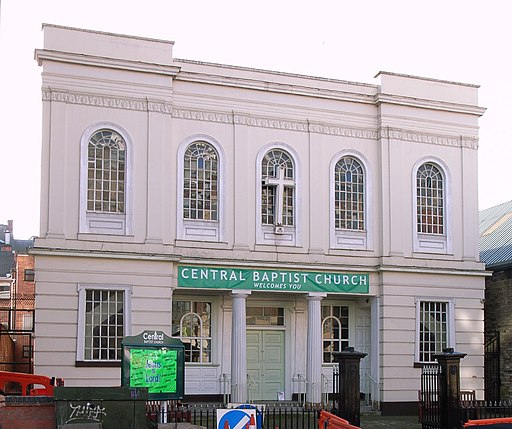
The William Carey Museum, housed within Central Baptist Church, represents an important effort to preserve and interpret the life and legacy of one of Christianity’s most influential missionary pioneers, William Carey. Though modest in size, the museum carries significant historical weight, connecting visitors with the origins of the modern missionary movement and the Baptist tradition in England.
The museum’s origins are closely tied to the history of Carey himself. Leicester played a key role in his early ministry, as it was the last place he served before departing for India in 1793. In the years following his death, interest in his life and work grew steadily. By the early twentieth century, a small “Carey museum” had been established near his former home. However, this original collection was lost when the site was demolished in 1968. Fortunately, many of the artifacts associated with Carey were preserved and later transferred to Central Baptist Church in Leicester, where the present museum was established.
The setting of the museum adds to its significance. Central Baptist Church itself dates back to the early nineteenth century and stands as a surviving example of Leicester’s strong Nonconformist heritage. The city was once known as a center of dissenting religious life, with numerous Baptist and other Free Church congregations. The placement of the museum within this historic church provides an appropriate context, linking Carey’s legacy to the broader Baptist movement that supported and sent him.
The museum is dedicated to telling the story of Carey’s life and achievements. Visitors encounter exhibits that highlight his work as a missionary, linguist, translator, and educator. Carey is often called the “father of modern missions,” and the displays reflect the breadth of his accomplishments. He translated portions of the Bible into multiple Indian languages and played a key role in the founding of the Baptist Missionary Society, which helped launch Protestant missionary efforts around the world.
Although specific exhibits may vary, the museum typically includes artifacts, documents, and interpretive materials related to Carey’s life. These may include items connected to his early years in England, his missionary work in India, and his influence on education and social reform. His contributions went beyond evangelism, extending into fields such as linguistics and printing, as he worked to make Scripture accessible to diverse populations.
The impact of the William Carey Museum lies primarily in its educational and inspirational role. For visitors, it provides a tangible connection to a figure whose influence is often discussed in abstract terms. By presenting physical artifacts and historical context, the museum helps bring Carey’s story to life, making it accessible to both scholars and the general public.
In addition, the museum serves as a reminder of the global reach of a movement that began in relatively humble circumstances. Carey himself was a self-taught cobbler turned preacher, yet his vision for worldwide missions helped reshape the direction of Protestant Christianity. The museum highlights this transformation, showing how one individual’s conviction could influence generations.
The museum also contributes to the preservation of Baptist heritage in England. As many historic chapels and institutions have disappeared or changed over time, sites like this one provide continuity, connecting present-day visitors with the roots of their tradition. It stands as both a historical repository and a place of reflection.
Today, the William Carey Museum continues to welcome visitors interested in history, faith, and mission. While not a large institution, its importance lies in what it represents: the life of a man whose work crossed cultural and linguistic boundaries, and the enduring legacy of a movement committed to sharing its message with the world.
♦ _____ ♦
In 1789, William Carey and his family moved into a cottage across the street from Leicester’s Harvey Lane Baptist Church, which he shepherded to the time of their departure to India in 1793. The Harvey Lane building no longer exists. When Harvey Lane Baptist outgrew its building, in 1845, the congregation moved to Belvoir Street and changed its name to Belvoir Street Baptist. In 1940, Belvoir Street Baptist and Charles Street Baptist (planted by Harvey Lane in 1831) merged to form the United Baptist Church, at the Charles Street faciltiies. In 1983, the United Baptist Church and the Victoria Road Church merged to form the present Central Baptist Church, still at the Charles Street address. Meanwhile, in 1915-16, the William Carey Cottage, on Harvey Lane, became the Carey Museum, or “House of Memories.” Due to street additions in the 1960s, the Carey Museum suffered demolition. A Holiday Inn now occupies the site. Across from the hotel’s main entrance is a commemorative plaque to Carey. Today, the William Carey Museum, in Central Baptist Church, displays the artifacts once housed in the Carey Museum at Harvey Lane. At the top of De Montfort Square, just off New Walk, there is a statue of Baptist preacher, Robert Hall Jr. (1764-1831), who served the Harvey Lane pastorate during 1807-26. (See Chapter 10.).
Copyrighted and used by permission from David Beale, Baptist History in England and America: Personalities, Positions, and Practices
_____
Image Source/Credit:
• Steve Cadman from London, U.K., CC BY-SA 2.0 <https://creativecommons.org/licenses/by-sa/2.0>, via Wikimedia Commons
Related
Sorry, no records were found. Please adjust your search criteria and try again.
Sorry, unable to load the Maps API.