
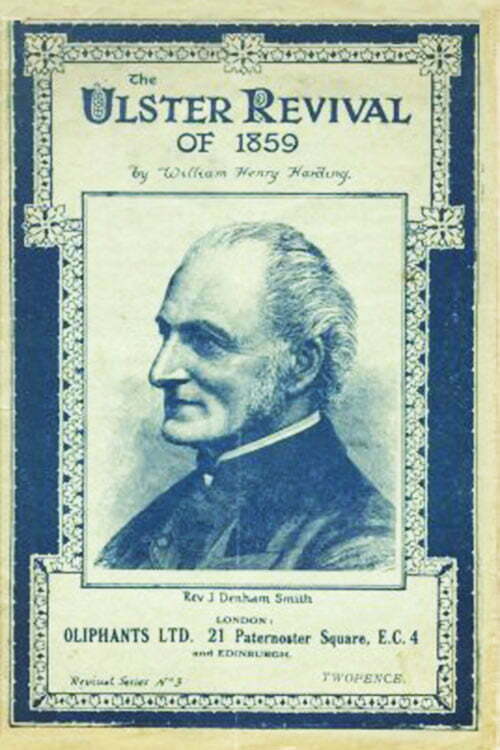
“[James] McQuilkin had put away the fighting cocks he had been rearing and had turned away from all the worldly pleasures because he claimed God had cleansed him from all his sins. All three of them, being old-line hyper-calvinistic Presbyterians, thought that such a claim as McQuilkin’s was, to say the least, presumptuous. Jeremiah Meneely was a communicant member of Connor Presbyterian Church but he could not claim such a knowledge of sins forgiven. Nevertheless, conscious of the unsatisfied depths of his yearning soul, he exclaimed, “I would give the world to know my sins forgiven.” Carlisle and the schoolmaster were of the same opinion. Eager to discover more about this amazing matter, Jeremiah Meneely sought out James McQuilkin…
“The place chosen for the meetings was the Old Schoolhouse near Kells and the meetings commenced in September 1857. During the long winter of 1857-1858 every Friday evening, these young men gathered an armful of peat each, and taking their Bibles made their way to the old schoolhouse. There they read and meditated upon the Scriptures of truth and with hearts aflame with a pure first love, poured out their prayers to the God of heaven. The peats made a fire in the schoolhouse grate and warmed their bodies from the winter’s chill, but their prayers brought down unquenchable fire from heaven, which set all Ulster ablaze for God, and warmed with saving rays at least 100,000 souls.”
-Ian Paisley, “The ’59 Revival”
http://ukwells.org/wells/school-house-kells
♦ _____ ♦
The Kells National Schoolhouse in County Meath, Ireland, is a preserved example of a nineteenth-century rural school, offering valuable insight into the development of education in Ireland. Situated near the historic town of Kells—best known for its association with the Book of Kells—the schoolhouse stands as a reminder of a time when formal education was becoming more widely accessible to ordinary people.
The origins of the Kells National Schoolhouse are closely tied to the establishment of the Irish national school system in 1831. This system, introduced by the British government, aimed to provide non-denominational elementary education to children across Ireland. At a time when schooling was often limited and influenced by religious divisions, the national school system sought to create a more standardized and inclusive approach, though in practice many schools still reflected the religious character of their communities.
The Kells schoolhouse is typical of the modest buildings constructed under this system. Usually consisting of a single classroom, such schools were designed to accommodate children of varying ages and levels of ability in one shared space. The teacher, often working alone, was responsible for instructing all students, managing lessons in reading, writing, arithmetic, and sometimes basic geography and history.
Inside the Kells National Schoolhouse, the arrangement of desks, blackboards, and teaching materials reflects the educational methods of the time. Students sat in rows, often grouped according to ability, while the teacher conducted lessons from the front of the room. Instruction relied heavily on repetition, memorization, and recitation. Textbooks and slates were the primary tools of learning, and resources were often limited, particularly in rural areas.
The daily life of students in such a school was shaped by both discipline and routine. Attendance could be irregular, especially during busy agricultural seasons when children were needed to help at home. Nevertheless, the establishment of national schools marked a significant step forward in literacy and basic education for the Irish population. Over time, these schools contributed to a more educated society and helped lay the foundation for modern educational standards.
The Kells National Schoolhouse also reflects broader social and cultural developments in nineteenth-century Ireland. Education was increasingly seen as a means of improvement and opportunity, particularly for those from poorer backgrounds. At the same time, schools played a role in preserving language, culture, and religious identity, even within a system that aimed for neutrality.
Today, the preserved schoolhouse serves as an educational and heritage site, allowing visitors to experience the atmosphere of a nineteenth-century classroom. Restored furnishings and period details help recreate the conditions under which generations of Irish children were taught. For many, the visit provides a tangible connection to the past, illustrating how education was once conducted and how far it has evolved.
The legacy of places like the Kells National Schoolhouse extends beyond their physical structure. They represent a pivotal moment in the history of education, when access to learning began to expand more broadly across society. While the methods used may now seem outdated, the commitment to providing education for all remains a central principle that continues to shape modern systems.
In conclusion, the Kells National Schoolhouse stands as a modest but meaningful symbol of Ireland’s educational heritage. It offers a window into the daily lives of students and teachers in the nineteenth century and highlights the enduring importance of education as a force for personal and social development.
_____
Image Source/Credit:
• “The Ulster Revival of 1859 – William H. Harding – Ebook.” Revival Books (revival-books.com/products/the-ulster-revival-of-1859-harding)
Related
Sorry, no records were found. Please adjust your search criteria and try again.
Sorry, unable to load the Maps API.