
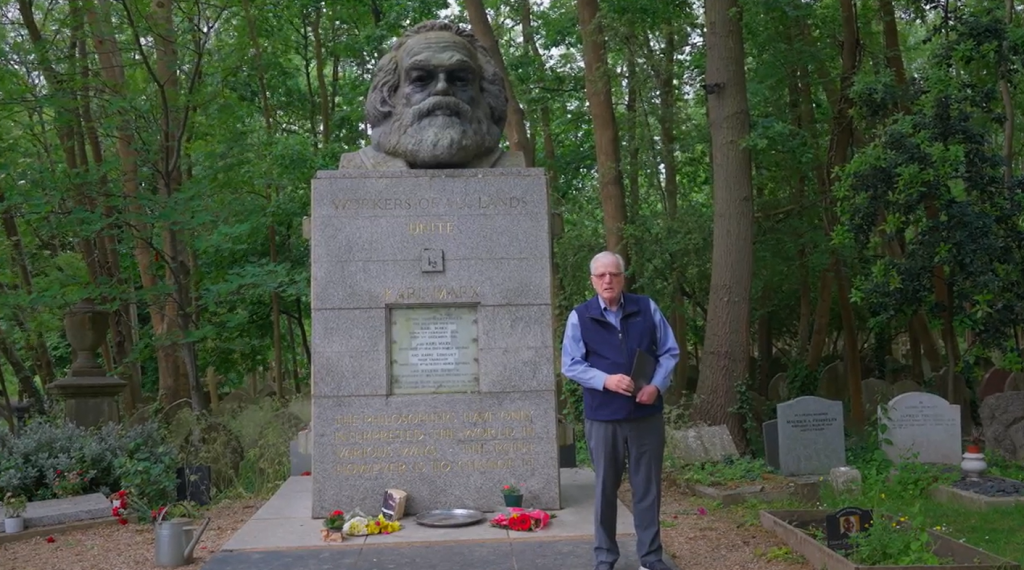
Hi, I’m Erwin Lutzer. Welcome to Highgate Cemetery here in London, England. I’m standing beside the grave of Karl Marx, a man who still rules much of the world from his grave. I want you to notice what is on his tombstone. This is a quotation from the Communist Manifesto, which he co-wrote with Engels. Workers of all lands unite.
But I’m especially interested in this quotation. It says, the philosophers have only interpreted the world in various ways. The point, however, is to change it. And change it he did, but not for the better. This actually is a lecture on a tale of two graves.
I’m going to be talking about Karl Marx. I’m going to be talking about what he believed and the impact that he has had and the lessons that he has left behind. And then we’re going to go to another cemetery where I will contrast his grave with that of another man, one of his contemporaries. Thank you so much for joining us.
Karl Marx was actually born in 1818 in the Rhineland of Germany. He was born into a Jewish home, but his father converted to Lutheranism. Some people say that he did that because of fear of being labeled as a Jew. But be that as it may, his father had some foreboding about his son. I’m actually reading a letter that Heinrich wrote to his son Karl when Karl was 18 years old. It reads this, At times I cannot rid myself of ideas which arouse in me sad forebodings and fear.
When I am struck as by lightning by the thought, is your heart in accord with your head and your talents? Has it room for earthly but more gentler sentiments? And since that heart is obviously animated and governed by a demon, not granted to all men, is that demon heavenly or Faustian? All of us remember, of course, that Faust is the man who sold his soul to the devil. I think history answers that question. Now, the letter goes on and asks this question. It says, are you going to be able to make those around you happy?
And his father had in mind a young woman whom Karl Marx was dating by the name of Jenny, whom he eventually married. They had seven children. One of them actually died of malnutrition. Two of them became older but committed suicide. All that to say, what was Marx’s philosophy?
Well, he looked around and he saw that there was oppression. It was during this time that we see the Industrial Revolution, and he noticed that the bourgeoisie who are really the owners. They own the means of production. They own the land. He saw that they were taking advantage of the workers. And, of course, there was oppression.
Nobody’s arguing with that. But his solution became a curse to the world. I want to share with you five basic tenets of Marxism. Number one, the abolition of all private property because it’s ownership that causes conflict. If no one owned anything, then all conflicts would end and human nature would arise with a sense of decency. The natural goodness of human beings would flourish.
Now, how did that work out? Not very well. As we have seen in some of the Stalin countries, whether you’re talking about Russia, other countries of the world, what you discover is Marxism became a paradise for parasites. Because as long as people got paid whether they worked or not, they did not work.
But let’s hurry on. Not only the abolition of private property, but secondly, the abolition of God. As a matter of fact, Marx actually said that disbelieving in God is the first step to human happiness. And so, what does he substitute in the place of God?
Well, mankind, or we could even say himself. I’m reading one of his poems. With disdain, I will throw down my gauntlet full in the face of the world and see the collapse of this pygmy giant whose fall will not stifle my ardor. Then I will walk godlike and victorious throughout the runes of the world and giving my words an active force, I will feel equal to the creator.
Marx believed that religion was the opium of the people. It kept them satisfied, despite the fact that they were being misused, because after all, in heaven, you’re going to be reaping all of these rewards. So the abolition of God was central to Marxist philosophy. And then third, He also believed in the abolition of the family. Because, you see, men oppressed their wives, parents oppressed their children, they took them to church, and God was the ultimate oppressor, of course. And so, in the mind of Karl Marx, the family had to be destroyed.
In a letter to Engles, he actually said, blessed is he who has no family. Inheritance rights, they actually had to be done away with because there were some parents who gave their inheritance to their children, and that would be unfair. I checked this last night. And he actually said this, that the moment a child is able to live without its mother, it must be put into state institutions. Parents cannot be trusted to properly teach their children. They have to be state taught. And remember, your children don’t belong to you. Your children belong to the state. family has to be abolished.
And then, of course, number four, as far as he was concerned, issues of truth and law were all socially constructed. This has huge implications. No objective truth, no objective history. It is all manipulation. It is all propaganda. Finally, it’s very important that there must be a revolution. That’s point five.
Because you see, the landowners weren’t going to give up their land voluntarily. There had to be an overthrow of society as it existed. And therefore, Marx was looking for revolutionaries, and he says that the bourgeoisie, who were the landowners, and those who controlled the means of production, they need to fear the proletariat, the workers who are going to rise up and destroy the society as it existed to bring about the kind of equality that they desired. Well, where did all this leave us? All of us know that these kinds of ideas were given new life by men such as Lenin and Stalin and Mao Zedong, and millions of people were brutally tortured and murdered.
My wife and I have been in Albania twice. I was there on a preaching tour. In the 1960s, Albania was considered the most atheistic country of the world. More than 1,200 synagogues and churches and mosques were closed. Christianity was totally abandoned and there was a war against God. I’m going to quote directly from the man who was responsible leading Albania at the time. In other words, God had to be obliterated.
As a matter of fact, if you had a Bible, you could be put to death. It was my privilege to have my picture taken with a woman who showed me a Bible, and she was an older Christian lady who had survived during those days of communism in the 1960s. As a matter of fact, if you had a child with a biblical name, like Paul or John or Mary or Ruth, you had until the end of the year to change the child’s name. There was no such thing as religious references in funerals or weddings. Total destruction. Brutalism.
As a matter of fact, even now they are still finding graves of people who had been put to death under the Marxist regime. Isn’t it interesting? Marx began his philosophy saying that we have to liberate people. We have to set them free from oppression. And his philosophy ended up becoming the most repressive, the most evil, and the most brutal philosophy in the world. And talk about liberation. Well, the result was the slavery of millions. I want you to understand that the man who’s buried here behind me has also had an impact in America.
I’d like to speak briefly about cultural Marxism. Cultural Marxism says that we can have Marxism without a revolution. All that we need to do is to bring about Marxism incrementally by capturing our universities, by capturing the media, and of course, voting for the proper politicians and having the right economic theory. Let me give you three ways in which the influence of Marxists felt in the United States. First of all, critical race theory. Very important. In Chicago, there was a man by the name of Saul Alinsky. He was a committed Marxist. And he said that I can take Marxism and apply it to matters of race. We can delineate groups in terms of those who are the oppressors and the oppressed. And so that has filtered into our society.
The idea is not that we should work together, but rather see ourselves in hardened categories dependent upon our skin color. You know, the Bible says this regarding races. In Jesus Christ, there’s neither Jew nor Greek, bond or free, barbarian or Scythian, All are one in Christ. To put it very clearly, critical race theory tears apart everything that Jesus died to bring together.
That also is the influence of Marxism. And then you have the influence of rewriting history, because remember Marx said that there was no such thing as a permanent objective truth, there was no objective history, so you have to rewrite the history of a country in favor of the Marxist agenda.
Some of us are old enough to remember when St. Petersburg in Russia was called Leningrad, then Stalingrad. And so we have those today in America who want to revise American history, not in a balanced way, but to ridicule and to show that America is an evil country.
As a matter of fact, Saul Alinsky told his students, whatever you do, Do not criticize America in relation to other countries because it’ll look too good. Criticize it only because it’s not living up to its ideals. And I might say this also of Saul Alinsky. I met a man who actually worked with him, and this man said this, we had good plans as to how to bring about some of the racial equity that is needed in Chicago. And Saul Alinsky said, no, we are not here to solve problems. We are here to use problems. And so you have the racial component.
You also have the issue of rewriting history in such a way that America can only look bad. What we need to do when we study history is to be objective. But at the same time, we also have the issue of rights, whether or not rights come from God or from the state, as Marx indicated. You know, people don’t understand this, but in a Marxist world, you don’t even have the right to criticize the state because the state has not given you the rights to criticize it. So Marxism continues to have its monumental impact, even in the United States.
But now I want to contrast his grave with that of another man, one of his contemporaries. D.L. Moody was actually somewhat younger than Karl Marx, but they shared life on this planet for 46 years. D.L. Moody was an evangelist, and let’s go to his grave because what I want to do is to show you what is on his grave marker and that of his wife, Emma, who, by the way, was a wonderful woman. She helped him tremendously in his ministry. On her tombstone are these words. His servants shall serve Him, and they shall reign forever and ever.” Beautiful words, beautiful promises from the book of Revelation. But if you go over to the grave of D.L. Moody, which is beside hers, you’ll find a snatch of one of his favorite verses, 1 John 2, verse 17, the world passes away in all of its lusts, but he who does the will of God abides forever.
Now, who was D.L. Moody? Well, actually, he was brought up in the Boston area. His father died an alcoholic, and D.L. Moody began to sell shoes. There was a man by the name of Edward Kimball, who was Moody’s Sunday school teacher, who led him to faith in Christ. As a matter of fact, in Boston, what you’ll find is a plaque The shoe store where Moody worked is long since gone, but there is a plaque there that says, this is where he was converted. And then he came to Chicago, and he began to open a Sunday school, even as he continued to sell shoes, and he was an excellent salesman.
Dill Moody preached to large crowds. As a matter of fact, one of his most successful tours was here in the British Isles. He visited London four times, But here’s what I want you to recognize, that the last time he was here in the 1870s, he was preaching to large crowds of up to 30,000 people an evening. And remember, this was the 1800s. He did that without a microphone.
It is estimated he preached to 100 million people during his ministry with D.L. Moody, Of course, be known to Karl Marx, of course, because Marx had already been here in London a number of decades before Moody came. And Moody was front-page news. As a matter of fact, stenographers would take down his messages and publish them in the newspaper the next day. So I’m confident that Karl Marx knew about D.L. Moody. I doubt that Moody knew anything about Marx, because Marx was just writing his books at that time. But the point is this. D.L. Moody has a tremendous legacy.
He has a legacy of preaching a gospel of liberation away from oppression. That, of course, was Karl Marx’s teaching as well, but that was a different kind of oppression. That was a different kind of liberation that led to the slavery of millions of people.
Dale Moody also had a message of liberation. Even as I’m standing here, the words of Jesus come to mind. You shall know the truth and the truth shall set you free. And if the sun sets you free, you shall be free indeed. It was freedom from the tyranny and the slavery of sin.
Marx influenced his millions. D.L. Moody influenced his millions. Millions upon millions of people. And what is the legacy of D.L. Moody? Well, today, of course, we still have the Moody Church. We have Moody Bible Institute. We also have what is known as the Moody Center, which is an online ministry. The impact of Moody goes on and on.
I want to thank you for spending this time with me because we’ve been talking about the tale of two graves, two different belief systems, two very different impacts, and two very different eternities. It’s really the difference between heaven and hell.
I conclude by asking you this question. It’s a question that all of us should ask. What is our legacy? What would we like to have on our tombstone? How will we be remembered? Our resume is not important, but our eulogy is very important. Will we impact this world with the good news of the gospel of Jesus Christ, or will we go along with the culture and not have an impact for him. Thank you so much for joining us direct here from Highgate Cemetery in London, England. God bless you.
Related
Sorry, no records were found. Please adjust your search criteria and try again.
Sorry, unable to load the Maps API.