
Erwin Lutzer at St. Paul’s Cathedral:
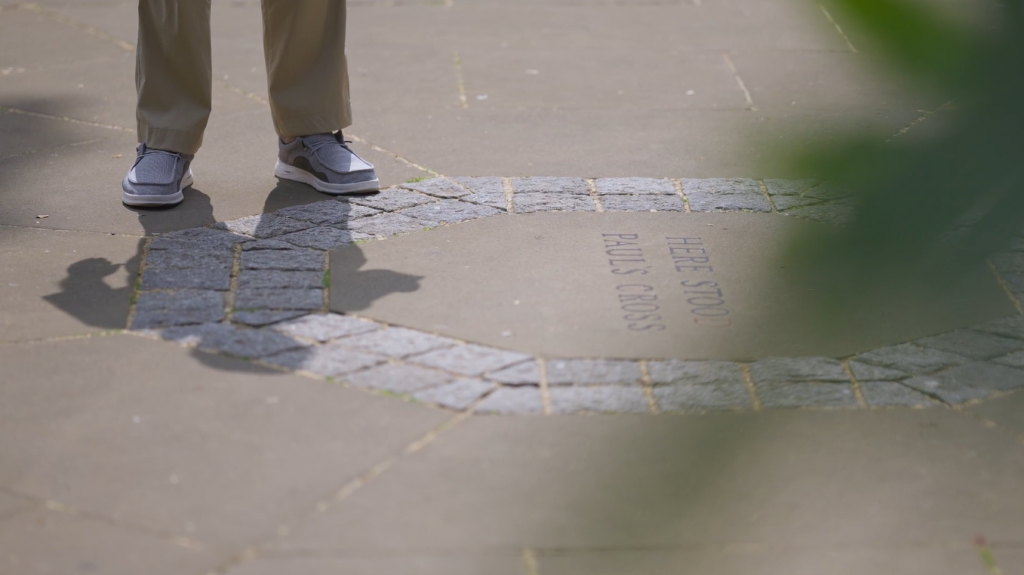
Welcome to St. Paul’s Cathedral here in London, England. I’m standing at a very important place, a place that reminds us so clearly of the tremendous price that was paid for the Bible that we oftentimes take for granted. So what happened here, and why is this so important?
You know, the Bible, as God has given it to us, oftentimes went through a great period of persecution, if I might put it that way. We’re actually standing at a place where Bibles were burned, especially Tyndale’s New Testament. You must remember that a man by the name of Wycliffe was born in 1390, and he had his students copy the Bible because Gutenberg’s printing press had not yet been developed. And it took them 10 months. for every student to copy the Bible. And these Bibles were spread throughout England, but there was a great deal of persecution. And Tyndale actually taught his students how to die, because if anyone was found with a Bible in an English translation, they could be put to death.
Later on, you have the New Testament developed, a new translation of the Bible in Greek. And that was done by a man by the name of Erasmus. And that New Testament was also used by Martin Luther in his translation of the New Testament. But more than 100 years after Wycliffe, we have the man by the name of Tyndale. I’m sure that you have heard of him. Great impact upon Christianity. He took that New Testament and he translated it into English.
Now, some of the footnotes were very anti-Catholic, so obviously he could not get it printed here in Britain, so he went to the continent. He went to Germany. He even met with Martin Luther. And then in Worms and other places in Germany, he was able to get his New Testament printed. And even Anne Boleyn received a copy, even though it was illegal in England. And if copies were found, they were brought here to St. Paul of the Cross, and they were brought here and they were burned.
And so we’re standing at a place in which we must understand that when you believe the Bible in those days, you would be under persecution. Now, let’s fast forward very quickly and recognize that after Tyndale, you have what is known as the Coverdale Bible. And an advisor to King Henry VIII, who broke from the Catholic Church, said, if you really want to break from it, have the Bible read in churches throughout London. And Henry VIII totally agreed, but now Let’s fast forward after that. When Mary became queen, that of course is Mary Tudor, she again began the persecution of those who had Bibles and those who were willing to accept the Bible as the Word of God and read it for themselves.
Many of these people went to Geneva. Calvin welcomed them. They had scholars there, English scholars, who said, we need a new translation of the Bible. And so they began what became known as the Geneva Bible. And when the pilgrims came to America, it’s the Geneva Bible that they brought. Imagine this. When you look at the history of the Bible, you finally discover that we should not take for granted the Word of God that we have in so many different translations all throughout the world, and the New Testament, which of course, any of us can read Old Testament or New Testament. We are thankful for those who are willing to pay the price that we might have that opportunity.
Related
Sorry, no records were found. Please adjust your search criteria and try again.
Sorry, unable to load the Maps API.