


Hymn History: The King of Love My Shepherd Is
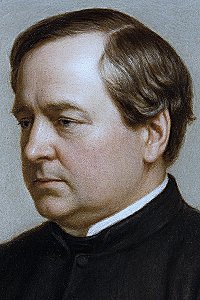
Author: Sir Henry Williams Baker
“This tender sadness, brightened by a soft calm peace, was an epitome of his poetical life.”
(Hymnary)
The Origin of the Hymn “The King of Love My Shepherd Is”
The hymn “The King of Love My Shepherd Is” stands as one of the most enduring and beloved paraphrases of Psalm 23, capturing in poetic form the deep trust and quiet confidence of the believer in the care of God. Rooted in Scripture yet shaped by the devotional spirit of the nineteenth century, the hymn reflects both ancient truth and a distinctly pastoral English sensibility.
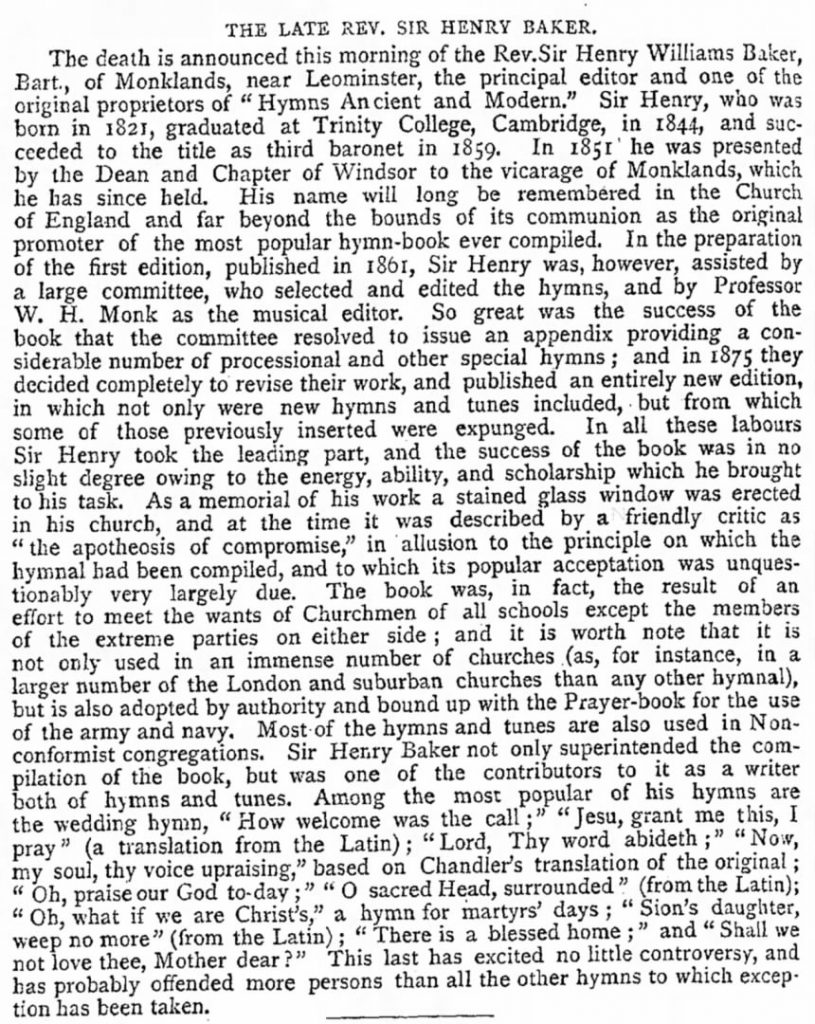
The text was written by Henry Williams Baker (1821–1877), an Anglican priest and hymn writer who played a central role in the development of English hymnody. Baker was educated at Trinity College, Cambridge, and later served as vicar of Monkland in Herefordshire. He is perhaps best remembered as the chief editor of Hymns Ancient and Modern, a landmark hymnal first published in 1861 that sought to combine ancient church texts with newer compositions in a way that would enrich Anglican worship. This hymnal proved immensely influential, shaping worship practices not only in the Church of England but throughout the English-speaking Christian world.
“The King of Love My Shepherd Is” first appeared in this 1868 edition of Hymns Ancient and Modern. Baker’s contribution was part of a broader movement within nineteenth-century Anglicanism that aimed to recover the richness of earlier Christian tradition while presenting it in language accessible to contemporary congregations. His paraphrase of Psalm 23 reflects a careful balance: it remains faithful to the structure and imagery of the biblical text while expanding it with additional lines that emphasize Christ’s redemptive work and personal care.
The hymn opens with the striking line, “The King of love my Shepherd is, whose goodness faileth never.” Here, Baker merges the imagery of the shepherd with that of the king, reinforcing both the tenderness and authority of Christ. This blending of images reflects the theological depth of the hymn, drawing connections between Old Testament imagery and New Testament fulfillment. The shepherd of Psalm 23 is understood explicitly as Christ, the Good Shepherd described in the Gospel of John.
Throughout the hymn, Baker elaborates on the themes of guidance, provision, and restoration. Lines such as “Where streams of living water flow my ransomed soul He leadeth” echo not only Psalm 23 but also broader biblical imagery of salvation and renewal. Particularly notable is the stanza that begins, “Perverse and foolish oft I strayed, but yet in love He sought me,” which introduces a more explicitly personal and penitential tone than the original psalm. This reflects the nineteenth-century evangelical emphasis on personal conversion and redemption.
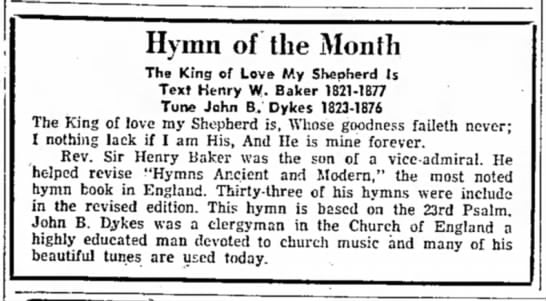
The hymn’s enduring appeal is also closely tied to its musical settings. The most commonly associated tune today is “Dominus Regit Me,” composed by John Bacchus Dykes. Dykes was a prolific composer of hymn tunes, many of which became standards in Anglican and Protestant worship. His melody for “The King of Love My Shepherd Is” is both stately and tender, perfectly complementing the text’s themes of peace and assurance.
Another widely used tune is the traditional Irish melody “St. Columba,” which brings a slightly different character—more flowing and reflective—yet remains well suited to the hymn’s pastoral imagery. The adaptability of the text to multiple musical settings has helped ensure its continued use across denominations and traditions.
Baker’s personal life adds a poignant note to the hymn’s legacy. According to tradition, “The King of Love My Shepherd Is” was sung at his bedside as he lay dying, a fitting tribute to a man whose work centered on leading others in worship and devotion. Whether apocryphal or not, the story captures the spirit of the hymn itself—a quiet trust in the Shepherd who guides His people even through “the valley of the shadow of death.”
Over time, the hymn has found a place in numerous hymnals beyond its original Anglican context, including Methodist, Presbyterian, and Baptist collections. Its language, while distinctly poetic, remains accessible, and its message continues to resonate with worshippers seeking comfort and assurance in times of uncertainty.
In a world that often feels restless and unsettled, “The King of Love My Shepherd Is” offers a steady reminder of divine care and faithfulness. By drawing deeply from Psalm 23 and expressing its truths in language both beautiful and enduring, Henry Williams Baker created a hymn that has transcended its era. It remains, more than a century later, a cherished expression of Christian faith—one that continues to lead hearts toward the Shepherd who never fails.
The King of love my shepherd is,
whose goodness faileth never.
I nothing lack if I am his,
and he is mine forever.
Where streams of living water flow,
my ransomed soul he leadeth;
and where the verdant pastures grow,
with food celestial feedeth.
Perverse and foolish, oft I strayed,
but yet in love he sought me;
and on his shoulder gently laid,
and home, rejoicing, brought me.
In death’s dark vale I fear no ill,
with thee, dear Lord, beside me;
thy rod and staff my comfort still,
thy cross before to guide me.
Thou spreadst a table in my sight;
thy unction grace bestoweth;
and oh, what transport of delight
from thy pure chalice floweth!
And so through all the length of days,
thy goodness faileth never;
Good Shepherd, may I sing thy praise
within thy house forever.
_____
Image Source/Credit (in order):
• Henry Williams Baker (www.hymntime.com/tch/bio/b/a/k/e/baker_hw.htm)
• Newspapers.com, The Pall Mall Gazette, February 13, 1877 (www.newspapers.com/article/the-pall-mall-gazette/192131047/)
• Feb 02, 1957, Page 6 – the Tipton Daily Tribune at Newspapers.com (www.newspapers.com/image/545610862/?match=1&terms=%22text%20henry%20w.%20baker%22)
Related
Sorry, no records were found. Please adjust your search criteria and try again.
Sorry, unable to load the Maps API.