
Reynold Hogg (1752–1843) was a significant yet often overlooked figure in the early Baptist movement in England. Closely associated with Thrapston Baptist Church, his life and ministry played an important role in shaping both local church life and the wider missionary vision that would transform global Christianity.
Hogg was born near London in 1752 and, by his own account, spent his early years without serious religious concern. As a teenager, however, he experienced a profound spiritual awakening after reading devotional literature. This change led him to pursue the Christian ministry, a calling that would define the rest of his life. He received theological training at an academy and began preaching in various locations, often in humble settings such as homes, barns, and open-air gatherings.
After several pastoral appointments, Hogg eventually settled in the Northamptonshire region, where his most lasting work would be done. In the 1790s, he became closely connected with the emerging Baptist cause in Thrapston. The Baptist chapel there had been opened in 1788, reflecting the growing strength of Nonconformist worship following earlier periods of restriction.
Hogg became the first pastor of the Thrapston Baptist congregation and served for approximately seventeen years. During this time, he helped organize and strengthen the church, guiding it through its formative years. Under his leadership, the congregation developed a clear identity rooted in Baptist principles such as believer’s baptism, congregational governance, and a strong emphasis on Scripture. His ministry extended beyond the town itself, as he frequently traveled to surrounding villages, preaching and encouraging the formation of new congregations.
One of the most significant aspects of Hogg’s life was his involvement in the founding of the Baptist Missionary Society. In 1792, a group of Baptist leaders gathered in Kettering to establish what would become the first major Protestant missionary society. Hogg was present at this historic meeting and was appointed its first treasurer.
Though not as widely known as William Carey, who became the society’s first missionary, Hogg’s role was crucial. As treasurer, he helped provide the financial structure necessary for the society’s work. Despite having a modest income, he personally contributed to the cause and actively promoted missionary efforts. His commitment reflected a broader vision that the gospel should be carried beyond England to the wider world—a concept that was still new and sometimes controversial at the time.
Hogg’s influence was not limited to administration. He was also deeply involved in evangelistic work, helping to establish meeting houses in nearby communities and supporting the spread of Baptist teaching throughout the region. His efforts contributed to making Thrapston a center of religious activity and outreach during his ministry.
In addition to his preaching and missionary involvement, Hogg wrote several devotional works, including books on personal religion and sermons aimed at encouraging practical Christian living. While not considered highly literary, his writings were valued for their clarity, sincerity, and pastoral concern.
Later in life, Hogg continued to serve in various capacities, though declining health eventually limited his public ministry. Remarkably, he lived long enough to witness the fiftieth anniversary of the Baptist Missionary Society in 1842, where he was recognized as the last surviving participant of its founding meeting. He died the following year at the age of 91 and was buried at Thrapston Baptist Church, where a memorial honors his life and service.
The impact of Reynold Hogg lies in both his local and global contributions. Locally, he helped establish a strong and enduring Baptist presence in Thrapston. Globally, his role in the founding of the Baptist Missionary Society contributed to a movement that would carry Christian missions across continents.
Though not always remembered by name, Hogg represents the kind of faithful, steady leadership that often undergirds great movements. His life demonstrates how commitment, even in modest circumstances, can have far-reaching and lasting influence.
♦ _____ ♦
The Baptist church at Thrapston, Northamptonshire, was once shepherded by Reynold Hogg (1752-1843), one of the founders of the Baptist Missionary Society (1792). With the construction of the present building, in 1787, a small, Congregationalist-Separtist group opened its doors for worship. In 1790, Reynold Hogg became their preacher. In 1797, they organized into a Baptist church and ordained Hogg as pastor. He served here for seventeen years. The remains of Reynold and his wife, Ann, lie entombed underneath the church. Inside the auditorium is a Commemorative Tablet. The congregation still uses this two-storied, brick building. Town records indicate some mid-nineteenth-century renovation.
Copyrighted and used by permission from David Beale, Baptist History in England and America: Personalities, Positions, and Practices
_____
Image Source/Credit:
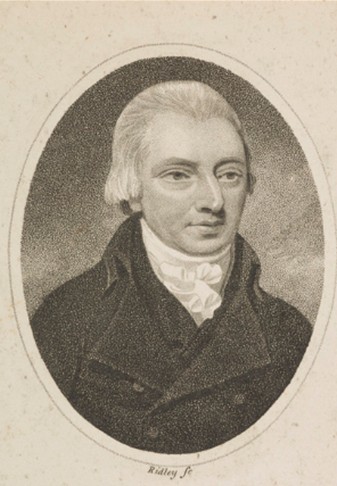
• “Rev. Reynold Hogg, 1752 – 1843. Baptist Minister by Ridley | National Galleries of Scotland.” National Galleries of Scotland (www.nationalgalleries.org/art-and-artists/104038)
Related
Sorry, no records were found. Please adjust your search criteria and try again.
Sorry, unable to load the Maps API.