
Carey Mission House occupies a quiet but profoundly important place in the history of Protestant missions. Though outwardly an ordinary English house, it is remembered as the birthplace of the modern missionary movement and a site closely associated with William Carey and his fellow Baptist leaders.
The significance of the Carey Mission House centers on a meeting that took place on October 2, 1792. At that time, a small group of Baptist ministers gathered in a house on Lower Street in the town of Kettering. Among them were Carey and Andrew Fuller, along with ten other ministers who shared a growing conviction that the Christian gospel should be taken beyond England to the wider world.
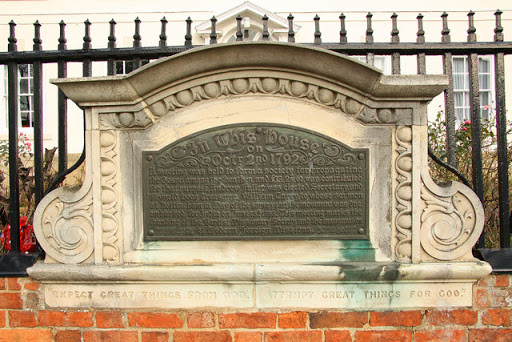
This meeting did not arise in isolation. Earlier that year, Carey had preached a sermon urging believers to take seriously the command to make disciples of all nations. His call—summarized in the now-famous phrase, “Expect great things from God; attempt great things for God”—helped stir renewed interest in missionary work. The gathering at Kettering was the practical outworking of that vision.
Inside the modest house, the ministers discussed the possibility of forming an organization dedicated to overseas missions. By the end of the meeting, they had established what became known as the Baptist Missionary Society. The financial resources were humble; a collection taken at the meeting amounted to just over thirteen pounds. Yet from this small beginning would grow a movement that reshaped global Christianity.
Carey himself soon became the society’s first missionary. In 1793, he departed for India, where he would spend the rest of his life translating the Bible, promoting education, and engaging in social reform. The work that began in the Carey Mission House thus extended far beyond England, influencing mission efforts across continents and generations.
The house itself was originally a private residence belonging to a member of Fuller’s congregation. Its transformation into a site of historical importance came not through architecture or size, but through the decisions made within its walls. Over time, it came to be known as the Carey Mission House, commemorating the event that took place there.
In later years, the building has undergone changes in use. It is no longer a functioning meeting place for missionary societies and is not regularly open to the public. However, it has been preserved, and a commemorative plaque marks its significance. Visitors who come to the site today encounter a quiet structure that belies its global historical impact.
The importance of the Carey Mission House lies in what it represents. It stands as a reminder that great movements often begin in small, unassuming settings. The twelve men who gathered there could not have foreseen the full extent of their influence, yet their shared conviction and willingness to act gave rise to a missionary enterprise that would span the world.
The house also symbolizes a turning point in Christian thought. Before this period, many believed that missionary work was either unnecessary or impractical. The decision made at Kettering challenged that assumption, asserting that the responsibility to spread the gospel was both urgent and universal.
Today, the Carey Mission House remains a place of reflection for those interested in church history and missions. It testifies to the power of vision, cooperation, and faith. From a single meeting in a modest English home emerged a movement that carried the Christian message to distant lands and helped shape the global character of the church.
In this way, the Carey Mission House continues to speak—not through grandeur, but through the enduring legacy of what began within its walls.
♦ _____ ♦
As faithful members of Andrew Fuller’s church, Beeby and Martha Wallis used their home as an inn for traveling evangelists. Many still call it the “Gospel Inn.” Situated on Lower Street, in the heart of Kettering town center, the historic Wallis House is now the “Carey Mission House,” the featured attraction of “Martha Wallis Court,” a residential facility of the elderly. The room in which fourteen men met, on October 2, 1792, to form the Baptist Missionary Society, still contains the table and chairs they used. The meeting concluded with a missionary offering. Fuller Baptist Church has Andrew Fuller’s silver snuffbox he passed around the table for the offering. Near the street is a bronze memorial plaque. Across the street is the Chesham House, home of Thomas Gotch, the merchant for whom Carey made shoes while at Moulton.
Copyrighted and used by permission from David Beale, Baptist History in England and America: Personalities, Positions, and Practices
_____
Image Source/Credit:
• “Carey Mission House Plaque.” Read the Plaque (readtheplaque.com/plaque/carey-mission-house-plaque#gsc.tab=0)
Related
Sorry, no records were found. Please adjust your search criteria and try again.
Sorry, unable to load the Maps API.