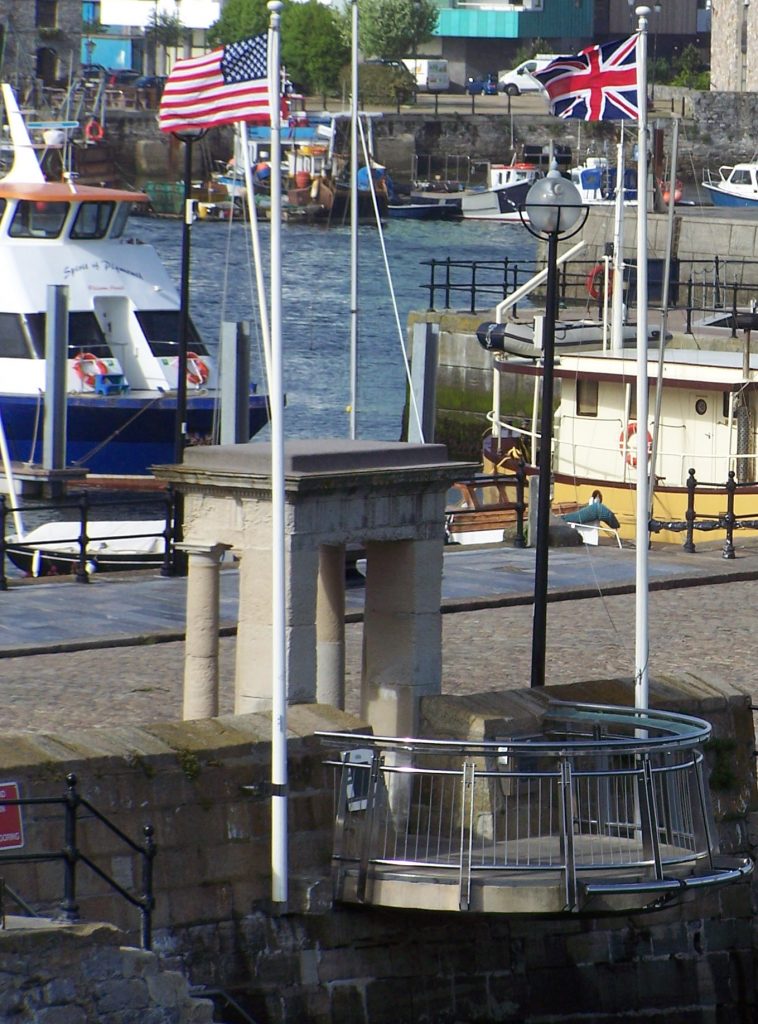
The Mayflower Steps Memorial in Plymouth is a commemorative site marking one of the most significant departures in early American colonial history. It honors the voyage of the Pilgrims aboard the ship Mayflower, which set sail in 1620 carrying English Separatists seeking religious freedom in the New World.
The memorial stands on the historic Barbican waterfront, traditionally believed to be near the location where the Mayflower anchored before its transatlantic journey. Although exact departure points are debated by historians, Plymouth has long been accepted as the symbolic starting point of the voyage that led to the founding of Plymouth Colony in North America.
The Pilgrims who boarded the Mayflower were part of a group of religious Separatists who had broken away from the Church of England. Seeking the freedom to worship according to their convictions, they first fled England to the Netherlands, settling in Leiden. However, concerns about cultural assimilation and economic hardship led them to seek a new life across the Atlantic.
In 1620, they secured passage aboard the Mayflower and set sail from Plymouth alongside other passengers, including merchants and settlers known as “Strangers.” The voyage was difficult and dangerous, lasting approximately two months across the North Atlantic. The ship encountered storms and navigational challenges before finally reaching land at Cape Cod, far north of their intended destination.
The Mayflower Compact, signed aboard the ship before disembarkation, became an important document in the development of self-governance in the American colonies. It established a framework for civil order based on mutual agreement, reflecting the Pilgrims’ desire to maintain social cohesion in a new and uncertain environment.
The Mayflower Steps Memorial itself consists of a granite structure and commemorative plaque installed in the early twentieth century. It overlooks the harbor and serves as a focal point for remembrance ceremonies. Nearby, a prominent column topped with a golden light, known as the “Sails of the Spirit,” was added later to enhance the site’s visibility and symbolic meaning.
The memorial area is part of Plymouth’s broader maritime heritage landscape, which includes other landmarks connected to exploration and transatlantic travel. Over the centuries, the city has preserved its identity as a key departure point for voyages that shaped global history.
The impact of the Mayflower Steps Memorial extends beyond local heritage. It represents a foundational moment in the history of what would become the United States. The Pilgrims’ journey is often associated with themes of religious liberty, perseverance, and the search for self-determination. These themes have made the site a place of interest not only for historians but also for visitors from around the world, particularly those tracing ancestral or cultural connections.
Commemorations at the site often include civic ceremonies, educational events, and international exchanges, particularly between Plymouth and communities in the United States such as Plymouth, Massachusetts. These connections highlight the enduring transatlantic relationship that originated with the 1620 voyage.
Today, the Mayflower Steps Memorial stands as both a local landmark and a symbol of global historical significance. It preserves the memory of a small group of voyagers whose journey had far-reaching consequences for the development of the Atlantic world. Through its presence on the Plymouth waterfront, it continues to link past and present, reminding visitors of the enduring impact of exploration, migration, and faith-driven determination.
♦ _____ ♦
Plaque:
On the 6th of September, 1620, in the Mayorality of Thomas Fownes, after being “kindly entertained and courteously used by divers friends there dwelling,” the Pilgrim Fathers sailed from Plymouth in the Mayflower, in the Providence of God to settle in New Plymouth, and to lay the Foundation of the New England States The ancient Causey whence they embarked was destroyed not many Years afterwards, but the Site of their Embarkation is marked by the Stone bearing the name of the Mayflower in the pavement of the adjacent Pier. This Tablet was erected in the Mayorality of J.T. Bond 1891, to commemorate their Departure, and the visit to Plymouth in July of that Year of a number of their Descendants and representatives.
_____
Image Source/Credit:
• RobertBFC at English Wikipedia, CC BY-SA 3.0 <http://creativecommons.org/licenses/by-sa/3.0/>, via Wikimedia Commons
Related
Sorry, no records were found. Please adjust your search criteria and try again.
Sorry, unable to load the Maps API.