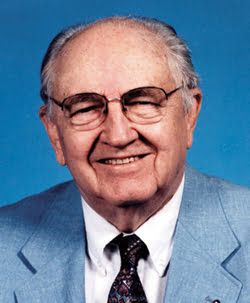
Henry M. Morris (1918–2006) was a prominent American engineer, educator, and Christian author best known for his role in developing and popularizing modern young-earth creationism. Often referred to as the “father of modern creation science,” Morris combined his technical training with a strong commitment to biblical authority, shaping a movement that would influence religious thought and education across the United States and beyond.
Morris was born in Dallas, Texas, and showed an early aptitude for academics, particularly in the sciences. He pursued higher education in civil engineering, earning his doctorate from the University of Minnesota. His early career focused on hydraulic engineering, and he served in both academic and professional roles, including teaching positions at institutions such as Virginia Tech. His technical work reflected a disciplined and analytical mind, traits that would later influence his approach to questions of science and faith.
Though trained in conventional scientific disciplines, Morris became increasingly concerned with what he viewed as a growing divide between scientific teaching and biblical belief. In particular, he challenged the dominance of evolutionary theory, arguing that it conflicted with a literal interpretation of the Book of Genesis. Rather than abandoning science, Morris sought to develop a framework in which scientific inquiry could be understood in harmony with Scripture.
This effort found its most influential expression in 1961 with the publication of The Genesis Flood, co-authored with theologian John C. Whitcomb. The book argued that many geological features of the earth could be explained by a global flood as described in the Bible. It presented an alternative to mainstream geological and evolutionary models, drawing on both biblical interpretation and scientific reasoning. The work became widely read within conservative Christian circles and is often credited with launching the modern creation science movement.
Building on this momentum, Morris went on to found the Institute for Creation Research (ICR) in 1970. The institute was established to promote research, education, and public outreach related to creationist perspectives. Through lectures, publications, and training programs, the ICR sought to equip individuals to defend a literal understanding of the Bible in the face of scientific and cultural challenges. Under Morris’s leadership, the organization became a central hub for creationist thought.
Morris was a prolific writer, authoring or co-authoring dozens of books and numerous articles. His works addressed a wide range of topics, including geology, biology, theology, and apologetics. He wrote in a clear and accessible style, aiming to make complex ideas understandable to general readers. Titles such as Scientific Creationism and The Biblical Basis for Modern Science further expanded his influence, particularly among those seeking to reconcile scientific education with traditional Christian beliefs.
The impact of Morris’s work extended into educational and cultural debates, especially in discussions over the teaching of origins in public schools. His advocacy contributed to broader efforts to include creationist perspectives in science curricula, leading to legal and public policy debates that continued for decades. While many in the scientific community rejected his conclusions, his ideas gained a substantial following among conservative Christians.
Morris’s approach was characterized by a firm conviction that Scripture provided a reliable foundation for understanding the natural world. He argued that scientific models should be interpreted through the lens of biblical revelation rather than the other way around. This perspective resonated with those who were concerned about the implications of secular scientific theories for faith and morality.
In addition to his intellectual contributions, Morris was known for his personal discipline and commitment to his work. He continued writing and speaking well into his later years, mentoring others who would carry forward the work of the Institute for Creation Research and related organizations.
Henry M. Morris died in 2006, leaving behind a legacy that remains influential within certain segments of the Christian community. His efforts helped establish creation science as a recognizable movement and provided a framework for ongoing discussions about the relationship between faith and science.
In sum, Dr. Henry M. Morris played a significant role in shaping modern debates over origins and the interpretation of Scripture. Through his writing, teaching, and organizational leadership, he influenced how many people approach questions of science and belief. Whether one agrees with his conclusions or not, his impact on American religious and intellectual life is undeniable, reflecting a persistent effort to engage deeply held convictions with the challenges of the modern world.
_____
Image Source/Credit:
• Wikipedia contributors. File:Henry M. Morris photo.jpg – Wikipedia (en.wikipedia.org/wiki/File:Henry_M._Morris_photo.jpg)
Related
Sorry, no records were found. Please adjust your search criteria and try again.
Sorry, unable to load the Maps API.