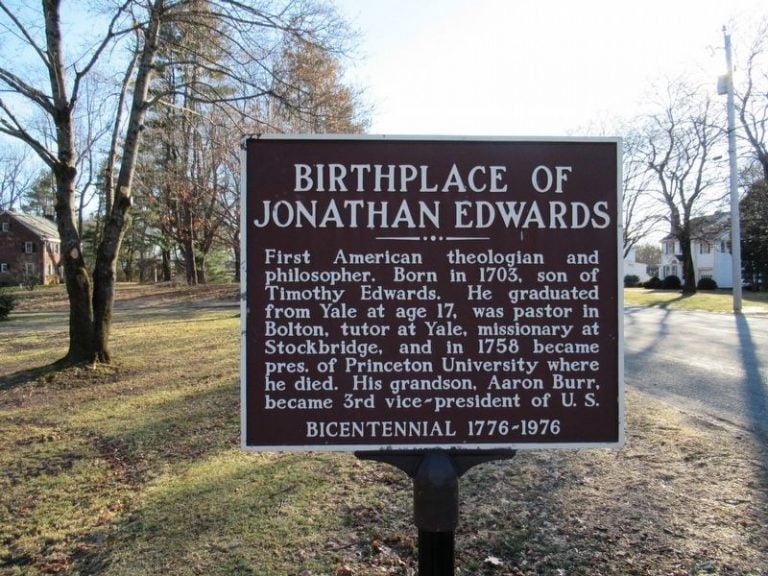
First American theologian and philosopher. Born in 1703, son of Timothy Edwards. He graduated from Yale at age 17, was pastor in Bolton, tutor at Yale, missionary at Stockbridge, and in 1758 became pres. of Princeton University where he died. His grandson, Aaron Burr, became 3rd vice president of U. S.
♦ _____ ♦
The birthplace of Jonathan Edwards stands as a significant landmark in the religious and intellectual history of early America. Located in East Windsor, this modest colonial setting gave rise to one of the most influential theologians and preachers of the eighteenth century. Though simple in its physical form, the site represents the beginnings of a life that would profoundly shape American Christianity.
Jonathan Edwards was born on October 5, 1703, into a family deeply rooted in Puritan faith and discipline. His father, Timothy Edwards, was a minister, and his mother, Esther Stoddard, came from a prominent clerical family. The home in East Windsor, therefore, was not merely a place of residence but a center of religious instruction and intellectual development. From an early age, Edwards was surrounded by Scripture, theological discussion, and a strong emphasis on moral responsibility.
The birthplace itself would have been typical of early New England homes—plain, sturdy, and built for function rather than display. Yet within its walls, Edwards displayed an unusual intellectual curiosity. As a boy, he showed a keen interest in the natural world, writing early observations about insects and the behavior of spiders. At the same time, he wrestled with deep spiritual questions, seeking to understand the nature of God, sin, and redemption. These early pursuits foreshadowed the remarkable mind that would later produce some of the most enduring works in American theology.
The importance of Edwards’s birthplace lies not only in its connection to his life but also in what it represents about the era in which he was raised. Colonial New England was a society shaped by religious conviction, where faith influenced education, law, and daily life. Growing up in this environment, Edwards absorbed the values of Puritanism—discipline, introspection, and a reverence for divine authority. These influences would later be evident in his preaching and writing.
Edwards went on to study at Yale College, where his intellectual gifts became more fully developed. He eventually became a pastor and gained widespread recognition during the period known as the First Great Awakening. His sermon “Sinners in the Hands of an Angry God” remains one of the most famous in American history, noted for its vivid imagery and urgent call to repentance. While such achievements belong to his later life, they are rooted in the formative influences of his early years in East Windsor.
Today, the site of Edwards’s birth serves as a place of reflection for those interested in American religious history. Though the original structure no longer stands in its original form, the location is recognized and preserved as part of the broader effort to remember his life and contributions. Visitors are reminded that great influence often begins in ordinary surroundings.
The legacy of Jonathan Edwards extends far beyond his birthplace. He is remembered as a leading figure in Reformed theology, a philosopher of considerable depth, and a central voice in one of the most important religious movements in American history. Yet the quiet beginnings of his life in East Windsor remain an essential part of his story.
In considering the birthplace of Jonathan Edwards, one sees more than a geographic location. It is a symbol of the early formation of a mind and spirit that would leave a lasting mark on the church and the nation. From this humble New England setting emerged a man whose words and ideas continue to be studied and respected centuries later.
_____
Image Source/Credit:
• Photo: Birthplace of Jonathan Edwards Marker (www.hmdb.org/PhotoFullSize.asp?PhotoID=416537)
Related
Sorry, no records were found. Please adjust your search criteria and try again.
Sorry, unable to load the Maps API.