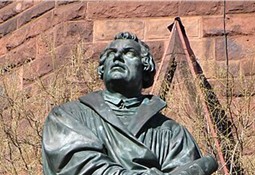
The Luther Monument is a significant religious and historical landmark located in Washington. Situated on the grounds of Luther Place Memorial Church near Thomas Circle, the monument commemorates the life and influence of Martin Luther, whose actions helped spark the Protestant Reformation.
Dedicated in 1884, the Luther Monument was the first statue of Martin Luther erected in the United States. It was modeled after a famous statue in Worms, Germany, where Luther made his historic stand at the Diet of Worms. The Washington monument reflects the same design, portraying Luther standing firmly with a Bible in his hand, symbolizing his commitment to the authority of Scripture.
The statue was a gift from German Lutherans and was presented to American Lutherans as a sign of shared faith and heritage. Its installation in the nation’s capital highlighted the growing influence of Lutheran communities in the United States during the nineteenth century. The monument also served as a visible reminder of the principles of religious freedom and conscience that Luther championed.
Luther Place Memorial Church, in whose grounds the statue stands, was itself established during a time of national division. Founded in 1873, the church became known for its commitment to social justice, reconciliation, and outreach, reflecting the broader moral concerns of the post–Civil War era. The presence of the Luther Monument on its grounds connects these values with the reformer’s legacy of standing for truth in difficult times.
Over the years, the monument has become a place of reflection for visitors interested in both religious history and the development of Protestant traditions in America. It also serves as a gathering point for commemorations and educational events, particularly those marking anniversaries related to the Reformation.
The legacy of the Luther Monument in Washington, D.C., lies in its enduring message. It honors Martin Luther’s courage in challenging established authority and emphasizes the importance of faith guided by conviction. At the same time, it reflects the transatlantic connections that shaped American religious life, linking the heritage of European reform with the ideals of freedom and belief that continue to define the United States.
_____
From Wikipedia:
The Luther Monument is a public artwork located in front of Luther Place Memorial Church in Washington, D.C., United States. The monument to Martin Luther, the theologian and Protestant Reformer, is a bronze, full-length portrait. It is a copy of the statue created by Ernst Friedrich August Rietschel as part of the 1868 Luther Monument in Worms, Germany. The version in Washington, D.C., inspired the installation of many other castings across the U.S. The statue is a contributing property to the Luther Place Memorial Church’s listing on the National Register of Historic Places (NRHP) and District of Columbia Inventory of Historic Sites (DCIHS). It is also a contributing property to the Greater Fourteenth Street Historic District, which is also listed on the NRHP and DCIHS.
The plan to erect a statue began in 1883. A group of interested people formed an association and began a fundraising effort. The total cost of the statue and granite pedestal, designed by Adolf Cluss and Paul Schulze, was $9,000. It was hoped the statue would be ready for 400th anniversary of Luther’s birth, but the project was not ready until 1884. The dedication ceremony was attended by thousands of onlookers and invited guests. A parade of German American societies also took place through downtown, ending at the church. The name of the church had been Memorial Evangelical Lutheran Church of Washington, D.C., but after the statue was installed, it was later nicknamed and then formally renamed to the current Luther Place Memorial Church.
_____
Image Source/Credit:
• Slowking4, Public domain, via Wikimedia Commons
Related
Sorry, no records were found. Please adjust your search criteria and try again.
Sorry, unable to load the Maps API.