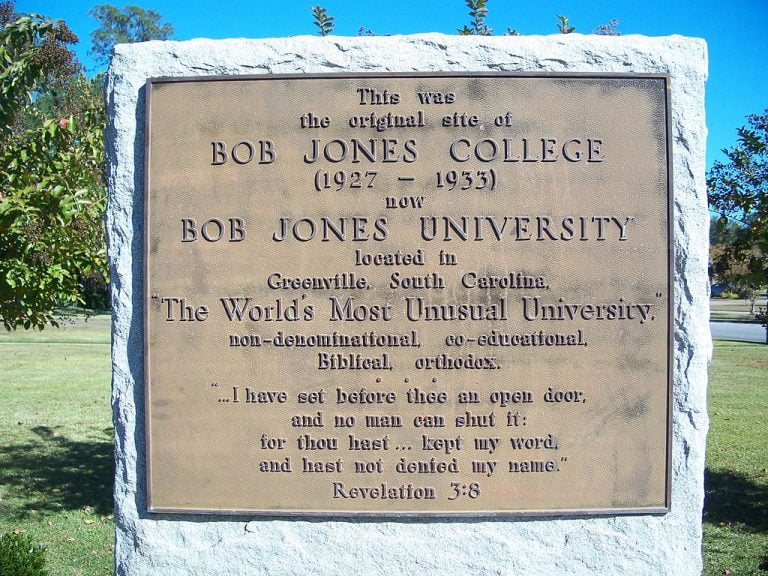
Bob Jones College was a fundamentalist Christian institution founded in 1927 with a clear purpose: to provide higher education grounded firmly in conservative Protestant beliefs. Established during a time of significant theological and cultural change in the United States, the college emerged as part of a broader effort to defend traditional Christian doctrines against the rising influence of modernism in education and religion.
The college was founded by Bob Jones Sr., a well-known evangelist who believed that many existing colleges had drifted away from biblical principles. Concerned about what he saw as a decline in moral and spiritual standards, Jones envisioned a school where academic instruction would be combined with strong spiritual formation. His goal was not only to educate students intellectually but also to prepare them for lives of Christian service.
Bob Jones College was originally located in Panama City, Florida. From the beginning, it emphasized strict discipline, doctrinal clarity, and a highly structured environment. Daily chapel services, Bible study, and adherence to a code of conduct were central features of campus life. The curriculum included both traditional academic subjects and theological training, reflecting the institution’s dual focus on education and ministry preparation.
In its early years, the college attracted students from across the country who shared its commitment to conservative Christianity. Many were drawn by the reputation of Bob Jones Sr., whose preaching and leadership gave the school a strong sense of identity. Faculty members were selected not only for their academic qualifications but also for their agreement with the school’s doctrinal positions, ensuring consistency in both teaching and practice.
The college soon faced challenges common to new institutions, including financial pressures and the need for expansion. In 1933, it relocated to Cleveland, Tennessee, in search of a more stable environment and greater opportunities for growth. This move marked an important step in the development of the institution, allowing it to broaden its reach and strengthen its programs.
During this period, Bob Jones College became increasingly influential within the fundamentalist movement. It served as a training ground for pastors, missionaries, and Christian workers who would go on to serve in churches and ministries throughout the United States and abroad. The school’s emphasis on biblical authority and separation from what it viewed as doctrinal compromise aligned it closely with the fundamentalist cause during the early twentieth century.
In 1947, the institution moved once again, this time to Greenville, South Carolina, where it adopted the name Bob Jones University. This transition reflected both its growth and its expanded academic offerings. While the name changed, the core mission remained the same: to provide Christ-centered education rooted in conservative theological convictions.
The legacy of Bob Jones College is closely tied to the broader history of American fundamentalism. At a time when many religious institutions were adapting to new intellectual trends, the college stood firmly for what it considered unchanging biblical truths. This stance earned it both loyal supporters and vocal critics, particularly in later decades as cultural and social issues brought increased scrutiny to its policies.
Despite controversies, the institution’s influence has been substantial. Thousands of graduates have entered ministry, education, and other fields, carrying with them the principles they learned during their time at the college. Its emphasis on discipline, moral conduct, and doctrinal fidelity has left a lasting imprint on those who passed through its halls.
In summary, Bob Jones College was more than just an educational institution; it was a statement of conviction during a period of significant change. Founded to uphold traditional Christian values in higher education, it played a key role in shaping the fundamentalist movement in America. Its legacy continues through Bob Jones University, which remains an active institution today, reflecting the vision first set forth by its founder nearly a century ago.
_____
Image Source/Credit:
• Ebyabe, CC BY-SA 3.0 <https://creativecommons.org/licenses/by-sa/3.0>, via Wikimedia Commons
Related
Sorry, no records were found. Please adjust your search criteria and try again.
Sorry, unable to load the Maps API.