
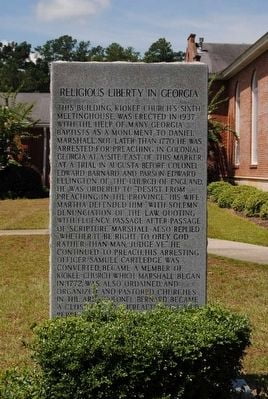
From the marker:
This building, Kiokee Church’s sixth meeting house, was erected in 1937 with the help of many Georgia Baptists as a monument to Daniel Marshall. Not later than 1770, he was arrested for preaching in Colonial Georgia at a site east of this marker. At a trial in Augusta before Colonel Edward Barnard and Parson Edward Ellington of the Church of England, he was ordered to “desist from preaching in the province.” His wife Martha defended him “with solemn denunciation of law, quoting with fluency passage after passage of scripture.” Marshall also replied “whether it be right to obey God rather than man, judge ye.” He continued to preach. His arresting officer, Samuel Cartledge, was converted, became a member of Kiokee Church which Marshall began in 1772, was also ordained, and organized and pastored churches in the area. Colonel Bernard became a close fried. Thereafter religious persecution ended in Georgia. The Marshall Historical Site, where Marshall lived and died, is east of this site on Tubman Creek, one mile past Old Kiokee Church.
♦ _____ ♦
The history of religious liberty in Georgia reflects a gradual but meaningful transition from restriction to freedom. Like many of the American colonies, Georgia’s early years were marked by limitations on religious expression, yet over time it became a place where diverse Christian traditions—and eventually broader faith communities—could worship with greater liberty.
Georgia was founded in 1733 under the leadership of James Oglethorpe as a philanthropic colony, intended in part as a refuge for the poor and a buffer against Spanish Florida. In its earliest charter, the colony formally allowed religious freedom, but in practice this liberty was limited. The Church of England was established as the official church, and Roman Catholics were initially excluded due to political tensions with Catholic Spain. Jews, however, were permitted to settle in the colony shortly after its founding, a notable exception compared to some other colonies.
One of the most significant early examples of religious life in Georgia was the arrival of John Wesley and his brother Charles Wesley in the 1730s. Sent as missionaries of the Church of England, they sought to minister both to colonists and Native Americans. Although their efforts in Georgia were short-lived and met with mixed success, their presence highlights the colony’s early connection to Anglicanism and the challenges of establishing religious order in a frontier setting.
A more lasting influence came through the work of George Whitefield, who established the Bethesda Orphan House near Savannah. Whitefield, associated with the Great Awakening, brought a more evangelical and revivalist spirit to the colony. His preaching attracted large audiences and helped introduce a broader range of Protestant expression beyond the formal structures of the established church.
By the mid-eighteenth century, restrictions on religious groups began to ease. Lutherans, Presbyterians, Baptists, and other dissenting Protestant groups gradually gained a foothold. This shift reflected both practical necessity—due to population growth and diversity—and the broader currents of religious change sweeping through the American colonies.
The American Revolution marked a decisive turning point. With independence came a rejection of established churches and state-imposed religion. Georgia’s 1777 state constitution granted broader religious freedom, declaring that “all persons whatever shall have the free exercise of their religion.” While this did not immediately eliminate all inequalities, it established an important legal foundation for religious liberty.
In the decades that followed, Georgia became a fertile ground for the growth of Baptist and Methodist churches, which emphasized personal faith and congregational independence. These groups often championed religious freedom, having themselves experienced marginalization under earlier systems. Their influence helped ensure that Georgia’s religious culture would be marked by diversity rather than uniformity.
The adoption of the First Amendment to the United States Constitution in 1791 further secured religious liberty by prohibiting Congress from establishing a national religion and protecting the free exercise of faith. While this applied at the federal level, its principles gradually shaped state practices as well, reinforcing Georgia’s commitment to religious freedom.
In modern times, Georgia reflects the full development of this long process. The state is home to a wide array of Christian denominations, as well as Jewish, Muslim, and other religious communities. What began as a colony with limited tolerance has become a society where religious expression is broadly protected and encouraged.
The history of religious liberty in Georgia is thus one of steady progress. From early restrictions tied to political and ecclesiastical concerns, the state moved toward a more open and inclusive understanding of faith. This development mirrors the broader American experience, where liberty of conscience came to be recognized not merely as a privilege, but as a fundamental right.
_____
Image Source/Credit:
• Religious Liberty in Georgia Historical Marker. 20 Oct. 2020 (www.hmdb.org/m.asp?m=87419)
Related
Sorry, no records were found. Please adjust your search criteria and try again.
Sorry, unable to load the Maps API.