
Daniel Marshall (1706–1784) stands as one of the most important pioneer figures in the spread of Baptist Christianity in the American South. A man of humble beginnings but deep conviction, Marshall helped carry the message of evangelical faith into regions where it had scarcely been known, leaving a lasting imprint on the religious life of Georgia and beyond.
Daniel Marshall was born in Windsor, Connecticut, into a family that would become deeply involved in early Baptist work. His brother, Shubal Stearns, would later play a central role in the Separate Baptist movement during the Great Awakening. Like many in that movement, Marshall experienced a personal religious conversion that led him to embrace Baptist convictions, including believer’s baptism and a strong emphasis on personal faith.
In the mid-eighteenth century, Marshall joined the wave of revivalist energy that swept through the American colonies. He became associated with the Separate Baptists, a group distinguished by their fervent preaching, emotional expression, and missionary zeal. These characteristics often set them apart from more established religious groups, and at times brought them into conflict with colonial authorities and traditional churches.
Marshall’s missionary work began in earnest when he traveled south from Connecticut into Virginia and the Carolinas, preaching in rural areas where organized churches were few. His efforts were not always welcomed. In Virginia, where the Church of England was established by law, Baptist preachers sometimes faced harassment or imprisonment for preaching without official approval. Despite these challenges, Marshall remained steadfast, convinced of the importance of spreading the gospel.
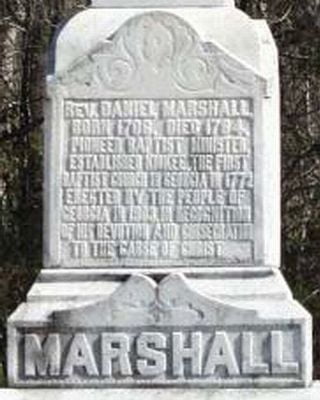
His most enduring contribution came after he moved to Georgia in the early 1770s. At that time, Baptist influence in the colony was minimal. Along with his wife, Martha Marshall, who was herself a gifted exhorter, he began preaching and organizing believers. Their efforts led to the founding of the Kiokee Baptist Church in 1772, widely regarded as the first permanent Baptist church in Georgia.
The establishment of Kiokee marked a turning point for Baptist life in the region. From this small beginning, Baptist churches began to multiply throughout Georgia and neighboring areas. Marshall’s work laid the foundation for what would become a strong and enduring Baptist presence in the South. His ministry was characterized by simplicity, earnestness, and a deep reliance on Scripture, qualities that resonated with frontier communities.
Beyond his immediate work, Marshall’s influence extended through the generations that followed. The churches he helped establish became centers of spiritual life and community, shaping the moral and religious character of the region. Baptists in Georgia would go on to play a significant role in advocating for religious liberty, drawing in part from the experiences of early preachers like Marshall who had faced opposition for their beliefs.
Marshall lived to see the fruits of his labor as Baptist congregations grew in number and strength. By the time of his death in 1784, the movement he had helped nurture was firmly established. His legacy is not found in written works or public honors, but in the living communities of faith that trace their origins to his efforts.
In many respects, Daniel Marshall represents the spirit of early American Baptist life—independent, missionary-minded, and rooted in personal conviction. His willingness to endure hardship and travel great distances for the sake of the gospel helped shape the religious landscape of the South. Today, he is remembered as a pioneer whose quiet faithfulness had a far-reaching and lasting impact.
_____
Image Source/Credit:
• Photo: Rev. Daniel Marshall Marker (www.hmdb.org/PhotoFullSize.asp?PhotoID=95052)
Related
Sorry, no records were found. Please adjust your search criteria and try again.
Sorry, unable to load the Maps API.