
George Whitefield (1714–1770) was one of the most influential preachers of the eighteenth century and a central figure in the transatlantic revival known as the First Great Awakening. His powerful oratory, tireless travels, and deep concern for the spiritual condition of ordinary people helped reshape Protestant Christianity in both Britain and the American colonies.
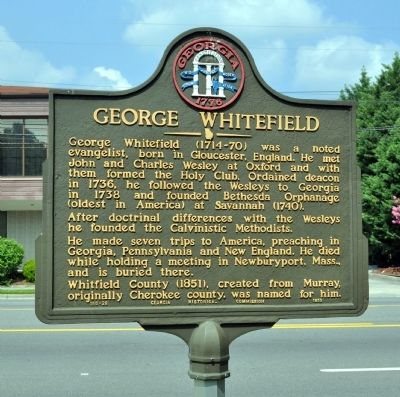
Whitefield was born in Gloucester, England, and educated at Pembroke College, Oxford. There he became associated with the “Holy Club,” a group of students devoted to disciplined spiritual practice. Among its members were John Wesley and Charles Wesley, who would later play major roles in the Methodist movement. Though Whitefield was ordained in the Church of England, his approach to ministry soon took on a distinctive character marked by emotional preaching and an emphasis on personal conversion.
From the beginning of his ministry, Whitefield demonstrated a remarkable ability to communicate with large audiences. Finding many church pulpits closed to him due to his unconventional style, he turned to open-air preaching—a practice that allowed him to reach thousands at a time. His voice, reportedly capable of carrying over great distances, and his dramatic delivery made him one of the most compelling speakers of his era.
Whitefield’s ministry quickly expanded beyond England. Beginning in 1738, he made multiple journeys to the American colonies, where his preaching ignited widespread revival. In cities such as Philadelphia, New York, and Boston, as well as in rural areas, crowds gathered in unprecedented numbers to hear him. His message was simple yet urgent: individuals must experience the “new birth,” a personal transformation brought about by faith in Christ.
The impact of Whitefield’s preaching during the First Great Awakening was profound. He helped break down traditional barriers between denominations, as people from various backgrounds responded to his message. While he remained an Anglican, his influence extended to Presbyterians, Congregationalists, Baptists, and others, fostering a sense of shared evangelical identity that transcended established structures.
In addition to his preaching, Whitefield was deeply involved in charitable work. He founded the Bethesda Orphan House in Georgia, one of the earliest institutions of its kind in the American colonies. To support this endeavor, he traveled extensively, raising funds and awareness. His concern for practical needs as well as spiritual ones contributed to his broad appeal.
Whitefield’s ministry was not without controversy. His emotional style and critique of established churches drew criticism from some clergy, who viewed him as disruptive. He also differed theologically from his friend John Wesley on issues such as predestination, aligning more closely with Calvinist views. Despite these disagreements, both men recognized the significance of the revival movement they helped lead.
Another aspect of Whitefield’s life that has been the subject of later reflection is his relationship to slavery. While he advocated for the welfare of enslaved people and supported their religious instruction, he also supported the legalization of slavery in Georgia to sustain his orphanage. This tension highlights the complexities of his legacy and the broader moral challenges of his time.
By the time of his death in 1770, Whitefield had become one of the most widely recognized figures in the English-speaking world. It is estimated that he preached thousands of sermons to millions of listeners across Britain and America. His final sermon was delivered in Newburyport, Massachusetts, where he was later buried, and where his influence remains part of local history.
The lasting impact of George Whitefield lies in his role as a catalyst for evangelical revival. He helped shift the focus of Protestant Christianity toward personal experience, heartfelt faith, and the necessity of conversion. His example also demonstrated the power of itinerant preaching and mass communication in spreading religious ideas.
In sum, George Whitefield’s life was marked by extraordinary energy and devotion to his calling. Through his preaching, philanthropy, and leadership, he left an enduring imprint on the religious life of the Atlantic world. His legacy continues to be felt in the emphasis on revival, evangelism, and personal faith that remains central to many Christian traditions today.
Whitfield County, Georgia (1851), created from Murray, originally Cherokee County, was named for him.
_____
Image Source/Credit:
• Gahistory. “Marker Monday: George Whitefield.” Georgia Historical Society, 24 Jan. 2024 (www.georgiahistory.com/marker-monday-george-whitefield)
Related
Sorry, no records were found. Please adjust your search criteria and try again.
Sorry, unable to load the Maps API.