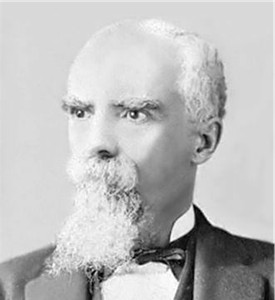
Watch Douglas Whitley as E.M. Bounds
Edward McKendree Bounds—better known as E. M. Bounds—stands as one of the most enduring voices on the subject of prayer in American Christian history. Though he lived in the nineteenth century, his writings continue to influence pastors, missionaries, and laypeople who seek a deeper, more disciplined spiritual life. His legacy rests not on institutional achievements or public fame, but on a quiet yet powerful insistence: that prayer is the central work of the Christian life.
Bounds was born on August 15, 1835, in Shelby County, Missouri. Raised in a devout Methodist household, he came of age during a time when faith and public life were closely intertwined. He pursued legal studies as a young man and was admitted to the bar, but his path soon shifted toward ministry. Feeling a clear call to preach, he entered the Methodist Episcopal Church, South, and began serving congregations in Missouri.
The outbreak of the American Civil War dramatically altered Bounds’s life. He served as a chaplain in the Confederate Army, ministering to soldiers under harsh and often desperate conditions. During the war, he was captured by Union forces and spent time in prison. This period of suffering and reflection deepened his spiritual convictions. It was here, in the crucible of hardship, that his understanding of prayer took on a profound urgency—not as a mere religious duty, but as a lifeline between the soul and God.
After the war, Bounds returned to pastoral ministry, serving churches in Tennessee and Alabama. He was known as a faithful, disciplined pastor who rose early each morning to pray, often spending hours in quiet communion before beginning his day. Those who knew him personally remarked that his preaching carried weight not because of rhetorical flair, but because it was grounded in a life saturated with prayer.
It was in the later years of his life, particularly after retiring from active pastoral work, that Bounds devoted himself to writing. His books were not widely published during his lifetime, but after his death in 1913, a series of manuscripts were compiled and released. These works—including Power Through Prayer, Purpose in Prayer, and The Necessity of Prayer—have since become classics of devotional literature.
At the heart of Bounds’s teaching is a simple yet demanding principle: prayer is not preparation for the greater work; prayer is the greater work. He believed that the effectiveness of a minister—or any Christian—depends far more on their private prayer life than on their public activity. In his view, sermons, programs, and organizational efforts could never substitute for a deep, abiding connection with God.
Bounds was particularly concerned with what he saw as a growing tendency in the church to rely on human methods rather than spiritual power. Writing in an age of increasing modernization, he warned against reducing ministry to efficiency and technique. For him, true spiritual authority could only come through earnest, persistent prayer. This conviction gives his writings a timeless quality, as each generation faces its own temptations to substitute activity for devotion.
Another defining feature of Bounds’s legacy is his emphasis on discipline. He did not present prayer as an occasional or spontaneous act, but as a structured and intentional practice. Early rising, extended times of solitude, and a steady commitment to intercession were, in his view, essential habits for anyone serious about the Christian life. While some may find his standards rigorous, many have also found them clarifying, offering a clear path in an often distracted age.
The impact of E. M. Bounds extends far beyond his own era. His books have been reprinted countless times and translated into multiple languages. Influential Christian leaders across denominations have drawn from his writings, particularly in movements that emphasize revival and spiritual renewal. His insistence on the primacy of prayer has helped shape devotional practices in churches around the world.
Yet perhaps the most enduring aspect of his influence lies in its personal nature. Bounds does not speak primarily to institutions, but to individuals. His writings challenge readers to examine their own lives, to reconsider their priorities, and to cultivate a deeper relationship with God through prayer. In a world marked by noise and haste, his call to quiet, persistent devotion remains both countercultural and compelling.
In sum, E. M. Bounds’s life and legacy remind us that lasting spiritual impact is often forged in private, unseen places. His message is neither complex nor fashionable, but it is steady and clear: the strength of the church, and the vitality of the believer, depend upon a life rooted in prayer.
_____
Image Source/Credit:
• Unknown field photographer of the Confederate Army, Public domain, via Wikimedia Commons
Related
Sorry, no records were found. Please adjust your search criteria and try again.
Sorry, unable to load the Maps API.