
Hymn History: He Is Coming Again
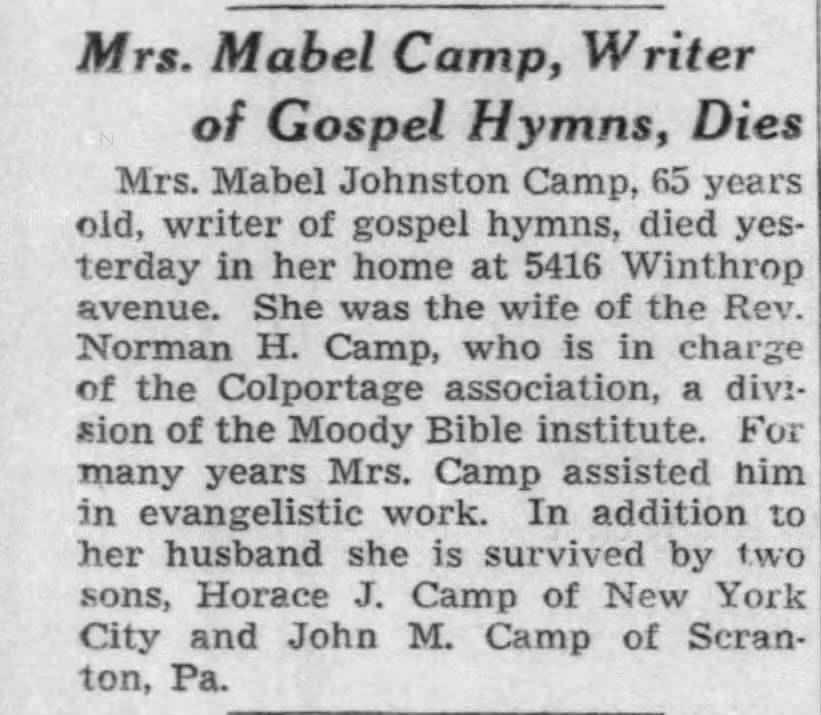
Author: Mabel Johnston Camp
“Mabel isn’t really known for writing hymns except for this hymn choice, but she too must have been living in anticipation of the Lord’s coming.”
(Barry Kauffman)
The Origin of the Hymn “He Is Coming Again”
The life and legacy of Mabel Johnston Camp are closely tied to her contribution to American gospel hymnody, particularly through her enduring hymn “He Is Coming Again.” Although not widely known outside hymnological circles today, Camp represents the dedicated work of early twentieth-century women hymn writers whose songs strengthened congregational devotion and reflected the revivalist spirit of the era. Her hymns combined accessible language with heartfelt spiritual exhortation, allowing everyday believers to engage actively in worship and discipleship.
Mabel Johnston Camp lived during a period of significant growth in the American evangelical movement. The late nineteenth and early twentieth centuries saw the proliferation of Sunday schools, youth fellowships, and evangelistic meetings. Hymns played a central role in these movements, serving both as teaching tools and as expressions of communal faith. Camp contributed to this tradition by providing texts that were doctrinally sound, emotionally engaging, and easily singable. While biographical details about her personal life are sparse, hymnological records indicate that she was actively involved in Christian circles that prioritized spiritual education and revivalist enthusiasm.
Her hymn “He Is Coming Again” exemplifies the devotional and eschatological themes common in gospel music of the early twentieth century. The hymn focuses on the Second Coming of Christ — a subject that had long inspired hope, anticipation, and moral urgency among believers. Rooted in biblical passages such as Matthew 24, Acts 1:11, and 1 Thessalonians 4, the hymn encourages believers to live in readiness for Christ’s return. It embodies both comfort and exhortation, reminding Christians that present trials are temporary and that eternal joy awaits those who remain faithful.
The text of “He Is Coming Again” is straightforward yet deeply evocative. It declares the certainty of Christ’s return while inviting a personal response from the singer: watchfulness, obedience, and joyful anticipation. Unlike more abstract theological compositions, Camp’s hymn communicates in language that could be grasped by children and adults alike. This simplicity aligns with the broader gospel song tradition, which aimed to make theological truths accessible without diluting their significance.
Musically, the hymn follows the style characteristic of early twentieth-century gospel songs. Composers paired it with melodies that were memorable and easy to sing in both formal church services and revival gatherings. The straightforward meter and recurring refrain helped congregations internalize the text, reinforcing its message of watchfulness and hope. Hymns such as this were often used at the close of sermons or during evangelistic services, where the repeated affirmation of faith encouraged personal commitment and spiritual reflection.
Camp’s hymn also reflects the broader context of evangelical women’s contributions to sacred music. During her era, women found in hymn writing an important avenue for influencing worship and nurturing faith within the church. Though they often received little public recognition, their songs became embedded in the devotional life of congregations. Camp’s work demonstrates this balance of humility and lasting impact. She used her talent not for personal fame, but to equip believers with tools for worship, instruction, and encouragement.
The legacy of “He Is Coming Again” continues to resonate, even as musical styles and worship practices evolve. Its focus on the Second Coming provides both hope and motivation. The hymn reminds worshipers that history moves toward fulfillment in Christ and that believers have a calling to remain faithful and diligent. Through this hymn, Camp’s voice endures, calling each generation to anticipate the Lord’s return with reverent joy and steadfast devotion.
Beyond this specific hymn, Camp’s life illustrates the quiet but meaningful influence of early twentieth-century gospel writers. She represents a generation of women whose work enriched the hymnals used by churches nationwide. While their names may not always appear prominently in historical accounts, their contributions shaped the devotional practices of countless congregations. Camp’s hymns, grounded in Scripture and expressed with pastoral sensitivity, exemplify this enduring legacy.
In conclusion, Mabel Johnston Camp’s life and work highlight the intersection of personal devotion, pastoral concern, and musical creativity. Through hymns like “He Is Coming Again,” she offered believers both encouragement and instruction, reminding them of the hope that underpins Christian faith. Her contributions continue to be sung in churches, preserving her voice across generations. Though historical records may leave much of her life in obscurity, her hymns ensure that her legacy of faithfulness and spiritual encouragement remains alive. In celebrating her work, one recognizes not only the message of Christ’s return but also the broader impact of dedicated hymn writers who nurtured the church’s worship and spiritual formation through song.
_____
Image Source/Credit:
• Newspapers.com, Chicago Tribune, May 28, 1937 (www.newspapers.com/article/chicago-tribune/192520659/)
Related
Sorry, no records were found. Please adjust your search criteria and try again.
Sorry, unable to load the Maps API.