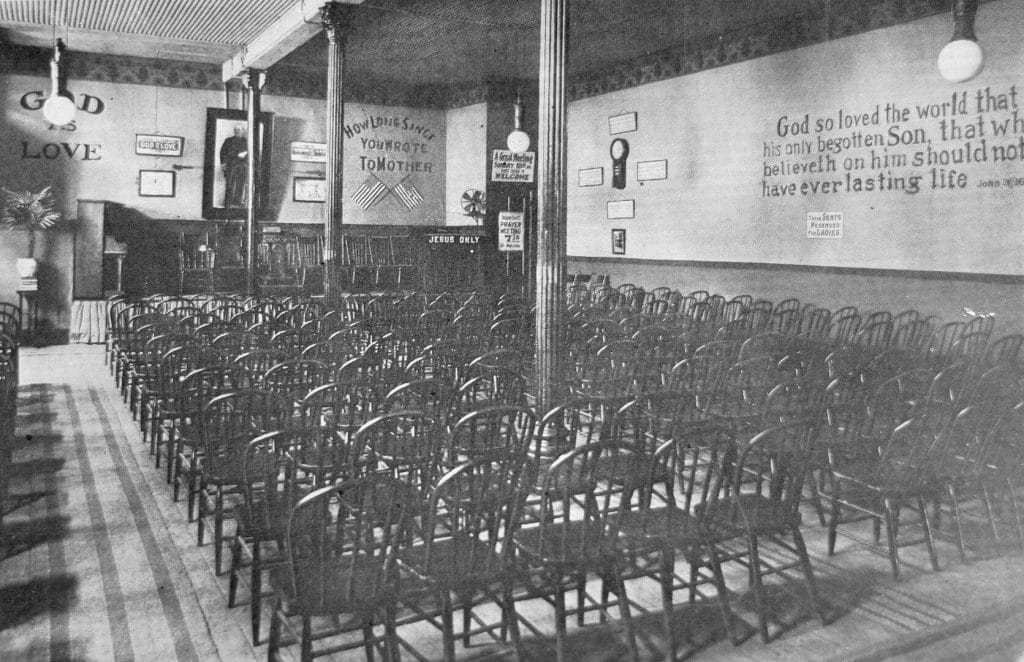
Billy Sunday is remembered today as one of the most dynamic revivalists in American history, a man whose fiery sermons and dramatic style captivated audiences across the nation in the early twentieth century. While his fame eventually spread far and wide, one of the most important turning points in his life occurred in Chicago, where his association with the Pacific Garden Mission helped set him on the path from professional athlete to evangelist.
Founded in the late nineteenth century, Pacific Garden Mission was a rescue mission dedicated to serving the urban poor, particularly those struggling with homelessness, addiction, and despair. Located in a rough district of Chicago, the mission offered food, shelter, and, most importantly, a message of spiritual hope. Its services were simple but powerful: hymns, testimonies, and straightforward preaching aimed at encouraging repentance and transformation. For many who passed through its doors, the mission represented a chance to begin again.
Billy Sunday first encountered this environment during his years as a professional baseball player. At the time, he was known more for his speed on the field than for any religious inclination. Playing in Chicago exposed him to a wide range of influences, both good and bad. The city’s nightlife, in particular, was a temptation for many athletes, and Sunday was no exception. Yet it was also in Chicago that he encountered a group of believers connected to Pacific Garden Mission whose example left a lasting impression.
One often-told account describes how Sunday and some teammates heard gospel singing while passing by the mission. Drawn in by curiosity, he listened as men shared testimonies of lives changed through faith. These were not polished speakers or prominent figures; they were ordinary individuals who spoke plainly about struggle, redemption, and hope. That authenticity struck Sunday deeply. Unlike the crowds and cheers of the baseball field, this was something personal and enduring.
Through continued contact with mission workers and attendees, Sunday experienced a religious conversion that altered the direction of his life. He began attending services more regularly, gradually distancing himself from the lifestyle that had accompanied his baseball career. The influence of Pacific Garden Mission was not merely emotional; it provided a practical example of lived faith. Here, religion was not an abstract concept but a daily commitment expressed through service, discipline, and moral reform.
This experience became the foundation for Sunday’s later work as an evangelist. After leaving baseball, he threw himself into Christian ministry, eventually developing a preaching style that was as energetic as his former athletic career. He preached against alcohol, vice, and moral complacency, themes that closely echoed the mission’s emphasis on personal transformation. His sermons often included vivid illustrations and urgent appeals, reflecting the straightforward, no-nonsense approach he had first encountered at Pacific Garden Mission.
The mission’s influence could also be seen in Sunday’s concern for ordinary people. Unlike some religious leaders who focused primarily on theological debate, Sunday addressed practical moral issues that affected everyday life. He spoke to workers, families, and individuals facing hardship, urging them to adopt a disciplined and upright way of living. This focus mirrored the mission’s commitment to meeting people where they were and offering both immediate help and long-term hope.
As Sunday’s reputation grew, so did his reach. He conducted revival meetings in cities across the United States, drawing large crowds and significant media attention. Temporary tabernacles were often constructed to accommodate the thousands who came to hear him preach. Despite his growing fame, the core message remained consistent: a call to repentance, faith, and moral responsibility. In many respects, he carried the spirit of Pacific Garden Mission with him wherever he went.
The broader social context of the time also amplified his impact. America was undergoing rapid industrialization and urbanization, changes that brought both opportunity and social challenges. Issues such as poverty, alcoholism, and dislocation were widespread, particularly in large cities like Chicago. Institutions like Pacific Garden Mission addressed these problems at the ground level, while figures like Billy Sunday brought them into the national conversation through preaching and public advocacy.
In reflecting on Billy Sunday’s life, it becomes clear that his encounter with Pacific Garden Mission was more than a passing influence. It was a defining moment that redirected his ambitions and gave him a new sense of purpose. The mission provided both the message and the model that would shape his ministry for decades to come.
Ultimately, Billy Sunday’s story is one of transformation rooted in real experience. From the noise of the baseball field to the humble services of a rescue mission, his journey illustrates how personal encounters and community influence can change the course of a life. Pacific Garden Mission, with its quiet but steadfast work, played a crucial role in that transformation, leaving a lasting mark not only on Sunday himself but on the many lives he would later touch.
♦ _____ ♦
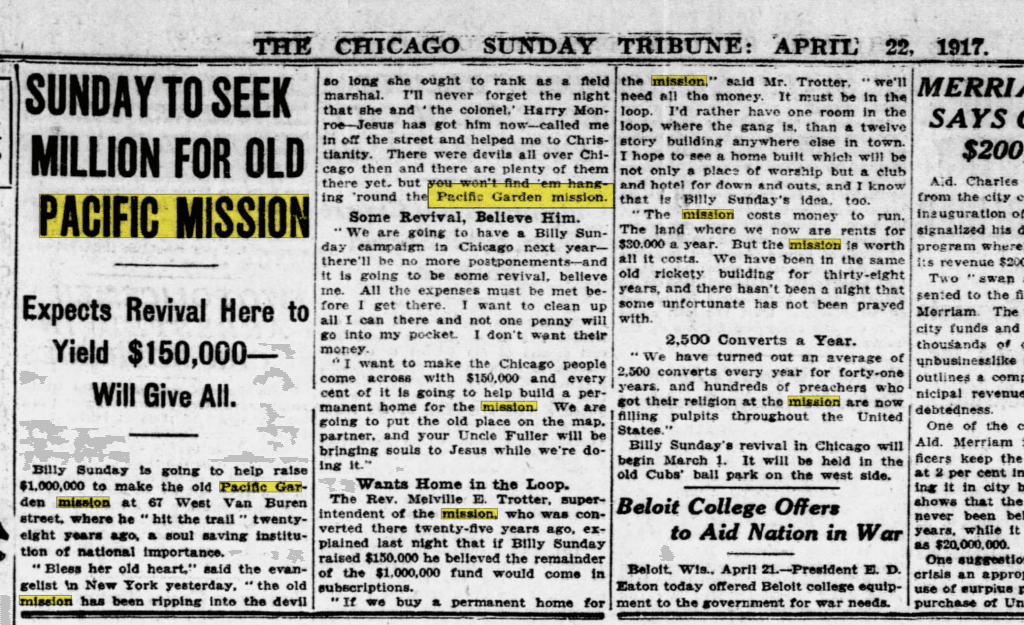
In 1880, the mission moved to 67 E. Van Buren Street, in a location which was formerly known as the Pacific Beer Garden. At that time, the current name of the mission, Pacific Garden Mission, was adopted; However, evangelist D.L. Moody suggested that the name of the former occupant should be kept but the word “Beer” should be dropped from the name.
_____
Image Source/Credit:
• Apr 22, 1917, Page 9 – Chicago Tribune at Newspapers.com (www.newspapers.com/image/354920772/?match=1&terms=%22pacific%20garden%20mission%22)
♦ _____ ♦
_____
Image Source/Credit:
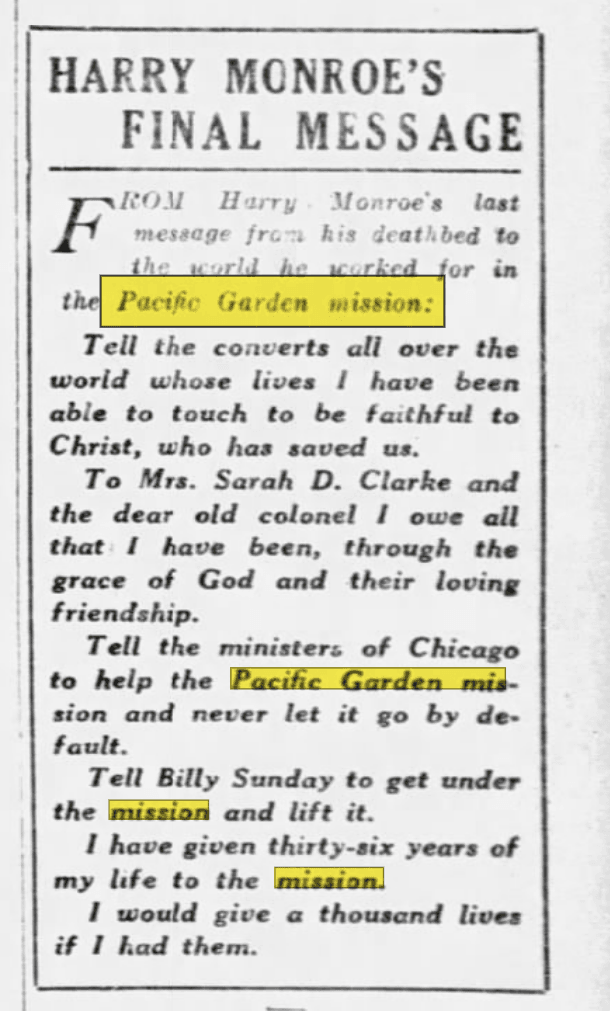
• Aug 03, 1916, Page 13 – Chicago Tribune at Newspapers.com (www.newspapers.com/image/354907572/?match=1&terms=%22sarah%20d.%20clarke%22)
Featured Image Source/Credit:
• William T. Ellis LL.D, Public domain, via Wikimedia Commons