
The relationship between Abraham Lincoln and religion has long been a subject of careful study and thoughtful debate. Unlike many American leaders of his time, Lincoln was not formally affiliated with a church, yet his language, convictions, and leadership were deeply shaped by religious ideas, particularly those rooted in the Bible.
Lincoln was born in 1809 in Hardin County, a region influenced by frontier Christianity, especially Baptist traditions. His parents were associated with Baptist congregations, and from an early age Lincoln was exposed to Scripture. Though he never joined a church, the King James Bible became one of his most influential books. Its language and imagery would later define his speeches and writings, giving them a moral clarity and solemn tone that set him apart.
In his early years, Lincoln’s views on religion appeared reserved and at times skeptical. Friends and acquaintances recalled that he questioned certain doctrines and avoided public declarations of personal faith. However, as he matured—particularly during his years in Springfield—his thinking deepened. He developed a strong belief in divine providence, the idea that God governs the affairs of nations and individuals, even when His purposes are not fully understood.
The turning point in Lincoln’s religious expression came during the crisis of the American Civil War. As president, he carried the immense burden of leading a divided nation through its darkest hour. The scale of suffering and loss profoundly affected him, and his public statements increasingly reflected a humble, searching faith. Rather than claiming certainty about God’s will, Lincoln often emphasized human limitation in understanding it.
This perspective is most clearly seen in his Second Inaugural Address, delivered in 1865. In that remarkable speech, Lincoln interpreted the Civil War as a form of divine judgment on both North and South for the sin of slavery. Quoting Scripture, he suggested that the war might continue “until every drop of blood drawn with the lash shall be paid by another drawn with the sword.” Such language revealed a man who saw history through a moral and religious lens, yet who resisted the temptation to claim that God was exclusively on one side.
Lincoln’s religion was marked by humility, moral seriousness, and a deep respect for the Bible. He frequently turned to Scripture for insight and expression, weaving its phrases into his speeches in ways that resonated with a broad audience. At the same time, he avoided aligning himself too closely with any denomination, perhaps reflecting his desire to speak to the entire nation rather than a particular religious group.
Privately, Lincoln also found comfort in prayer, especially during the war years. Though he left few explicit statements about his personal devotional life, those close to him observed that he often sought guidance and strength in quiet reflection. His faith was not one of outward display, but of inward reliance.
In the end, Abraham Lincoln’s relationship with religion cannot be easily categorized. He was neither conventionally devout nor openly irreligious. Instead, he stands as a figure whose faith was shaped by experience, refined by hardship, and expressed with remarkable depth and restraint. His words continue to endure, not only for their political wisdom but for their profound moral and spiritual insight.
♦ _____ ♦
Newton Bateman (1822-1897) was born in poverty in New Jersey, moved to Illinois, started a school in St. Louis, then became Illinois Superintendent of Public Instruction, and authored the Historical Encyclopedia of Illinois.
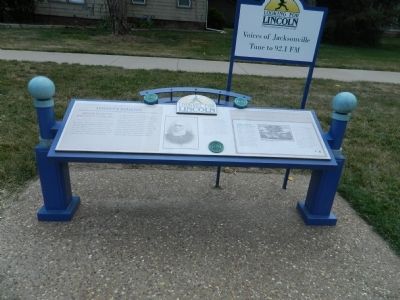
While Bateman was a student at Illinois College in Jacksonville (Illinois), Lincoln was a state legislator representing nearby New Salem, in the also nearby Springfield. They met through Bateman’s new Sigma Pi literary society. In 1851, Bateman bought (and later expanded) the house on this site. A nearby plaque notes a speech he gave in 1859.
Between his presidential nomination (1860) and his departure for Washington (1861), Lincoln would use Dr. Bateman (“my little friend [Bateman was much shorter than the tall Lincoln] and big schoolmaster”).
Lincoln has always been controversial (he was the first president to be assassinated), but his religious views are even more debated.
This plaque records a statement Lincoln made to Bateman in 1860, and Bateman shared to Josiah Holland for his Life of Lincoln.
Inscription:
Abraham Lincoln was often accused by his detractors—and even by some of his friends—of not being a Christian. Just before becoming President, Lincoln shared the following with his friend Dr. Newton Bateman: “I know there is a God, and that He hates injustice and slavery. I see the storm coming, and I know that His hand is in it. If He has a place and work for me—and I think He has—I believe I am ready. I am nothing, but truth is everything. I know that I am right because I know that liberty is right, for Christ teaches it, and Christ is God. I have told them that a house divided against itself cannot stand, and Christ and reason say the same; and they will find it so. (Stephen) Douglas don’t care whether slavery is voted up or voted down, but God cares, and humanity cares, and I care; and with God’s help I shall not fail. I may not see the end; but it will come, and I shall be vindicated; and these men will find that they have not read their Bibles aright.”
_____
Image Source/Credit:
• Photo: Lincoln in Hancock County Marker (>www.hmdb.org/PhotoFullSize.asp?PhotoID=213365)
Related
Sorry, no records were found. Please adjust your search criteria and try again.
Sorry, unable to load the Maps API.