
William Jennings Bryan Park, along with the nearby statue and historical marker dedicated to William Jennings Bryan, forms an important commemorative landscape in Lincoln. These sites preserve the memory of one of America’s most influential orators and political figures of the late nineteenth and early twentieth centuries, honoring both his public achievements and his deep connections to Nebraska.
The park is closely tied to Bryan’s final years and legacy. After his death in 1925, Bryan was buried at his home, Fairview, which later became part of the broader memorial landscape. Over time, local and state efforts sought to preserve his memory in a more public setting, leading to the establishment of William Jennings Bryan Park. The park serves as both a green space and a place of reflection, allowing visitors to engage with the history of a man whose influence reached far beyond Nebraska.
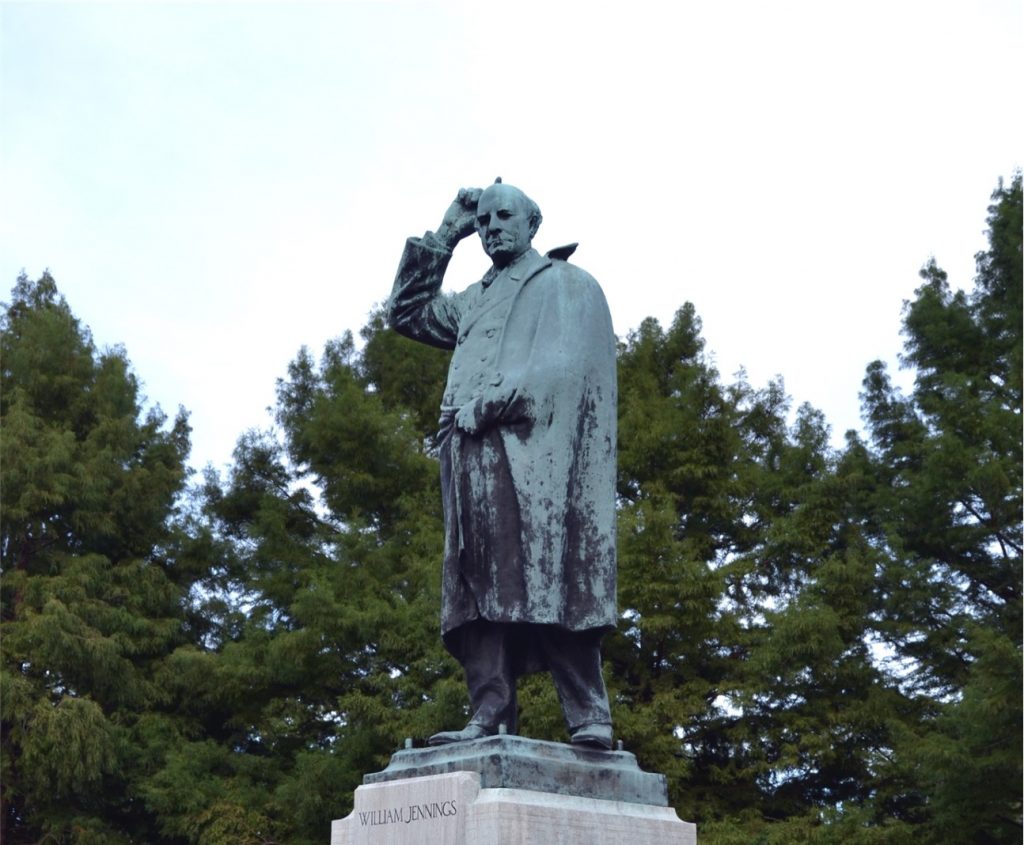
At the center of the commemorative area is a statue of Bryan, depicting him in a dignified, forward-looking pose. The statue reflects his public identity as a three-time presidential candidate, a leading voice in the Democratic Party, and a champion of populist causes. Bryan’s political career was marked by his passionate advocacy for issues such as the regulation of railroads, opposition to imperialism, and support for the direct election of senators. His famous “Cross of Gold” speech in 1896 cemented his reputation as one of the greatest speakers of his generation.
The historical marker near the park provides context for visitors, summarizing Bryan’s life and accomplishments. It highlights his role not only as a politician but also as a lawyer, newspaper editor, and devout Christian. Bryan’s faith was central to his public identity, influencing both his political positions and his later involvement in national debates over education and religion. His participation in the Scopes Trial remains one of the most discussed episodes of his later life, illustrating his commitment to what he believed were moral and biblical principles in public education.
The establishment of the park and its memorial features reflects a broader effort in the twentieth century to preserve the memory of national figures at local and regional levels. In Nebraska, Bryan is remembered not only as a political leader but also as a symbol of the state’s influence on national affairs during a transformative period in American history. The park provides a setting where his achievements can be understood in context, connected to the place where much of his work was based.
Over the years, the site has become a destination for both residents and visitors interested in American political history. It is often included in educational tours and local heritage programs, offering an opportunity to learn about Bryan’s impact on American democracy. The combination of park space, statue, and interpretive marker creates a layered experience: one that blends natural surroundings with historical reflection.
Maintenance of the site has been supported by local government and historical organizations, ensuring that the park remains accessible and informative. The statue and marker are carefully preserved as focal points, while the surrounding grounds provide space for contemplation and public gatherings.
In sum, William Jennings Bryan Park and its associated statue and marker serve as enduring tributes to a man whose voice shaped national debates for decades. They stand not only as memorials to Bryan himself but also as reminders of a period in American history when political oratory, moral conviction, and public service were deeply intertwined.
_____
Image Source/Credit:
• William Jennings Bryan Historical Marker. 15 July 2021 (www.hmdb.org/m.asp?m=99119)
Related
Sorry, no records were found. Please adjust your search criteria and try again.
Sorry, unable to load the Maps API.