
The story of Peter Cartwright United Methodist Church is deeply rooted in the early days of American frontier life and the spread of Methodism across the Midwest. More than just a local congregation, the church stands as a lasting testament to the work and influence of Peter Cartwright, one of the most energetic and influential preachers of the nineteenth century.
The origins of the church date back to 1824, the same year Cartwright moved to Illinois. At that time, the region was still developing, with scattered settlements and limited access to organized religion. Like many Methodist ministers of his era, Cartwright served as a circuit rider, traveling long distances to preach to isolated communities. Rather than waiting for people to come to church, he brought the church to them—often on horseback, across rough and undeveloped terrain.
The earliest form of the church began humbly, meeting as a small religious class in Cartwright’s own home. These gatherings were simple but meaningful, reflecting the practical and determined spirit of frontier faith. As more settlers arrived and the congregation grew, the need for a dedicated place of worship became clear. In 1838, Cartwright donated both land and money to construct a log chapel, giving the congregation a permanent foundation.
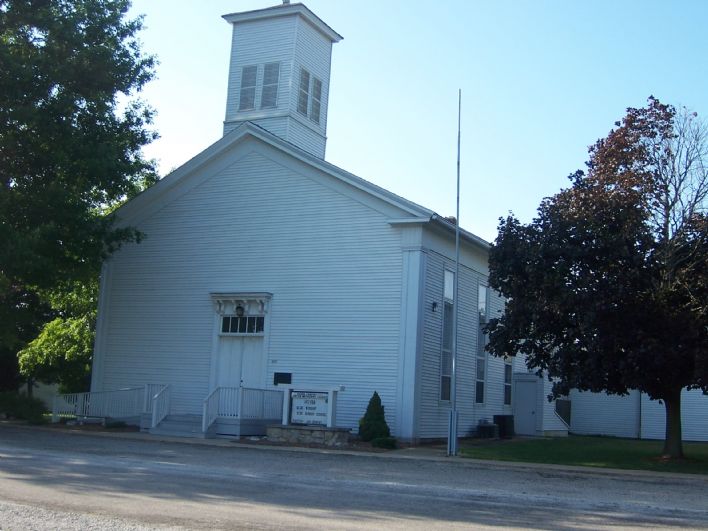
This first structure served the community for many years, but growth continued. By the early 1850s, the congregation had expanded enough that it eventually divided into separate groups, a common occurrence in rapidly developing frontier regions. One group relocated nearby, while the other settled in what became the village of Pleasant Plains. In 1857, a more substantial church building was constructed there, forming the core of what remains today. Remarkably, much of that original structure has been preserved, offering a rare and tangible link to the past.
The church’s significance extends beyond its physical structure. It represents the broader movement of Methodism across Illinois during the early nineteenth century. Cartwright himself was a central figure in that movement. Known for his powerful preaching and tireless work ethic, he delivered thousands of sermons and helped establish numerous congregations throughout the region. His efforts were instrumental in shaping the religious character of the frontier and providing spiritual guidance to settlers facing the challenges of a new and often difficult life.
In addition to his religious work, Cartwright was also active in civic life. He served in the Illinois legislature and was involved in the founding of several educational institutions. Yet it was his role as a preacher that left the deepest impression. His straightforward style, combined with a strong sense of conviction, resonated with ordinary people and helped build enduring communities of faith.
Today, Peter Cartwright United Methodist Church is recognized as a historic landmark within the United Methodist tradition. Visitors who step inside are not simply entering a place of worship but walking into a piece of living history. The building, the grounds, and the ongoing congregation all reflect a continuity that stretches back nearly two centuries.
In a time when much of modern life moves quickly and traditions can be easily forgotten, the church stands as a steady reminder of earlier days. It recalls a period when faith was carried by horseback, when communities were built through shared effort, and when individuals like Peter Cartwright shaped both the spiritual and social fabric of an entire region.
_____
Image Source/Credit:
• “Peter Cartwright United Methodist Church – Pleasant Plains, Illinois – Find-A-Church.” The United Methodist Church (www.umc.org/en/find-a-church/church?id=001Um00000PFMr5IAH)
Related
Sorry, no records were found. Please adjust your search criteria and try again.
Sorry, unable to load the Maps API.