
The story of the “Beecher Bibles” and the later shortfall of the Social Gospel movement reflects two distinct but related attempts to address moral crisis in American life. Both arose from a desire to confront injustice, yet they differed sharply in method and long-term impact.
The term “Beecher Bibles” is associated with Henry Ward Beecher, a prominent nineteenth-century minister and outspoken opponent of slavery. During the turbulent years leading up to the American Civil War, violence erupted in the Kansas Territory as pro-slavery and anti-slavery forces struggled for control. This period, often called “Bleeding Kansas,” saw settlers arming themselves in preparation for conflict.
Beecher, convinced that slavery was a profound moral evil, supported efforts to aid anti-slavery settlers. Through his encouragement, funds were raised to send rifles—specifically Sharps rifles—to those in Kansas. These weapons were sometimes packed in crates labeled as “Bibles,” giving rise to the nickname “Beecher Bibles.” The label carried both a practical and symbolic meaning. Practically, it concealed the contents; symbolically, it reflected Beecher’s belief that in the face of violent injustice, moral conviction might require forceful defense.
This episode reveals the intensity of the national struggle over slavery. For Beecher and his supporters, the cause of freedom justified extraordinary measures. Yet it also raises enduring questions about the relationship between faith and force. The use of weapons in a cause framed in moral and even religious terms demonstrated how deeply the conflict had penetrated the conscience of the nation.
In the decades following the Civil War, a different approach to social reform emerged in the form of the Social Gospel. Leaders such as Walter Rauschenbusch sought to apply Christian ethics to the pressing social issues of industrial America—poverty, labor conditions, and urban inequality. Rather than focusing on individual conversion alone, they emphasized transforming society by addressing systemic injustice.
The Social Gospel movement made important contributions. It inspired reforms in labor laws, public health, and education, and it encouraged Christians to take an active role in improving social conditions. Its emphasis on compassion and justice resonated with many who saw the harsh realities of industrial life.
However, the movement also revealed certain limitations. In focusing heavily on social structures, it sometimes downplayed the importance of personal faith and spiritual transformation. Critics argued that it risked reducing Christianity to a program of moral reform, detached from its theological foundations. Without a strong emphasis on individual repentance and renewal, its vision could become more about societal improvement than about the deeper spiritual change that earlier generations had emphasized.
Additionally, the Social Gospel often struggled to sustain its influence in the face of complex economic and political realities. While it addressed real problems, it sometimes underestimated the persistence of human nature and the difficulty of achieving lasting reform through social programs alone.
Taken together, the history of the Beecher Bibles and the Social Gospel highlights two different responses to injustice—one immediate and forceful, the other gradual and reform-oriented. Both were rooted in a desire to apply moral principles to public life. Yet both also reveal the challenges of doing so effectively. They serve as reminders that the pursuit of justice requires not only conviction and compassion, but also a careful balance between outward action and inward transformation.
♦ _____ ♦
Lyman Beecher was Henry Ward Beecher’s father, a traditional Calvinist that would be common in Puritan New England. Yet as the 1800s went on, Henry Ward Beecher would lay the foundation for the “social gospel” movement.
“Harry Emerson Fosdick would comment that whenever we preach freely to sympathetic audiences the social gospel…, we are building on foundations that Mr. Beecher helped to lay….In 1882 he endorsed the theory of evolution. He said, ‘I am an evolutionist and that strikes at the root of all medieval and orthodox modern theology. Men have not fallen as a race. Men have come up.”” –Tim Hutchinson
Inscription:
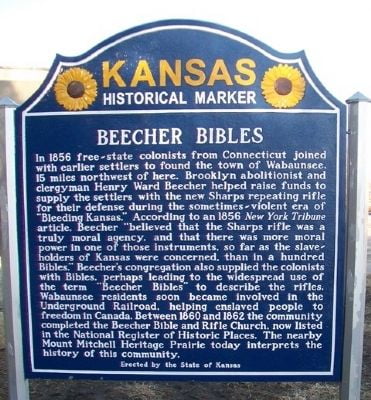
1856 free-state colonists from Connecticut joined with earlier settlers to found the town of Wabaunsee, 15 miles northwest of here. Brooklyn abolitionist and clergyman Henry Ward Beecher helped raise funds to supply the settlers with the new Sharps repeating rifle for their defense during the sometimes-violent era of “Bleeding Kansas.” According to an 1856 New York Tribune article, Beecher “believed that the Sharps rifle was a truly moral agency, and that there was more moral power in one of those instruments, so far as the slaveholders of Kansas were concerned, than in a hundred Bibles.” Beecher’s congregation also supplied the colonists with Bibles, perhaps leading to the widespread use of the term “Beecher Bibles” to describe the rifles. Wabaunsee residents soon became involved in the Underground Railroad, helping enslaved people to freedom in Canada. Between 1860 and 1862 the community completed the Beecher Bible and Rifle Church, now listed in the National Register of Historic Places. The nearby Mount Mitchell Heritage Prairie today interprets the history of this community.
_____
Image Source/Credit:
• Bluestem in the Flint Hills / Beecher Bibles Historical Marker. 17 Dec. 2024 (www.hmdb.org/m.asp?m=73107)
Related
Sorry, no records were found. Please adjust your search criteria and try again.
Sorry, unable to load the Maps API.