
The Mayflower Compact stands as one of the most significant founding documents in early American history. Signed aboard the ship Mayflower in November 1620, it established a basic framework for self-government among English settlers who had arrived on the shores of what is now Massachusetts without a formal governing charter. Though brief in length, the Compact carried lasting influence, shaping political ideas that would later become central to the development of constitutional government in the United States.
The story of the Mayflower Compact begins with a group of English Separatists and other settlers who sought religious freedom outside of the Church of England. Many of these passengers, later known as Pilgrims, had first fled to the Netherlands before deciding to cross the Atlantic in search of a new settlement. Their intended destination was within the bounds of the Virginia Company’s territory, where they held a legal patent to establish a colony. However, storms and navigation errors carried them far north of their planned destination, eventually bringing them to Cape Cod.
Because they had landed outside the jurisdiction of their original patent, questions immediately arose about authority and governance. Some passengers argued that the original agreement no longer applied, raising concerns that disorder could follow if no new system was established. To address this uncertainty, the leaders and male passengers aboard the ship drafted and signed the Compact before disembarking.
The document itself was simple but profound. It declared the settlers’ intention to form a “civil body politic” for the purpose of ordering and governing themselves. It further stated that laws, ordinances, and offices would be created “for the general good of the colony,” and that all signers agreed to submit to these regulations. In essence, the Compact was an agreement of mutual consent, binding its participants to a shared system of governance.
Although it was not a constitution in the modern sense, the Mayflower Compact is widely regarded as an early expression of self-rule in the English colonies. It represented a shift away from purely top-down authority toward a system based on collective agreement. The idea that government derives its legitimacy from the consent of the governed would later become a foundational principle in American political thought.
The Compact was signed by 41 male passengers, including leaders such as William Bradford, who would later become a key chronicler of the colony’s early history. Bradford’s writings provide much of what is known about the Mayflower voyage and the challenges faced by the settlers after landing. Under his leadership and others, the group established Plymouth Colony, one of the earliest successful English settlements in North America.
In the years that followed, the Mayflower Compact took on symbolic importance beyond its immediate practical function. It came to be seen as a pioneering step toward democratic governance in America. While its scope was limited—applying only to the settlers of Plymouth—it introduced the principle that communities could establish their own governing rules through agreement rather than relying solely on external authority.
The legacy of the Compact can also be seen in later colonial and state constitutions. Its emphasis on consent, cooperation, and the rule of law influenced political development throughout New England and beyond. In American historical memory, it is often cited alongside other early documents as part of the intellectual foundation of the United States.
Today, the Mayflower Compact is remembered not only as a practical solution to a moment of uncertainty but also as a landmark in the evolution of political ideas. It reflects the determination of a small group of settlers to create order in a new and uncertain land, and it continues to be studied as an early example of collective self-government rooted in mutual agreement and shared responsibility.
♦ _____ ♦
Inscription:
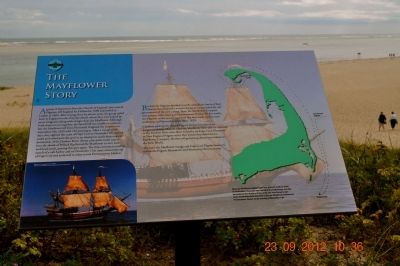
A group of Separatists from the Church of England, later named Pilgrims, left England for Holland in 1608 in settled in Leiden in 1609. After staying there for 11 years, the group sailed back to England on the ship Speedwell, where they joined by more immigrants along with a larger ship, the Mayflower. Although both ships set out together, the Speedwell was unable to continue, but the Mayflower left from Plymouth, England, for America on September 6th, 1620 with 102 passengers. After a voyage of 66 days, they cited the coast of Cape Cod on November 9th, turned South and sailed past this spot in an attempt to reach that original destination of the Hudson River. About 9 miles south east of here the shoal of Pollack Rip forced the Mayflower to turn back and head north, passing this spot again. The ship continued north in search of a safe harbor and on November 11th came around the tip of Cape Cod anchored in what is now Provincetown Harbor.
Because the Pilgrims decided to settle outside the limits of their charter, they believed a written document was needed for self government of the new colony. Thus, the Mayflower Compact was written.
After staying in Provincetown Harbor for five weeks, the Pilgrims sailed across Cape Cod Bay and made a permanent settlement in Plymouth in December, 1620.
Chatham profoundly shaped Pilgrim history because of its dangerous waters offshore. Had the Mayflower been able to continue to the Hudson River area, there would be no Cape Cod, Plymouth or New England Pilgrim story. Nor would there have been a Mayflower Compact, the first self governing document written in the New World.
The story the Mayflower voyage and Cape Cod Pilgrim history is told at the Pilgrim Monument and Museum in Provincetown.
_____
Image Source/Credit:
• Photo: Journey of the Mayflower Marker (www.hmdb.org/PhotoFullSize.asp?PhotoID=498254)
Related
Sorry, no records were found. Please adjust your search criteria and try again.
Sorry, unable to load the Maps API.