

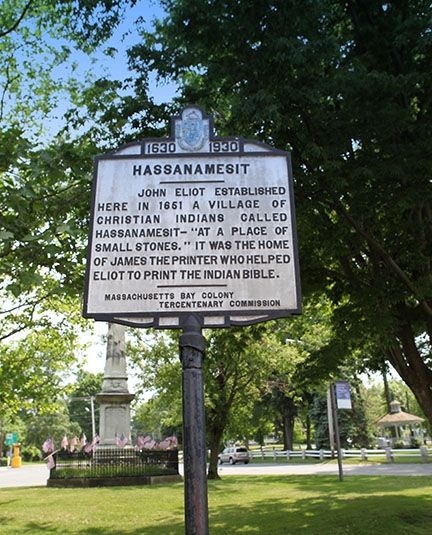
Hassanamesit was one of the most important “Praying Indian” towns established in seventeenth-century New England. Located in what is now Grafton, Massachusetts, it played a significant role in the early interactions between Native American communities and English colonists, particularly in the context of Christian missionary efforts and colonial expansion.
The name Hassanamesit comes from the Nipmuc language and is often translated as “place of small stones” or “place of gravel.” Before English settlement, the area was inhabited by the Nipmuc, a group of Algonquian-speaking Native Americans who lived throughout central Massachusetts. The Nipmuc people had their own social structures, traditions, and spiritual practices long before European contact.
In the mid-seventeenth century, Hassanamesit became one of several communities designated as “Praying Towns.” These towns were part of a missionary initiative led by John Eliot, a Puritan minister who sought to convert Native Americans to Christianity. Eliot believed that establishing separate communities where Native converts could live according to Christian teachings would encourage the spread of the faith. Hassanamesit was one of the largest and most prominent of these towns.
Life in Hassanamesit reflected a blending of cultures. Residents were encouraged to adopt aspects of English-style living, including agriculture, housing, and religious practices. At the same time, many elements of Native identity persisted, creating a complex and evolving community. The town included a meetinghouse for worship and instruction, as well as fields for farming, which were worked collectively by its inhabitants.
One of the most notable figures associated with Hassanamesit is Moses Tunda Tatamy, who spent time in the region and had connections to missionary efforts among Native peoples. While Tatamy is more closely associated with the Lenape of Pennsylvania, his broader interactions reflect the interconnected nature of Native communities and missionary work during this period.
Hassanamesit’s history was deeply affected by the events of King Philip’s War, a devastating conflict between Native American groups and English colonists. During the war, many Praying Indian communities were viewed with suspicion by the colonists, despite their conversion to Christianity. Residents of towns like Hassanamesit faced displacement, violence, and the destruction of their homes. The war marked a turning point, leading to a decline in the stability and population of these communities.
In the years following the war, Hassanamesit continued to exist but gradually changed as English settlement expanded. Land that had been set aside for Native inhabitants was increasingly encroached upon or sold, often under pressure. By the eighteenth century, much of the original Native community had been dispersed, and the area became more fully integrated into colonial—and later American—society.
Today, the site of Hassanamesit is recognized for its historical significance. Archaeological work in the area has uncovered artifacts that provide insight into the daily lives of its inhabitants, including tools, pottery, and remnants of structures. These findings help historians better understand the unique cultural blend that characterized the Praying Towns.
The legacy of Hassanamesit lies in its role as a place of cultural encounter and adaptation. It represents both the efforts of missionaries like John Eliot to spread Christianity and the resilience of Native communities navigating profound change. At the same time, its history serves as a reminder of the challenges and injustices faced by Native Americans during the colonial period.
In conclusion, Hassanamesit stands as an important chapter in early American history. It reflects the complexities of faith, identity, and survival in a time of transformation. Though the original community no longer exists, its story continues to inform our understanding of the relationships between Native Americans and European settlers in New England.
_____
Image Source/Credit (in order):
• Photo: Hassanamesit Marker (www.hmdb.org/PhotoFullSize.asp?PhotoID=156695)
• Hassanamesit Historical Marker. 23 Mar. 2026 (www.hmdb.org/m.asp?m=295848)
Related

Sorry, no records were found. Please adjust your search criteria and try again.
Sorry, unable to load the Maps API.