
God’s Ten Commandments Park is a distinctive religious landmark located in southern Illinois. Overlooking the town of Murphysboro from a wooded hillside, the park has become known for its large-scale displays of biblical scenes, particularly its prominent monument to the Ten Commandments. Combining religious devotion, folk art, and local initiative, the park reflects a unique expression of faith in the American landscape.
The origins of the park date to the late twentieth century, when local resident and World War II veteran George “Bud” Bong began developing the site. Motivated by a desire to share the message of Scripture in a public and accessible way, Bong transformed the hillside into a series of religious displays. What began as a personal project gradually expanded into a park that would draw visitors from across the region.
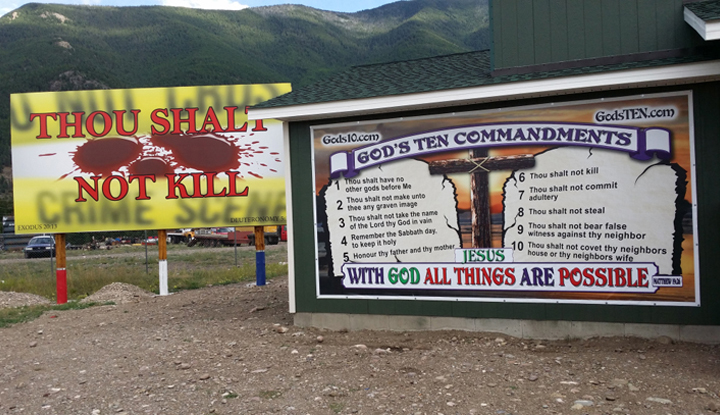
The most striking feature of the park is the large Ten Commandments monument, prominently displayed so that it can be seen from a distance. The commandments, traditionally understood as foundational moral laws given to Moses, are presented in bold lettering, serving as both a visual and spiritual focal point. Surrounding this central feature are numerous other elements, including statues, crosses, and illustrated scenes from the Bible.
Visitors to the park encounter a variety of biblical representations, from depictions of Christ’s life to scenes of judgment and redemption. These displays are often created in a straightforward, accessible style, reflecting the park’s grassroots origins rather than formal artistic training. The result is a setting that feels both personal and direct, inviting reflection rather than impressing through grandeur.
The park’s location on a hill overlooking Murphysboro adds to its character. The elevated setting provides expansive views of the surrounding countryside, reinforcing the sense of the park as a place set apart. For many visitors, the climb to the site becomes part of the experience, symbolizing a journey toward contemplation and spiritual awareness.
In terms of impact, God’s Ten Commandments Park has served as a local destination for individuals and families seeking a quiet place for reflection. It has also attracted visitors interested in roadside attractions and folk religious art, making it part of a broader American tradition of devotional landscapes. Such sites often arise from individual initiative rather than institutional planning, and they reflect the personal faith of their creators.
The park also touches on broader cultural themes, particularly the role of religious expression in public spaces. While it is privately maintained, its visibility and accessibility have made it a point of interest in discussions about how faith is displayed and shared within the community. In this way, it represents both a personal testimony and a public statement.
Over the years, the park has required ongoing care and maintenance, often supported by local volunteers and supporters who value its message and presence. Its continued existence reflects a shared commitment to preserving a place that has become meaningful to many.
God’s Ten Commandments Park may not be widely known on a national scale, but its significance lies in its sincerity and accessibility. It stands as an example of how individuals can shape their environment to reflect deeply held beliefs, creating spaces that invite others to pause and consider matters of faith and morality.
In a broader sense, the park embodies a tradition that runs deep in American life—the desire to make faith visible and tangible. Through its hillside setting, its bold displays, and its enduring message, God’s Ten Commandments Park continues to serve as a quiet but notable expression of that impulse.
_____
Image Source/Credit:
• Gods10.com / Gods Ten Commandments (godsten.net/gods10park.html)
Related
Sorry, no records were found. Please adjust your search criteria and try again.
Sorry, unable to load the Maps API.