
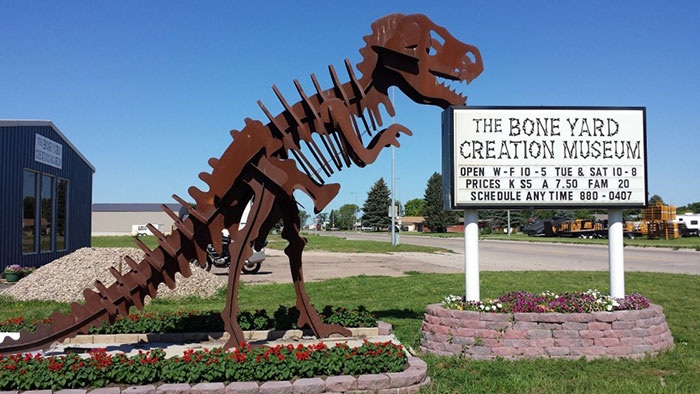
The Boneyard Creation Museum is a small but distinctive creationist exhibit located in the United States that focuses on fossils, dinosaurs, and geological specimens interpreted through a biblical worldview. Like other creation-focused institutions, it seeks to present the natural world as evidence of intelligent design and a relatively young earth, as understood through a literal reading of Scripture.
The museum is associated with independent creationist outreach efforts and is often visited alongside other regional attractions that emphasize biblical history and interpretation of science. Its name, “Boneyard,” reflects its central emphasis on fossils—particularly dinosaur remains and Ice Age animal bones—which form the core of its displays. These specimens are presented not simply as ancient remnants of evolutionary processes, but as evidence of a world shaped by rapid, catastrophic events, often linked to the biblical account of Noah’s Flood.
Exhibits within the Boneyard Creation Museum typically include fossilized bones, replicas of dinosaur skeletons, and geological samples collected from various regions. In some cases, the museum also features local finds, helping visitors connect global scientific questions with nearby natural history. Interpretive panels explain how these items are understood within a creationist framework, emphasizing alternative explanations for fossil formation and geological strata.
A defining feature of the museum is its educational approach. Rather than functioning solely as a display space, it often incorporates guided tours, lectures, and interactive discussions. Visitors are encouraged to ask questions and engage directly with the material, making it particularly appealing to families, homeschool groups, and church organizations. This hands-on style of learning is intended to make complex scientific topics more accessible while also reinforcing the museum’s interpretive perspective.
In addition to fossil exhibits, the museum frequently includes displays related to biblical history and apologetics. These may feature timelines of earth history based on the book of Genesis, comparisons between evolutionary and creationist models, and presentations on the reliability of Scripture. Some exhibits also explore archaeological discoveries that supporters believe align with biblical narratives, such as ancient civilizations and flood-related geological formations.
The Boneyard Creation Museum is part of a broader network of similar institutions across the United States and other countries. These museums vary in size and scope, but they share a common goal: to challenge mainstream scientific interpretations of origins and to present what they consider to be a biblically consistent understanding of natural history. Within this movement, museums like the Boneyard serve as educational tools and outreach centers for creationist organizations.
While supporters view the museum as an important resource for faith-based education, it has also been subject to criticism from mainstream scientists and educators. Critics argue that its interpretations of fossils and geology are not consistent with widely accepted scientific evidence and methodologies. Despite these disagreements, the museum continues to attract visitors who are interested in exploring alternative viewpoints on science and origins.
The atmosphere of the Boneyard Creation Museum is typically informal and approachable. Unlike large metropolitan museums with extensive technological displays, it often relies on direct interaction, personal explanations, and simplified presentations. This simplicity is part of its appeal, allowing visitors to engage with the subject matter in a more conversational and less technical environment.
In summary, the Boneyard Creation Museum represents a small but active expression of the creationist museum movement. Through its fossil collections, biblical exhibits, and educational programs, it offers a particular interpretation of natural history grounded in Scripture. Whether viewed as a teaching tool, a faith-based exhibit, or a subject of debate, it remains a notable example of how different perspectives on science and history are presented in museum settings.
_____
Image Source/Credit:
• Llc, Heartland Hosting. “Broken Bow, NE – Nebraska’S Junk Jaunt.” Nebraska’s Junk Jaunt, 21 Feb. 2022 (junkjaunt.com/broken-bow-ne)
Related
Sorry, no records were found. Please adjust your search criteria and try again.
Sorry, unable to load the Maps API.