
Lew Wallace, remembered as a Union general, author of Ben-Hur, and American diplomat, also played a significant role in the history of the American Southwest during his tenure as governor of the New Mexico Territory from 1878 to 1881. Central to this chapter of his life was the Palace of the Governors in Santa Fe, the historic seat of government that became both his workplace and a stage for some of the most notable events of his administration.
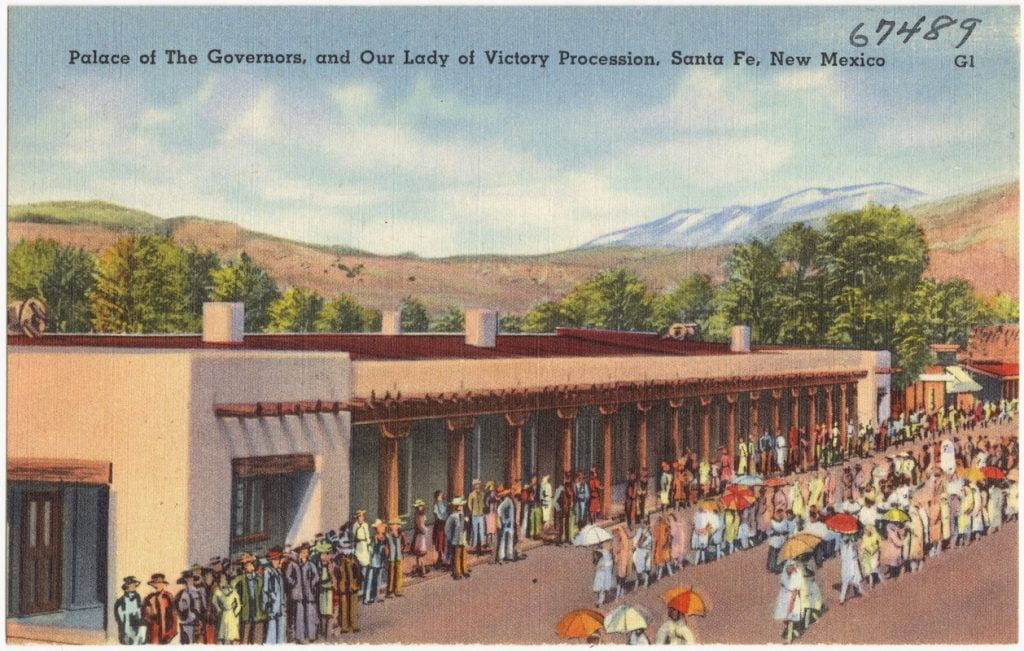
The Palace of the Governors, constructed in the early seventeenth century during Spanish colonial rule, is one of the oldest continuously occupied public buildings in the United States. By the time Wallace arrived in Santa Fe, the structure had already witnessed centuries of political change, serving Spanish, Mexican, and then American authorities. Its long adobe façade and central location on the Santa Fe Plaza made it the symbolic and practical center of governance in the territory.
When Wallace assumed office, New Mexico was a region marked by instability, lawlessness, and cultural diversity. The territory included a mix of Native American communities, Hispanic settlers, and Anglo newcomers, all navigating the shifting political realities of American expansion. Wallace’s task as governor was to bring order and stability while respecting the region’s complex cultural fabric.
From his office in the Palace of the Governors, Wallace worked to strengthen legal institutions and assert the rule of law. One of the most famous episodes of his governorship involved the outlaw Billy the Kid. Wallace issued a proclamation offering a reward for the capture of those involved in violent crimes and later entered into negotiations with Billy the Kid, promising leniency in exchange for testimony in a murder case. Although the agreement ultimately fell apart, the episode highlighted Wallace’s pragmatic approach to governance in a challenging environment.
The Palace also served as a place where Wallace engaged in diplomatic and administrative duties, meeting with local leaders and addressing the concerns of a diverse population. His efforts to promote fairness and order were not always successful, but they reflected a genuine attempt to govern responsibly in a territory undergoing rapid change.
Despite the demands of his office, Wallace continued his literary work during his time in Santa Fe. It was while serving as governor, in part, that he developed ideas that would later contribute to Ben-Hur: A Tale of the Christ, the novel that would bring him lasting fame. The contrast between the rugged frontier life of New Mexico and the historical and spiritual themes of his writing illustrates the breadth of his interests and abilities.
The legacy of Wallace’s time at the Palace of the Governors is multifaceted. On one hand, he is remembered for his efforts to impose order in a turbulent region and for his involvement in some of the most colorful episodes of Western history. On the other, his tenure reflects the broader challenges of governing a frontier territory during a period of national expansion.
Today, the Palace of the Governors operates as a museum and historical site, preserving the building’s long and varied history. Visitors can explore exhibits that cover its Spanish colonial origins, its role in territorial governance, and its place in American history. Wallace’s tenure is an important part of this narrative, connecting the building to a figure whose life spanned military service, literature, and public office.
In conclusion, Lew Wallace’s association with the Palace of the Governors represents a significant chapter in both his life and the history of New Mexico. The building provided the setting for his efforts to bring order to the territory and remains a lasting symbol of the complex and layered history of the American Southwest.
♦ _____ ♦
From the website:
The Palace of the Governors
Situated on the north side of the historic Santa Fe Plaza, the Palace of the Governors is a beloved icon, complex symbol, and anchor for the New Mexico History Museum.
Dating back to 1610, the Palace is the oldest public building in continuous use constructed by European settlers in the continental United States. Built by the Spanish for colonial administration, the structure has been extensively modified over the centuries to meet changing needs and stylistic interests. In addition to Spanish colonial life, the Palace has associations with the Pueblo Revolt (1680–1692), a brief period of Mexican rule (1821–1848), settlement as an American territory (1848–1912), and statehood for New Mexico (1912–present).
In 1909 the building was designated as the home for the Museum of New Mexico. To reinforce its connections with earlier cultures the building was renovated using features drawn from local building traditions. The resulting Spanish-Pueblo Revival style helped influence the architectural character of Santa Fe and much of the state. With a few minor changes, this is the Palace of the Governors we see today.
In recognition of its historical and architectural significance, this modest one-story adobe structure has been designated a National Historic Landmark. In 2015 it was also recognized as a National Treasure by the National Trust for Historic Preservation.
For many visitors to Santa Fe, the Palace is best known for its block-long portal where Native American artisans sell handmade jewelry and other crafts. Behind the adobe walls, visitors can find interpretive galleries, the Palace Press, and a large courtyard that connects with the rest of the museum campus. Although work has been done to improve heating and cooling, lighting, and visitor access, care has been taken to maintain the building’s historic character.
Except for special occasions, access to the Palace is through the Lincoln Street entrance to the New Mexico History Museum.
_____
Image Source/Credit:
• Boston Public Library, Public domain, via Wikimedia Commons
Related
Sorry, no records were found. Please adjust your search criteria and try again.
Sorry, unable to load the Maps API.