
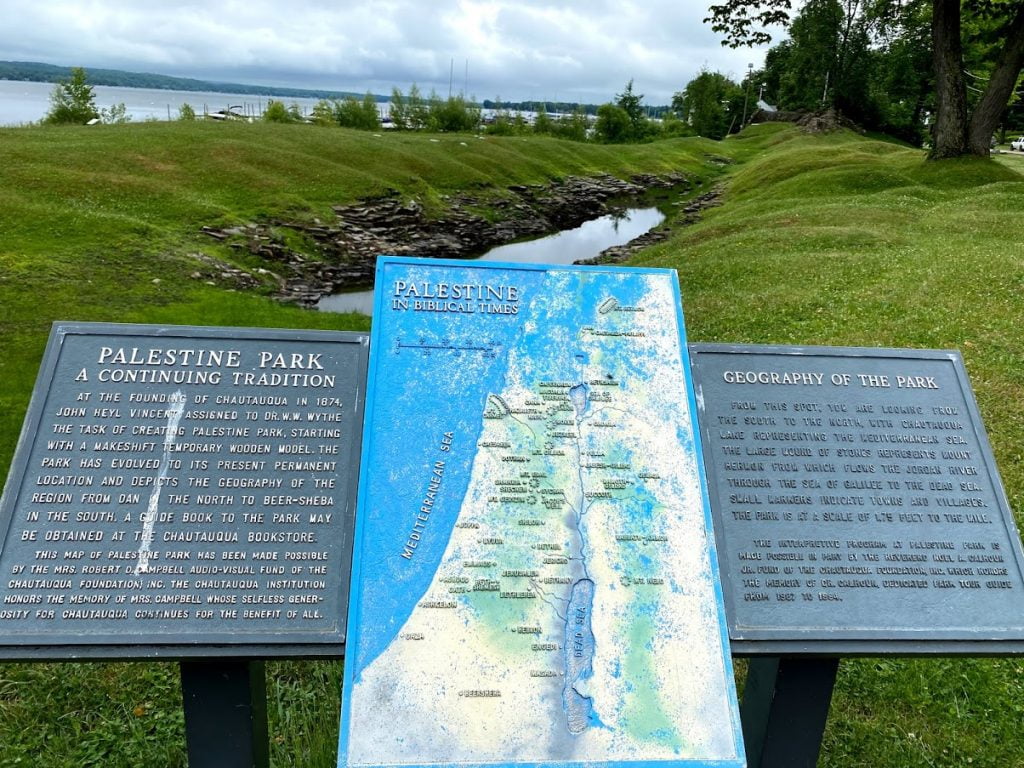
Palestine Park is a unique historical and educational attraction located within the grounds of the Chautauqua Institution in western New York State. Designed in the late nineteenth century, the park is a full-scale model of the Holy Land as it was understood in biblical geography, offering visitors a physical representation of the landscapes described in Scripture.
The park was developed during the height of the Chautauqua movement, a broader educational and religious initiative that began in the 1870s along Chautauqua Lake. This movement sought to combine education, moral instruction, and cultural enrichment in a rural retreat setting. Palestine Park was created as part of this vision, giving visitors an opportunity to visualize the geography of the Bible in a hands-on and immersive way.
At its core, Palestine Park is a carefully arranged landscape featuring miniature topographical representations of key biblical regions. The design includes bodies of water, hills, and pathways that correspond to locations such as the Mediterranean Sea, the Sea of Galilee, and the Jordan River. The layout was intended to help visitors better understand the setting of biblical events, particularly those found in the Old and New Testaments. By walking through the park, guests could symbolically trace the journeys of biblical figures in a way that textbooks alone could not provide.
One of the most distinctive features of the park is its scale model of Jerusalem. This model includes representations of the ancient city’s walls, gates, and key landmarks. For many visitors in the late nineteenth and early twentieth centuries, this offered a rare visual aid for understanding the historical and spiritual significance of the city. The model was not intended to be archaeologically exact by modern standards but rather educational and interpretive, reflecting the knowledge and scholarship of its time.
Palestine Park also reflects the educational philosophy of the Chautauqua movement, which emphasized experiential learning. Instead of relying solely on lectures or written materials, organizers believed that physical engagement with ideas could deepen understanding. In this sense, the park functioned as an outdoor classroom, where geography, history, and theology intersected.
Visitors to the Chautauqua Institution would often tour Palestine Park as part of a broader program that included lectures, religious services, and cultural events. The park became especially popular among Sunday school groups and church organizations, who used it as a teaching tool for biblical education. Its combination of recreation and instruction made it a memorable feature of the Chautauqua experience.
Over time, Palestine Park has been preserved as part of the institution’s historic landscape. While educational methods have evolved, the park remains a valued heritage site, reflecting both the religious enthusiasm and pedagogical creativity of its era. It stands as a reminder of a time when educators sought to bring Scripture to life through tangible, physical environments.
Today, visitors to the Chautauqua Institution continue to walk through Palestine Park, experiencing it much as earlier generations did. Though modest in scale, the park carries significant historical meaning, representing a period when faith and education were closely intertwined in American cultural life.
In sum, Palestine Park is more than a landscaped curiosity; it is a testament to the Chautauqua movement’s commitment to learning, imagination, and spiritual reflection. It preserves a distinctive approach to biblical education, one that sought to make ancient history accessible by placing it quite literally within reach of those who came to explore it.
Download the Guidebook to Palestine Park (1920).
_____
Image Source/Credit:
• Palestine Park Historical Marker. 19 May 2018 (www.hmdb.org/m.asp?m=117529)
Related
Sorry, no records were found. Please adjust your search criteria and try again.
Sorry, unable to load the Maps API.