

The birthplace of Ira David Sankey stands as a quiet but meaningful landmark in the history of American gospel music. Located in Edinburgh, this modest home reflects the humble beginnings of a man whose voice would one day carry the message of the gospel across continents.
Ira D. Sankey was born on August 28, 1840, into a devout Methodist family. His early life in rural Pennsylvania was shaped by simple routines—family worship, church attendance, and the steady rhythm of small-town life. It was in this setting that Sankey first developed his love for music. Though the house itself was unremarkable in size or design, it became the starting point for a life devoted to sacred song. In many ways, its simplicity mirrors the plain, heartfelt style that would later define Sankey’s ministry.
The significance of this birthplace lies not in architectural grandeur, but in what it represents. From this small beginning, Sankey rose to become one of the most influential figures in 19th-century evangelical music. He is best remembered for his partnership with Dwight L. Moody, the famed evangelist. Together, they conducted revival campaigns throughout the United States and Great Britain, drawing immense crowds. While Moody preached, Sankey sang—his rich baritone voice and sincere delivery making gospel hymns accessible and moving to ordinary people.
The home in Edinburgh serves as a reminder that Sankey’s effectiveness did not come from formal musical training or worldly prestige. Rather, it grew out of a deep personal faith and a willingness to use his natural gifts in service to God. Visitors and historians alike often reflect on how such a global influence could arise from so quiet a place. It underscores a truth long recognized in Christian history: great movements often begin in hidden corners.
Over time, the site of Sankey’s birth has been preserved and recognized for its historical value. While it may not draw the crowds of larger historic landmarks, it holds a special place for those interested in gospel music and revival history. It connects directly to a period when hymn singing played a central role in evangelism, shaping both public worship and private devotion.
Sankey’s later contributions—including the publication of hymn collections such as Sacred Songs and Solos—can be traced back to the musical impressions formed in his youth. The songs he helped popularize were marked by clarity, emotional warmth, and doctrinal simplicity, qualities that echo the environment in which he was raised. The birthplace, therefore, is more than a physical location; it is a symbol of the formative influences that shaped his life’s work.
Today, the Ira D. Sankey birthplace stands as a quiet testament to enduring faith and faithful service. It reminds us that influence is not determined by where one begins, but by how one uses what has been given. From this small Pennsylvania home came a voice that helped define an era of gospel music, leaving a legacy that continues to be felt in churches around the world.
♦ _____ ♦
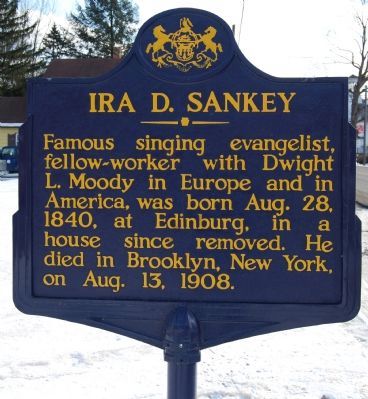
Inscription on Historical Marker:
Famous singing evangelist, fellow-worker with Dwight L. Moody in Europe and in America, was born August 28, 1840, at Edinburg, in a house since removed. He died in Brooklyn, New York, on August 13, 1908.
Hymns composed by Ira David Sankey found in Great Hymns of the Faith:
#147 – There’ll Be No Dark Valley
#157 – What a Gathering!
#219 – Grace! ‘Tis a Charming Sound
#245 – I Am Praying for You
#262 – Trusting Jesus
#263 – A Shelter in the Time of the Storm
#269 – Under His Wings
#282 – Hiding in Thee
#402 – Faith Is the Victory
_____
Image Source/Credit (in order):
• Ira D. Sankey Marker. www.hmdb.org/PhotoFullSize.asp?PhotoID=144313
• Ira David Sankey. www.hymntime.com/tch/bio/s/a/n/k/sankey_id.htm
Related
Sorry, no records were found. Please adjust your search criteria and try again.
Sorry, unable to load the Maps API.