
When planning a shoot for our TV/ program, we try to group geographically proximate locations together. It so happened that while planning an interview with the son of Singspiration founder Al Smith, nearby we found a documented site tied to the old spiritual, “The Old Time Religion.”
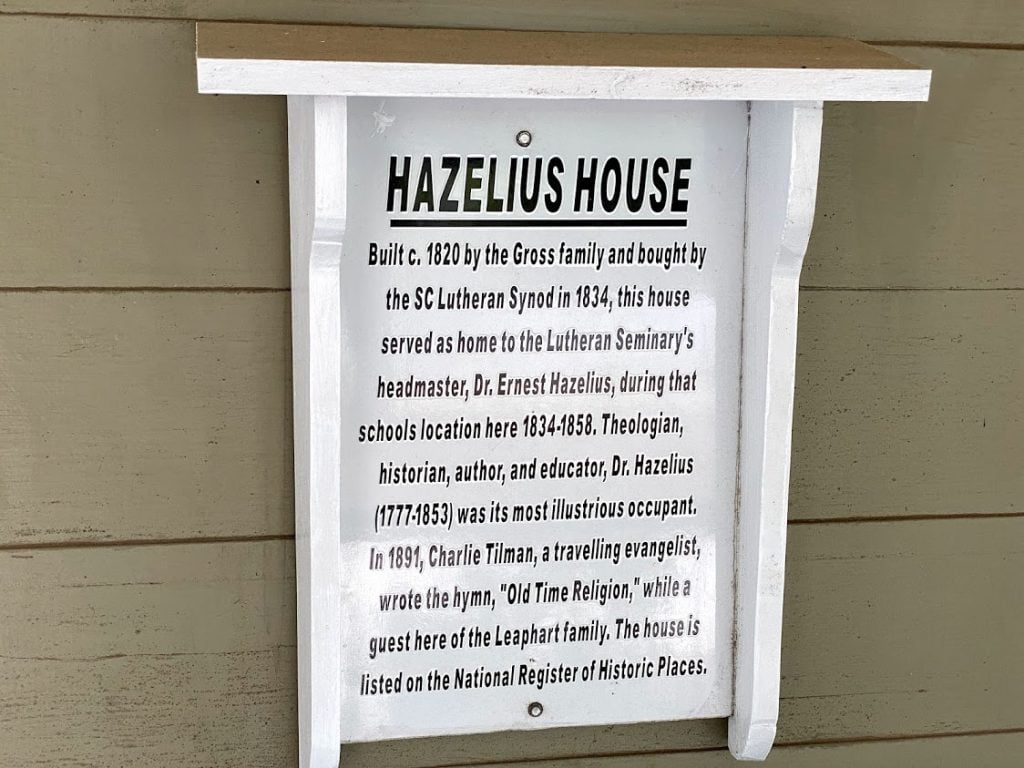
In 1834, the South Carolina Lutheran Synod purchased this building and started a seminary here. Dr. Ernest Hazelius, as headmaster, lived in the building before the Civil War. But the fame of the place comes about 40 years later, in 1889.
In 1889, the Leaphart family owned the Hazelius House, and their friend Charles Davis Tillman was staying with them. He was assisting his father, a Baptist preacher, with a tent meeting. Following their revival meeting in Lexington, South Carolina, an African-American group asked to use the tent, and the Tillmans obliged. While they were singing, the music struck the younger Tillman. He asked the song leader about the music, and the choir leader shared the song with Tillman.
“The Old Time Religion” was previously published in a different form in 1873, by the Fisk University Jubilee Singers, but Tillman was able to popularize the song, especially among white congregations.
♦ _____ ♦
Hymn History: The Old Time Religion
Compiler: Charles Davis Tillman
“His influence is felt less in individual compositions than in the tradition he helped shape.”
The Origin of the Hymn “The Old Time Religion
“The Old Time Religion” is one of the most recognizable and enduring hymns in American religious history, celebrated for its simplicity, emotional power, and deep roots in communal worship. Emerging from the rich traditions of African American spirituals in the nineteenth century, the song captures a longing for a faith that is heartfelt, experiential, and grounded in shared tradition.
The exact origins of “The Old Time Religion” are difficult to trace, as is often the case with folk hymns and spirituals passed down orally. It is widely believed to have developed among African American congregations in the post–Civil War South, where music played a central role in both religious expression and community identity. These congregations blended biblical themes with personal testimony, creating songs that were both theological and deeply emotional. “The Old Time Religion” reflects this heritage through its repetitive structure and call-and-response style, making it easy for groups to sing together and adapt spontaneously.
The hymn gained broader recognition in the early twentieth century, particularly through the efforts of music collectors and publishers. One of the most influential figures in this process was Charles Davis Tillman, a gospel song promoter who helped bring Southern religious music to a national audience. Tillman published versions of the song in his hymnals, introducing it to white evangelical congregations and expanding its reach beyond its original cultural context. This transition marked an important moment in the history of American gospel music, as songs rooted in African American experience began to influence mainstream Protestant worship.
Musically, “The Old Time Religion” is characterized by its straightforward melody and repetitive chorus: “Give me that old time religion, it’s good enough for me.” This simplicity is part of its strength. The song’s structure allows singers to add verses that reflect personal beliefs, biblical figures, or contemporary concerns. Over time, countless variations have emerged, with verses referencing figures such as prophets, apostles, and even modern believers. This adaptability has helped the hymn remain relevant across generations.
The hymn’s message centers on a desire for authenticity in faith. Rather than emphasizing formal theology or institutional authority, it celebrates a religion that is lived, felt, and experienced. This theme resonated strongly during periods of social and cultural change, when many believers sought stability and continuity. The phrase “old time religion” came to symbolize a return to perceived foundational truths and practices, especially in contrast to modernizing trends within churches.
During the twentieth century, the song became closely associated with revival meetings and evangelistic campaigns. Figures like Billy Graham often incorporated traditional hymns into their gatherings, reinforcing a sense of continuity with earlier generations of believers. In these settings, “The Old Time Religion” functioned not only as a song but as a cultural touchstone, evoking shared values and collective memory.
The hymn also found a place in American popular culture. It has been recorded and performed by numerous artists across genres, from gospel choirs to folk musicians. Its inclusion in films, recordings, and public events has further solidified its status as a piece of cultural heritage. Despite these adaptations, the core message of the song has remained intact, continuing to emphasize sincerity and devotion.
At the same time, the hymn’s history raises important questions about cultural exchange and appropriation. As it moved from African American communities into broader usage, the context in which it was created was sometimes overlooked. Modern discussions of the song often seek to acknowledge and honor its origins while appreciating its widespread influence.
Ultimately, “The Old Time Religion” endures because it speaks to a universal desire for meaning and connection. Its blend of historical depth, musical accessibility, and emotional resonance has allowed it to transcend its origins and become a lasting part of the American religious landscape.
♦ _____ ♦
Inscription
Built c. 1820 by the Gross family and bought by the Lutheran Synod in 1834, this house served as home to the Lutheran Seminary’s headmaster, Dr. Ernest Hazelius, during that school’s location here 1834-1858. Theologian, historian, author, and educator, Dr. Hazelius (1777-1853) was its most important occupant. In 1891, Charlie Tilman, a traveling evangelist, wrote the hymn, “Old Time Religion,” while a guest here of the Leaphart family. The house is listed on the National Register of Historic Places.
_____
Image Source/Credit:
• Photo Randy Melchert
Related
Sorry, no records were found. Please adjust your search criteria and try again.
Sorry, unable to load the Maps API.