
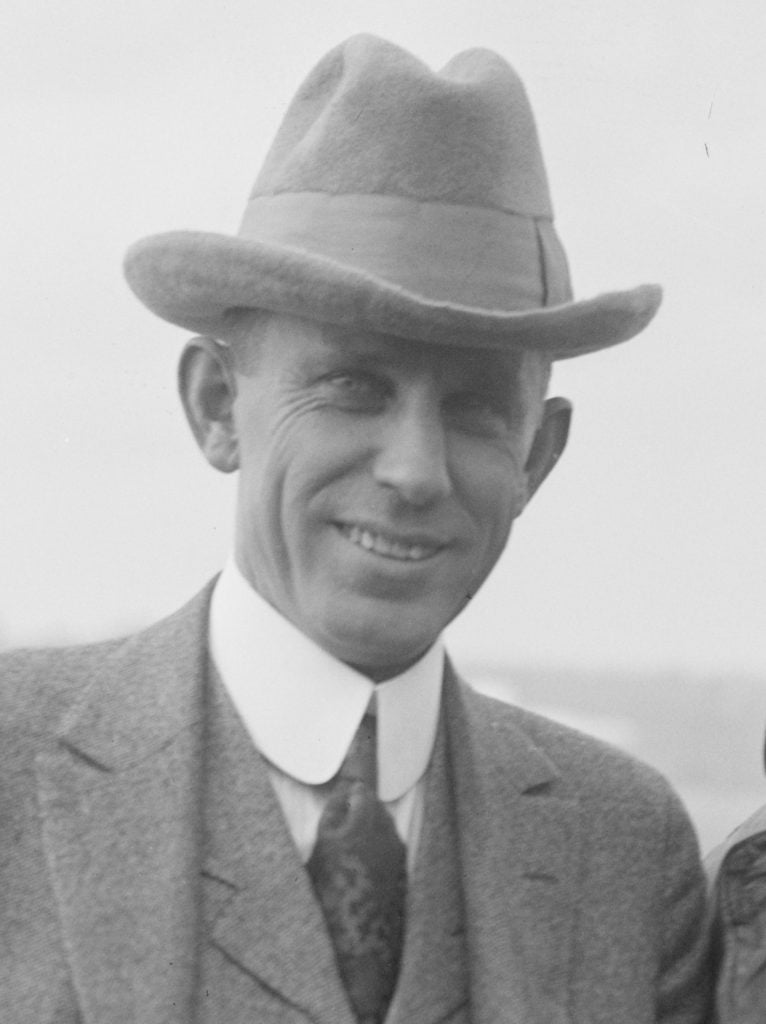
J. Frank Norris (1877–1952) was one of the most controversial and influential figures in twentieth-century American fundamentalism. A fiery preacher, church builder, and polemicist, Norris helped shape the independent Baptist movement and played a significant role in the broader fundamentalist-modernist controversy that marked his era.
John Franklyn Norris was born on September 18, 1877, in Alabama, but was raised in Texas, where his life and ministry would largely unfold. His early years were marked by hardship, including a violent incident in his youth that nearly cost him his life. This experience, along with a later religious conversion, deeply influenced his outlook and sense of calling. Norris went on to pursue ministerial training, eventually studying at Baylor University, though he did not complete a formal degree.
In 1909, Norris became pastor of the First Baptist Church of Fort Worth, Texas. At the time, the congregation was relatively small, but under his leadership it grew rapidly into a large and influential church. Norris proved to be an energetic organizer and a compelling speaker, drawing crowds with his bold preaching style and willingness to address controversial issues. He later also pastored Temple Baptist Church in Detroit, Michigan, effectively leading two major congregations simultaneously—an unusual and demanding arrangement.
Norris rose to prominence during the Fundamentalist-Modernist Controversy, a period of intense theological conflict within American Protestantism. He positioned himself firmly on the side of fundamentalism, defending what he saw as the essential doctrines of the Christian faith—such as the authority of Scripture, the virgin birth, and the bodily resurrection of Christ. At the same time, he strongly opposed modernist theology, which he believed compromised these core beliefs.
Known for his confrontational approach, Norris frequently engaged in public disputes with other religious leaders, politicians, and even civic authorities. He used his newspaper, The Searchlight, as a platform to criticize those he believed were undermining biblical truth or moral standards. His style earned him both devoted supporters and determined critics, making him a polarizing figure in religious and public life.
One of the most dramatic events associated with Norris occurred in 1926, when he was involved in the shooting death of a man named D. E. Chipps in his church office. Norris claimed self-defense, and after a highly publicized trial, he was acquitted. The incident intensified the controversy surrounding him and remains one of the most debated aspects of his life.
Despite such controversies, Norris’s influence continued to grow. He became a key figure in the development of independent Baptist churches, particularly through his emphasis on local church autonomy and separation from denominational control. His leadership contributed to the formation of networks of like-minded churches that would later become a significant force within American evangelicalism.
Norris also played a role in founding institutions for ministerial training. Among these was a seminary in Fort Worth, which aimed to prepare preachers committed to fundamentalist principles. His efforts in education reflected his desire to ensure the continuation of his theological perspective in future generations.
Another notable aspect of Norris’s ministry was his brief but significant association with John R. Rice, a fellow fundamentalist leader. Together, they worked to promote revivalism and conservative theology, though their partnership eventually ended due to disagreements. Even so, both men remained influential in shaping the direction of fundamentalist Baptist life.
Norris’s preaching was characterized by urgency, conviction, and a strong emphasis on evangelism. He held large revival meetings and placed great importance on personal conversion. His sermons often addressed social issues as well, reflecting his belief that Christianity should have a direct impact on public morality.
He continued his work actively until his death on August 20, 1952. By that time, he had spent more than four decades in ministry and had left a lasting imprint on the churches he served and the movement he helped to define.
The legacy of J. Frank Norris is complex and multifaceted. On one hand, he is remembered as a pioneer of independent Baptist fundamentalism, a man who stood firmly for his convictions during a time of theological uncertainty. His emphasis on biblical authority, evangelism, and church autonomy continues to influence many congregations today.
On the other hand, his life is also marked by controversy and conflict. His confrontational style and involvement in public disputes have led some to view his legacy more critically. Yet even his critics acknowledge the scope of his influence and the intensity of his commitment.
In the broader context of American religious history, Norris represents a particular kind of leader—one shaped by the struggles of his time and determined to defend what he believed to be essential truths. His impact can still be seen in the institutions he helped build, the movement he advanced, and the ongoing conversations about faith, authority, and the role of the church in society.
Ultimately, J. Frank Norris remains a figure who cannot be easily categorized. His life serves as both an example of passionate conviction and a reminder of the challenges that often accompany strong leadership. His legacy, for better or worse, continues to be felt in the world of Baptist and fundamentalist Christianity.
_____
Image Source/Credit:
• Bain News Service, publisher, Public domain, via Wikimedia Commons
Related
Sorry, no records were found. Please adjust your search criteria and try again.
Sorry, unable to load the Maps API.