
Berryville Baptist Church—formerly known as Buckmarsh Baptist Church—represents one of the enduring threads of Baptist history in the Shenandoah Valley of Virginia. Its story reflects both continuity and change, tracing a path from early frontier religion to an established community presence in the town of Berryville.
The church’s origins date back to around 1773, when Buckmarsh Baptist Church was organized amid the religious fervor of the Great Awakening. This period saw a surge in evangelical preaching across the American colonies, emphasizing personal conversion, the authority of Scripture, and the need for heartfelt faith. Baptist ministers, often itinerant and unordained by established authorities, found a receptive audience among settlers in western Virginia. The Buckmarsh congregation emerged from this movement, forming a body of believers committed to simple worship and congregational independence.
In its early years, the church existed in a climate where dissenting groups still felt the lingering effects of establishment under the Church of England. Baptists in Virginia were among the strongest advocates for religious liberty, often facing fines or imprisonment for preaching without official sanction. The eventual passage of the Virginia Statute for Religious Freedom marked a turning point, securing the rights for groups like Buckmarsh Baptist Church to worship freely and organize without interference.
As the region developed, so did the church. In the early nineteenth century, the growing town of Berryville became a center of local life in Clarke County. Over time, the congregation relocated from its original rural setting near Buckmarsh to Berryville itself, reflecting the shifting population and the desire to minister more effectively within the town. With this move came a new identity, and the church became known as Berryville Baptist Church, while still preserving its historical roots.
Throughout the nineteenth century, the church played a vital role in the spiritual and social life of the community. It provided a place for regular worship, biblical teaching, and fellowship, while also serving as a gathering point for important life events. Like many churches in Virginia, it endured the disruptions of the American Civil War, as the Shenandoah Valley became a contested region. Despite these challenges, the congregation continued its ministry and contributed to the rebuilding of community life in the postwar years.
In the late nineteenth and early twentieth centuries, Berryville Baptist Church expanded its ministries to meet the needs of a changing society. Sunday schools, mission efforts, and organized outreach became central features of its work. The church also maintained connections with wider Baptist associations, participating in cooperative efforts that extended its influence beyond the local level.
The impact of Berryville Baptist Church is best understood through its steady presence across generations. It has served as a place where individuals have come to faith, families have been nurtured, and community bonds have been strengthened. Its history illustrates how a congregation rooted in revival and shaped by the struggle for religious liberty can adapt to new circumstances while maintaining its core convictions.
Today, the church stands as both a historical institution and a living community of faith. Its dual identity—as the successor to Buckmarsh Baptist Church and as a central congregation in Berryville—gives it a unique place in Virginia’s religious history. The legacy of its early members, who gathered in simpler times with a shared commitment to the gospel, continues to be felt in its ongoing ministry.
In this way, Berryville (formerly Buckmarsh) Baptist Church reflects the broader story of Baptist life in America: born in revival, strengthened by liberty, and sustained by faithful community witness over time.
♦ _____ ♦
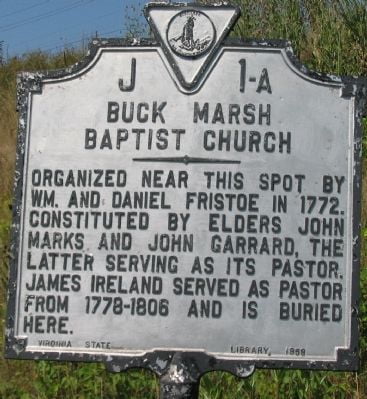
Berryville (formerly Buckmarsh) Baptist Church is at 114 Academy Street. John Gerrard (Garrard, ca. 1720-87), in 1772, constituted the Buckmarsh church. James Ireland (ca. 1745-1806) served the Buckmarsh pastorate from 1786 until his death. Ireland’s remains lie in an unknown grave in the Buckmarsh cemetery. A historical plaque marks the site where Buckmarsh Baptist once stood. The plaque is only a few yards north of the VA 7 overpass on US 340 (southbound lane), just north of Berryville. In the 1840s the Buckmarsh congregation moved into Berryville and changed their name to Berryville Baptist. Note: The marker on US 340 gives 1778 as the year Ireland began his pastorate at Buckmarsh, but a James Ireland memorial cenotaph, at Berryville Baptist Church, has a bronze plaque, giving 1786 as the date. The year 1786 is accurate, since Gerrard was pastor until near the time of his death in 1787.
Copyrighted and used by permission from David Beale, Baptist History in England and America: Personalities, Positions, and Practices
_____
Image Source/Credit:
• Photo: Buck Marsh Baptist Church Marker (www.hmdb.org/PhotoFullSize.asp?PhotoID=5125)
Related
Sorry, no records were found. Please adjust your search criteria and try again.
Sorry, unable to load the Maps API.