
Inscription
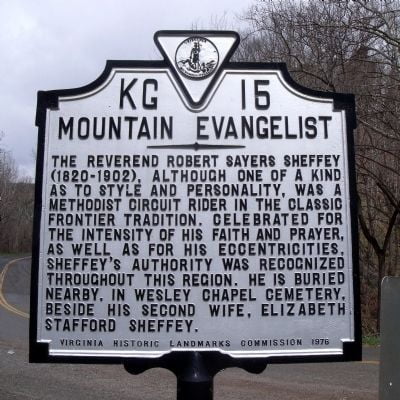
The Reverend Robert Sayers Sheffey (1820-1902), although one of a kind as to style and personality, was a Methodist Circuit Rider in the classic frontier tradition. Celebrated for the intensity of his faith and prayer, as well as for his eccentricities, Sheffey’s authority was recognized throughout this region. He is buried nearby, in Wesley Chapel Cemetery, beside his second wife, Elizabeth Stafford Sheffey.
♦ _____ ♦
The life of Robert Sheffey stands as a vivid example of the rugged, deeply personal Christianity that shaped the American frontier. Known affectionately as “Uncle Bob,” Sheffey became one of the most beloved Methodist circuit riders in the Appalachian regions of Virginia and Tennessee during the nineteenth century. His story is not one of polished sermons or theological writings, but of fervent prayer, tireless travel, and a singular devotion to the spiritual welfare of others.
Robert Sheffey was born in 1820 in Wytheville. His early years were marked by hardship, including the death of his mother when he was young. He was raised in a Christian home and exposed early to the teachings of Methodism, yet his own conversion came later, during a revival meeting. That experience profoundly changed him. From that point forward, Sheffey became known for his intense spiritual earnestness and an unusual boldness in prayer.
He attended Emory and Henry College, where he prepared for ministry. However, Sheffey never quite fit the mold of a conventional minister. Rather than settling into a single congregation, he embraced the life of a circuit rider, traveling on horseback through remote mountain communities. These regions were often isolated, with limited access to churches or regular preaching. Sheffey saw them as his field of labor.
What set Sheffey apart was not merely his willingness to travel, but his approach to ministry. He was known for his habit of stopping anywhere—homes, fields, or roadsides—to pray. Accounts of his life frequently describe him dismounting suddenly, kneeling in the dirt, and calling out to God with remarkable directness. He prayed for individuals by name, often asking for their conversion with a persistence that left a strong impression on those who heard him.
Stories of answered prayer surround Sheffey’s ministry. While such accounts are often passed down through local tradition, they consistently emphasize his faith and sincerity. Whether praying for a hardened skeptic or a struggling family, he believed firmly that God would act. This confidence gave his ministry a sense of immediacy and power that resonated deeply with frontier communities.
Sheffey’s preaching style was simple and direct. He did not rely on elaborate rhetoric or scholarly argument. Instead, he spoke plainly about sin, repentance, and salvation, urging his listeners to respond. His sermons were often accompanied by heartfelt singing, reflecting the strong connection between music and evangelism in Methodist practice. In this way, his work paralleled broader movements in American revivalism, where personal experience and emotional engagement were central.
Despite his effectiveness, Sheffey remained a humble figure. He was known for his plain dress, modest habits, and lack of concern for material comfort. Much of his life was spent in the saddle, traveling long distances in all kinds of weather. This willingness to endure hardship earned him the respect of those he served. To many, he embodied the ideal of the self-sacrificing minister.
Sheffey’s influence extended beyond the immediate results of his preaching. He helped sustain and strengthen Methodist presence in rural Appalachia at a time when organized religion could easily have faded from such क्षेत्रों. His work contributed to the shaping of a religious culture marked by earnest prayer, strong community ties, and a deep sense of personal faith.
He died in 1902, leaving behind no major written works, but a legacy preserved in stories, memories, and local histories. In later years, his life was recounted in books and even dramatized, ensuring that his example would not be forgotten. These accounts often emphasize his unwavering commitment to prayer as the defining feature of his ministry.
In reflecting on Robert Sheffey’s life, one is struck by the contrast between his simple methods and his lasting impact. He did not seek recognition or influence in the conventional sense. Instead, he devoted himself to the steady, often unseen work of spiritual care. Yet from those efforts grew a reputation that has endured for generations.
The story of Robert Sheffey serves as a reminder of a time when faith was carried on horseback into the most remote corners of the country. His life illustrates the power of conviction, the importance of perseverance, and the enduring value of personal ministry. In an age of increasing complexity, his example points back to a simpler, yet deeply rooted, expression of Christian service—one grounded in prayer, humility, and a steadfast commitment to others.
_____
Image Source/Credit:
• Photo: Mountain Evangelist Marker (www.hmdb.org/PhotoFullSize.asp?PhotoID=149071)
Related
Sorry, no records were found. Please adjust your search criteria and try again.
Sorry, unable to load the Maps API.