


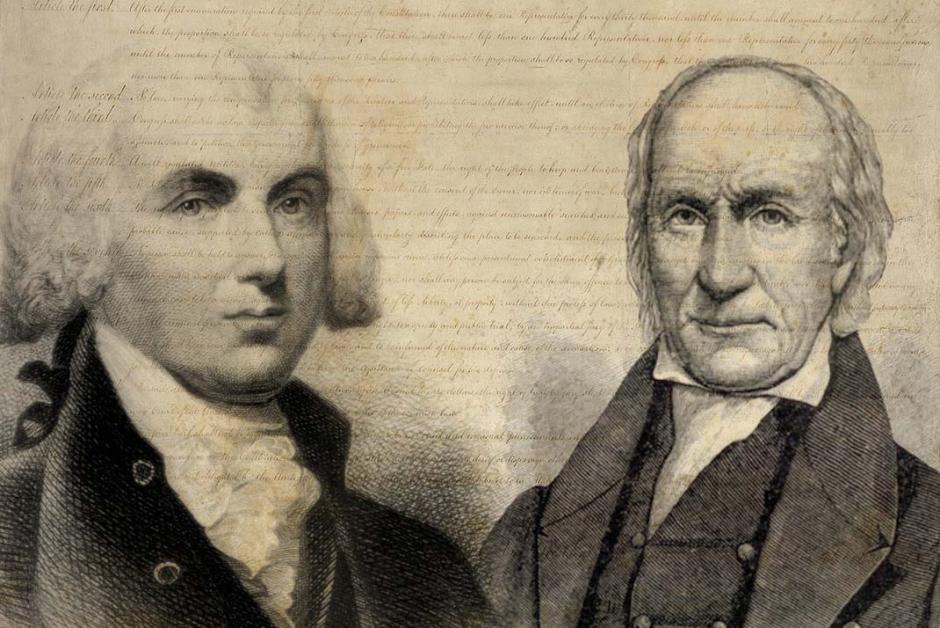
The meeting between John Leland and James Madison stands as a notable moment in the early history of American religious liberty. Though surrounded by some elements of tradition and later retelling, the encounter symbolizes a real and consequential alliance between Baptist advocates of religious freedom and the political leaders who would shape the United States Constitution.
John Leland, a prominent Baptist preacher in Virginia and later Massachusetts, was a passionate defender of liberty of conscience. He opposed any form of religious establishment, arguing that faith must be voluntary and that civil government should have no authority over the soul. At the time, many Baptists in Virginia faced legal restrictions and social discrimination under the Anglican establishment. Leland emerged as a leading voice calling for full religious freedom.
James Madison, meanwhile, was deeply involved in the formation of the new American government. A principal architect of the Constitution, he was also sensitive to concerns about individual rights, including religious liberty. However, when the Constitution was first proposed in 1787, it did not include a bill of rights, which caused concern among many citizens, including Baptists.
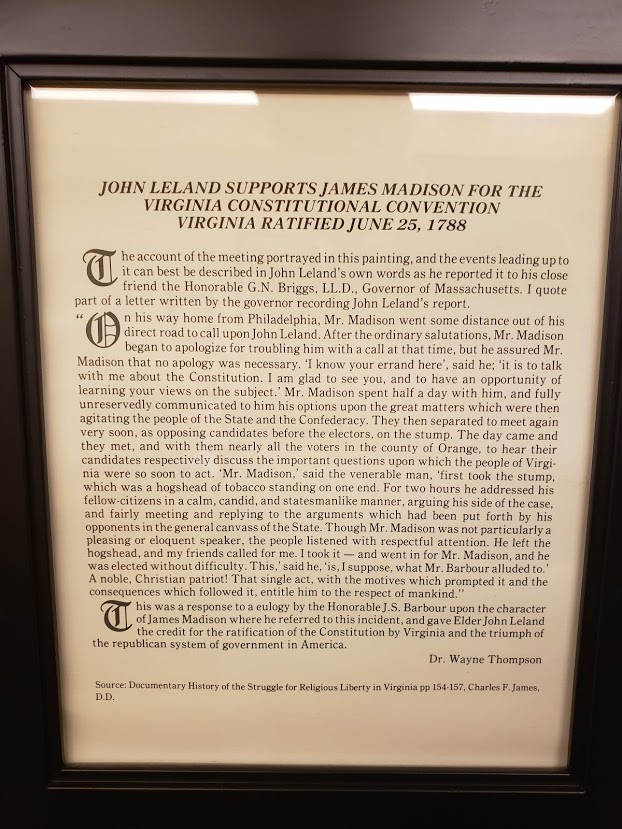
According to longstanding accounts, Leland and Madison met in 1788 in Orange County, Virginia, during the debate over whether to ratify the Constitution. Leland initially opposed ratification, fearing that without explicit protections, the new federal government might one day interfere with religious practice. Madison, seeking both support and unity, engaged with Leland and other Baptist leaders to address these concerns.
The result of this meeting—or series of discussions—was a mutual understanding. Madison pledged to support amendments that would guarantee essential liberties, including freedom of religion. In turn, Leland agreed to back Madison’s candidacy for the Virginia ratifying convention and later for Congress. This cooperation proved decisive, helping Madison secure election and strengthening support for ratification in a key state.
True to his word, Madison went on to play a leading role in drafting the United States Constitution First Amendment. Ratified in 1791, the First Amendment established that “Congress shall make no law respecting an establishment of religion, or prohibiting the free exercise thereof.” This provision reflected many of the principles long championed by Baptists like Leland—namely, that religion must be free from government control and that all individuals should be able to worship according to conscience.
While some details of the Leland-Madison meeting have been debated by historians—particularly later stories such as Leland presenting Madison with a giant cheese—the broader significance of their relationship is well established. It represents a moment when grassroots religious conviction met political leadership, producing lasting constitutional change.
The impact of this alliance has been profound. The protections secured in the First Amendment have allowed for a remarkable diversity of religious expression in the United States, setting it apart from many nations of the eighteenth century. Baptists, once a persecuted minority in some colonies, became strong supporters of the constitutional order because it guaranteed the freedoms they had long sought.
In sum, the meeting between John Leland and James Madison illustrates how principled advocacy and thoughtful statesmanship can work together to achieve lasting reform. It serves as a reminder that the freedoms enshrined in American law were not inevitable but were secured through careful negotiation, conviction, and cooperation.
♦ _____ ♦
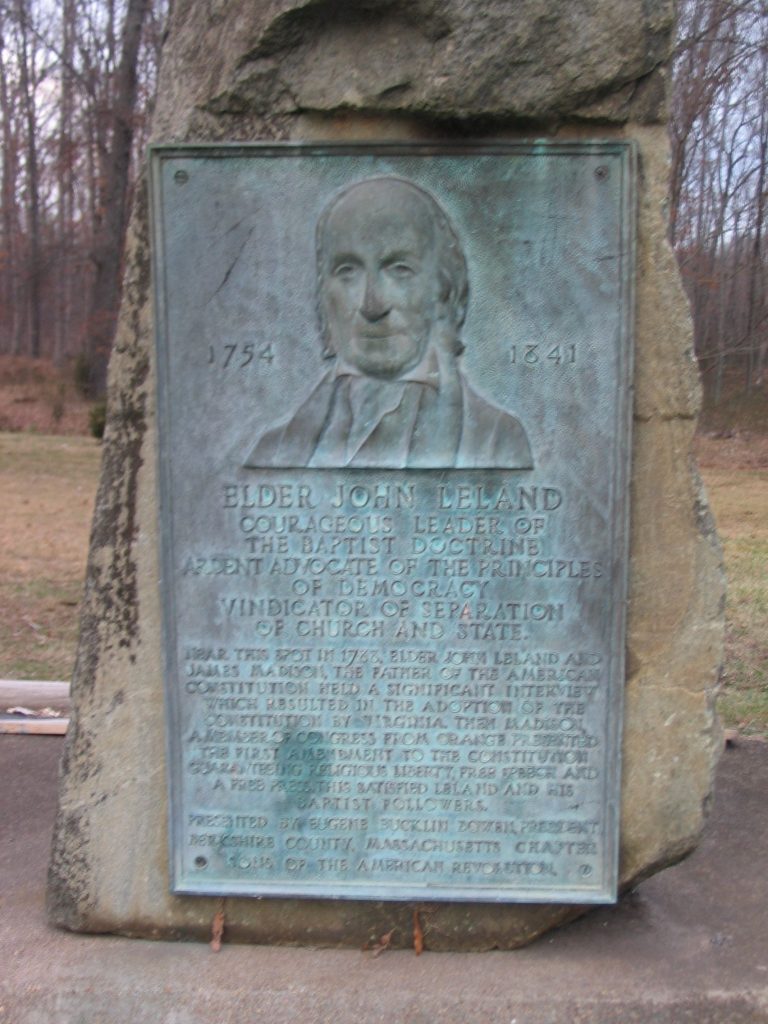
The Leland-Madison Memorial Park, six miles east of Orange, at the intersection of US 20/Constitution Highway and SR 658/Clifton Road, is the place where James Madison met in an oak grove with Baptist-Evangelist John Leland, to discuss the issue of religious freedom of conscience. This meeting led to the Bill of Rights.
Copyrighted and used by permission from David Beale, Baptist History in England and America: Personalities, Positions, and Practices
♦ _____ ♦
the Baptist Doctrine
Ardent advocate of the principles
of democracy
Vindicator of separation
of church and state.
Presented by Eugene Bucklin Dowden, President, Berkshire County, Massachusetts Chapter, Sons of the American Revolution.
_____
Image Source/Credit (in order):
• Speak Freely, Without Fear (www.libertymagazine.org/article/speak-freely-without-fear)
• Unknown
• “Leland-Madison Park.” Elder John Leland, 19 Oct. 2013 (elderjohnleland.com/leland-madison-park)
Related
Sorry, no records were found. Please adjust your search criteria and try again.
Sorry, unable to load the Maps API.