
Old Essex County Courthouse, commonly known as the 1728 Essex County Courthouse, is one of the oldest surviving courthouses in the United States and a remarkable example of colonial architecture in Virginia. Located in the historic town of Tappahannock, the building stands as a lasting witness to the legal, political, and social life of early America.
Constructed in 1728, the courthouse was built during a period when Virginia’s colonial government was expanding its local institutions. Counties served as the primary units of governance, and courthouses were central to their operation. The Essex County Courthouse was designed to accommodate not only legal proceedings but also the broader administrative functions of the county, including record-keeping, public meetings, and elections.
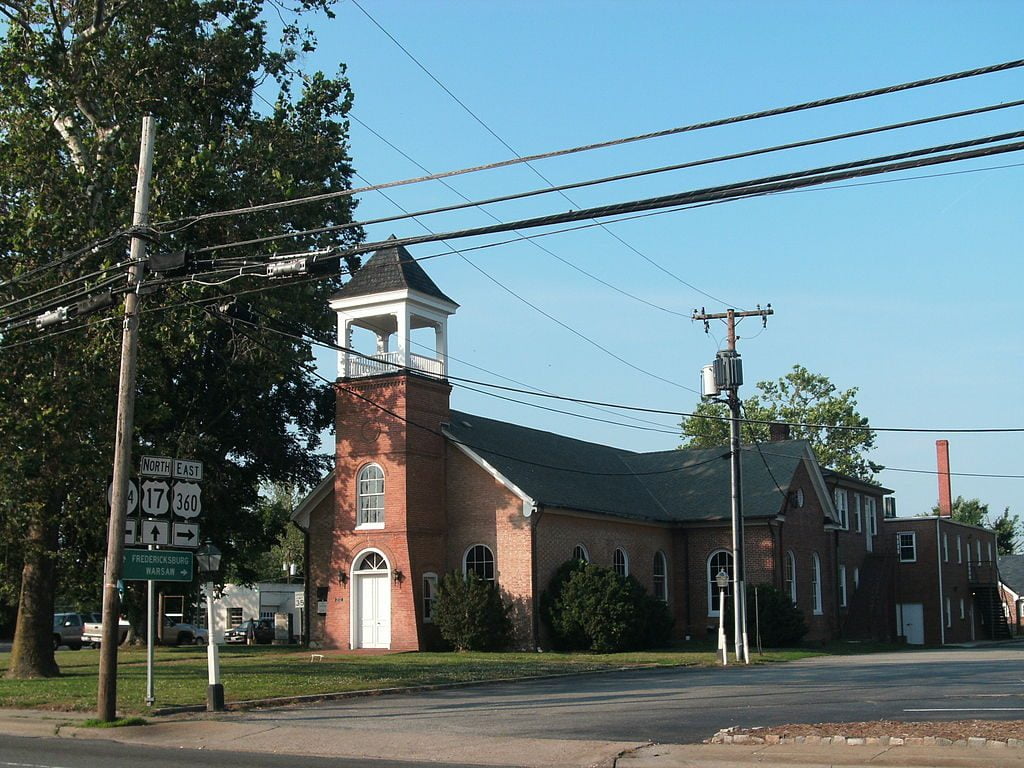
Architecturally, the building reflects the practical yet enduring style of colonial Virginia. Constructed of brick, it features a rectangular plan and a hipped roof, with a simple but dignified appearance. The use of locally made materials and skilled craftsmanship has contributed to its longevity. Unlike many structures of its time, which have been lost to fire or decay, the Essex County Courthouse has survived for nearly three centuries with relatively few alterations.
The courthouse quickly became the focal point of civic life in Essex County. Here, justices of the peace—often drawn from the local gentry—presided over cases ranging from minor disputes to serious criminal matters. The court also handled issues such as land transactions, wills, and the administration of estates. In a largely rural society, the courthouse was one of the few places where residents regularly gathered, making it both a legal and social center.
The building’s history is closely tied to the broader development of colonial Virginia. During the eighteenth century, the county court system played a crucial role in maintaining order and implementing British law in the colonies. At the same time, it reflected the hierarchical nature of colonial society, with power concentrated in the hands of a relatively small group of landowners.
As tensions grew between the American colonies and Great Britain, courthouses like the one in Essex County became sites where revolutionary ideas were discussed and debated. Although specific events at the courthouse are not always fully documented, it would have been part of the wider network of local institutions that contributed to the movement for independence.
Following the American Revolution, the courthouse continued to serve its original purpose, adapting to the needs of a new nation. It remained in use well into the nineteenth century, even as newer buildings were constructed to accommodate a growing population. Over time, its role shifted from an active center of governance to a preserved historical site.
Today, the Old Essex County Courthouse is recognized for its historical and architectural significance. It is listed on the National Register of Historic Places and is maintained as part of the county’s heritage. Visitors can view the exterior and, on certain occasions, explore the interior, gaining a sense of how justice was administered in early America.
The impact of the 1728 Essex County Courthouse lies in its remarkable continuity. Few buildings in the United States can claim such a direct connection to the colonial era while remaining largely intact. It provides a tangible link to the past, illustrating how local government functioned and how communities were organized in the early eighteenth century.
In preserving this structure, Essex County has safeguarded an important piece of American history. The courthouse stands not only as an architectural landmark but also as a symbol of the enduring role of law and governance in shaping society.
♦ _____ ♦
In 1774, Baptists in Tappahannock established the earliest Baptist church in Essex County-Piscataway (now Mt. Zion) Baptist, on Dunbrooke Road. On that same day, inside the local Essex County Courthouse, which is now the oldest courthouse building in Virginia, officials sentenced fines and imprisonments to the three men who preached the church’s opening service – John Waller, John Shackleford, and Robert Ware. Their crime was “preaching and expounding the Scriptures contrary to law.” Shackledford and Ware spent eight days in the local jail. Waller spent fourteen. This 1728 Essex County Courthouse, with its thick walls of Flemish bond brick, still stands on the corner of US 360 and US 17. In a turn of irony, from 1878 to 2007, this same courthouse would serve as a church. In 1875, Frank Brown Beale had founded Tappahannock’s Centennial Baptist Church, named for the forthcoming, one-hundredth anniversary of America’s founding. In 1878, the church purchased the courthouse and added a bell tower to the front. Near the location of Beale’s pulpit, magistrates had condemned Waller, Shackleford, and Ware for preaching Christ. These same dense walls, which had resounded condemnation against preaching, would reverberate the gospel for 130 years. When Frank Beale died in 1908, the church changed its name to Beale Memorial Baptist. During 2004-7, the church moved into new facilities on Tidewater Trail, just north of town, and sold the 1728 courthouse building back to Essex County.
Copyrighted and used by permission from David Beale, Baptist History in England and America: Personalities, Positions, and Practices
_____
Image Source/Credit:
• AlbertHerring, CC BY-SA 3.0 <https://creativecommons.org/licenses/by-sa/3.0>, via Wikimedia Commons
Related
Sorry, no records were found. Please adjust your search criteria and try again.
Sorry, unable to load the Maps API.