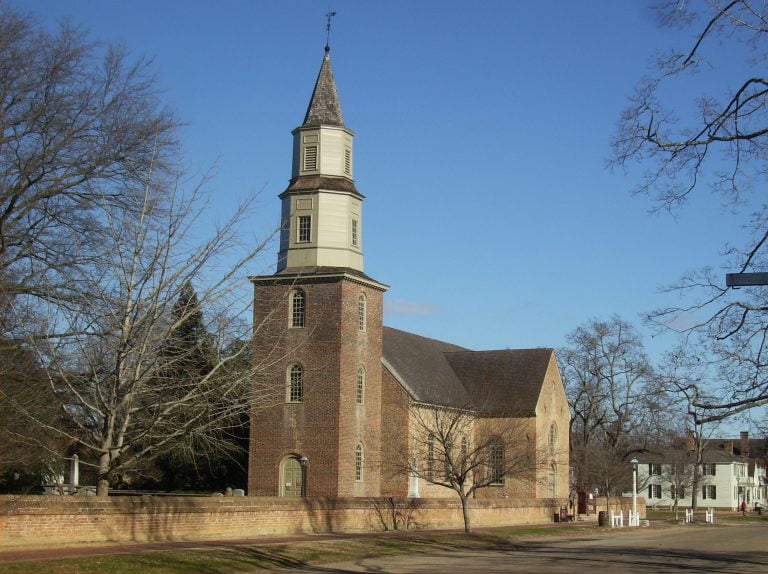
The Bruton Parish Church is one of the most historically significant churches in the United States, serving as a living link between colonial Virginia, the American Revolution, and modern American heritage. Founded in the late seventeenth century, it has stood at the center of civic, political, and religious life in Williamsburg for more than three centuries.
The parish was established in 1674 through the merger of two earlier colonial parishes, Middle Plantation and Marston Parish. It was named for the English village of Bruton in Somerset, reflecting the deep cultural and religious ties between colonial Virginia and the Church of England. The present church building was constructed beginning in 1711 under the leadership of Reverend James Blair, who also played a central role in founding the College of William & Mary. Completed in 1715, the structure quickly became the principal place of worship for Virginia’s colonial capital.
As Williamsburg developed into a political and cultural center, Bruton Parish Church became closely connected with the governing elite of the colony. Many of Virginia’s most prominent figures attended services there, including members of the House of Burgesses and leading families of the Tidewater region. The church thus functioned not only as a religious institution but also as a gathering place for civic life, where ideas and relationships that shaped colonial governance were formed.
During the eighteenth century, the church stood at the heart of the growing tensions that would eventually lead to the American Revolution. Many of Virginia’s revolutionary leaders, including George Washington, Thomas Jefferson, and Patrick Henry, had ties to the parish through their families or attendance. While the church itself remained formally Anglican until the disestablishment of the Church of England in Virginia, its congregation included individuals who would become central to the cause of independence.
The Revolution brought significant changes to Bruton Parish Church. With the end of Anglican establishment, the church transitioned into what would become the Episcopal tradition in the United States. Despite the political upheaval, the building itself remained intact and continued to serve as a place of worship. Its survival through the war and the relocation of the capital to Richmond preserved it as one of the few remaining structures from colonial Williamsburg.
Architecturally, the church reflects the simplicity and dignity characteristic of early Georgian design. Built of brick with a modest steeple added in later years, it embodies the restrained elegance of colonial ecclesiastical architecture. Over time, restorations have sought to preserve its historic character while maintaining its active role as a parish church.
In the twentieth century, Bruton Parish Church became an integral part of the restoration of Colonial Williamsburg, one of the most ambitious historic preservation projects in the United States. Under the leadership of the Colonial Williamsburg Foundation, the church was carefully restored to reflect its eighteenth-century appearance while continuing to function as a living congregation. This dual role—as both historic site and active parish—distinguishes it from many other colonial-era buildings.
Today, Bruton Parish Church remains an active Episcopal congregation, welcoming worshippers and visitors from around the world. Its services continue a tradition of nearly uninterrupted worship since the early eighteenth century. At the same time, it serves as a powerful educational resource, offering insight into the religious, political, and cultural life of colonial Virginia.
In sum, Bruton Parish Church stands as a remarkable testament to continuity amid change. It has witnessed the rise of a colony, the birth of a nation, and the evolution of American religious life. Its enduring presence reflects both the stability of faith and the enduring significance of history preserved in place.
♦ _____ ♦
From 5 Minutes In Church History:
Stephen Nichols (SN): We are on location in Colonial Williamsburg. I’m here with a good friend of ours, Dr. Steve Lawson.
Steve Lawson (SL): Steven, it’s great to be with you. I can’t believe where we are right now.
SN: We find each other in great spots, don’t we?
SL: That’s right.
SN: Something happened here on December 16, 1739. What happened?
SL: The grand evangelist himself, the grand itinerant, George Whitefield, came to Bruton Parish Church and preached a powerful evangelistic message right here.
_____
Image Source/Credit:
• Michael Kotrady, CC BY-SA 3.0 <https://creativecommons.org/licenses/by-sa/3.0>, via Wikimedia Commons
Related
Sorry, no records were found. Please adjust your search criteria and try again.
Sorry, unable to load the Maps API.