Dwight D. Eisenhower and Billy Graham formed one of the most influential partnerships between political leadership and religious life in twentieth-century America. Their relationship, which developed during Eisenhower’s presidency in the 1950s, reflected a broader cultural moment in which faith, patriotism, and public life were deeply intertwined.
Eisenhower, a five-star general during World War II, entered the presidency in 1953 with immense public trust but relatively undefined personal religious commitments. Although he had been raised in a religious household, he was not baptized until shortly after taking office. Billy Graham, already a nationally known evangelist by that time, played a subtle but significant role in shaping Eisenhower’s public expression of faith. Graham’s message of moral clarity, spiritual renewal, and national purpose resonated strongly with Eisenhower’s vision of American identity during the Cold War.
The Cold War context is essential to understanding their connection. The ideological struggle between the United States and the Soviet Union was often framed as a moral and spiritual conflict. Communism was widely portrayed in American discourse as atheistic and opposed to religious freedom. Eisenhower embraced this framing, and Graham reinforced it in his preaching. Together, they helped cultivate the idea that American democracy was grounded in religious belief.
This partnership had tangible effects on American civic life. During Eisenhower’s presidency, several religious elements were incorporated into national traditions. In 1954, the words “under God” were added to the Pledge of Allegiance. Two years later, “In God We Trust” was adopted as the national motto and began appearing on U.S. currency. While these decisions involved Congress and reflected broader public sentiment, Graham’s influence and Eisenhower’s receptiveness to religious language played a role in shaping the climate in which such changes occurred.
Graham’s access to Eisenhower was notable but often discreet. He was not an official advisor, yet he was invited to the White House and consulted on matters where faith intersected with public life. Importantly, Graham maintained a level of respect for the boundaries between church and state. He later reflected that he tried not to exploit his proximity to political power, even as he sought to encourage leaders to embrace spiritual principles.
Eisenhower, for his part, viewed religion as a unifying force rather than a divisive one. He famously remarked that the American form of government made no sense unless it was founded in a deeply felt religious faith—though he also emphasized that the specific denomination was less important than the presence of belief itself. This inclusive but faith-centered perspective aligned well with Graham’s broadly ecumenical approach to evangelism.
Their relationship set a precedent for future interactions between American presidents and religious leaders. While later figures would navigate this dynamic in different ways, the Eisenhower-Graham era marked a turning point in the public visibility of faith in the presidency.
In retrospect, the connection between Eisenhower and Graham illustrates how personal relationships can influence national culture. At a time of global tension and domestic change, their shared emphasis on faith helped shape the moral language of American politics in enduring ways.
♦ _____ ♦
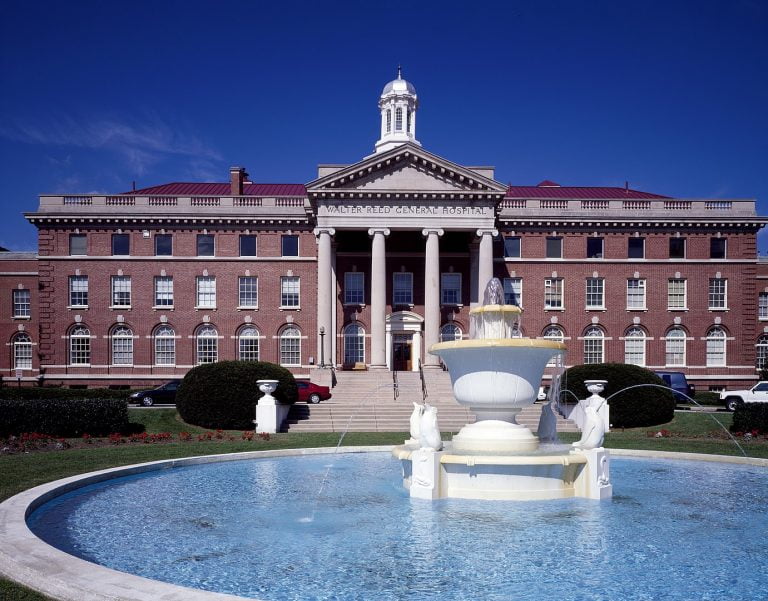
Years down the road, Graham met with Eisenhower at Walter Reed Hospital a few months before the president passed away. Graham recalls the conversation in his autobiography, “Just As I Am”:
“As my scheduled twenty minutes with him extended to thirty, he asked the doctor and nurses to leave us. Propped up on pillows amidst intravenous tubes, he took my hand and looked into my eyes. ‘Billy, you’ve told me how to be sure my sins are forgiven and that I’m going to Heaven. Would you tell me again?’
I took out my New Testament and read to him the familiar Gospel verses, the precious promise of God about eternal life. Then, my hand still in his, I prayed briefly.
‘Thank you,’ he said. ‘I’m ready.’”
_____
Image Source/Credit:
• Library of Congress, Public domain, via Wikimedia Commons
Related
Sorry, no records were found. Please adjust your search criteria and try again.
Sorry, unable to load the Maps API.