The relationship between Daniel Sickles and Abraham Lincoln offers a striking window into the complexities of leadership, politics, and personality during the American Civil War. Both men were prominent figures in Union efforts, yet they came from very different backgrounds and embodied contrasting styles of authority.
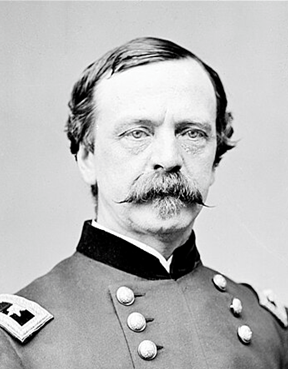
Daniel Sickles was one of the most unconventional generals in the Union Army. Before the war, he had built a reputation as a controversial New York politician, even standing trial for murder after killing his wife’s lover in 1859—a case in which he was acquitted using the first successful temporary insanity defense in U.S. history. Despite his lack of formal military training, Sickles leveraged his political connections to secure a commission as a general when the Civil War broke out.
Abraham Lincoln, by contrast, rose from humble beginnings to become president at one of the nation’s most perilous moments. Though he also lacked extensive military experience, Lincoln approached leadership with humility, strategic patience, and a willingness to learn. As commander-in-chief, he faced the daunting task of managing not only the war effort but also a diverse and often fractious group of generals—including figures as unpredictable as Sickles.
Their relationship was shaped largely by Lincoln’s pragmatic approach to leadership. He understood that political generals like Sickles, while not always militarily reliable, were valuable for maintaining support among key constituencies. Sickles, a Democrat loyal to the Union, helped Lincoln broaden his political base at a time when unity in the North was essential. Lincoln tolerated, and at times even defended, such figures despite their shortcomings on the battlefield.
The most famous episode involving Sickles came during the Battle of Gettysburg in July 1863. Against orders from his superior, General George G. Meade, Sickles moved his III Corps from a strong defensive position to more exposed ground. This decision created a vulnerable salient in the Union line that Confederate forces quickly exploited. The resulting fighting was intense, and Sickles’ corps suffered heavy casualties. Sickles himself was severely wounded, losing a leg to a cannonball.
Lincoln’s response to Sickles after Gettysburg reflects his nuanced leadership style. Rather than publicly condemning him, Lincoln allowed the situation to be handled through military channels while maintaining broader focus on the war’s outcome. Sickles, for his part, later attempted to deflect blame for the near-disaster at Gettysburg onto Meade, engaging in a long-running campaign to reshape public perception of the battle. This behavior underscored his political instincts but also his controversial nature.
Despite these tensions, Sickles remained a symbol of the complicated alliance between politics and military command in the Union war effort. Lincoln’s willingness to work with such figures demonstrated his recognition that winning the war required more than battlefield success; it demanded political cohesion and careful management of personalities.
In the end, the connection between Daniel Sickles and Abraham Lincoln highlights the challenges of leadership during crisis. Lincoln’s ability to balance principle with pragmatism allowed him to navigate relationships with difficult subordinates, while Sickles’ career serves as a reminder of the unpredictable human element in history. Together, their stories illuminate the broader struggle to preserve the Union and define the nation’s future.
♦ _____ ♦
General Sickles: “Well, Mr. President, I beg pardon, but what did you think about Gettysburg? What was your opinion of things while we were campaigning and fighting up there?”
“O,” replied Mr. Lincoln. “I didn’t think much about it. I was not much concerned about you!”
“You were not?” rejoined Sickles, as if amazed. “Why, we heard that you Washington folks were a good deal excited, and you certainly had good cause to be. For it was ‘nip and tuck’ with us a good deal of the time!”
“Yes, I know that. And I suppose some of us were a little ‘rattled.’ Indeed, some of the Cabinet talked of Washington’s being captured, and ordered a gunboat or two here, and even went so far as to send some government archives abroad, and wanted me to go, too, but I refused. Stanton and Welles, I believe, were both ‘stampeded’ somewhat, and Seward, I reckon, too. But I said: ‘No, gentlemen, we are all right and we are going to win at Gettysburg;’ and we did, right handsomely. No, General Sickles, I had no fears of Gettysburg!”
“Why not, Mr. President? How was that? Pretty much everybody down here, we heard, was more or less panicky.”
“Yes, I expect, and a good many more than will own up now. But actually General Sickles, I had no fears of Gettysburg, and if you really want to know I will tell you why. Of course, I don’t want you and Colonel Rusling here to say anything about this — at least not now. People might laugh if it got out, you know.. But the fact is, in the very pinch of the campaign there, I went to my room one day and got down on my knees, and prayed Almighty God for victory at Gettysburg. I told Him that this was His country, and the war was His war, but that we really couldn’t stand another Fredericksburg or Chancellorsville. And then and there I made a solemn vow with my Maker, that if He would stand by you boys at Gettysburg, I would stand by Him. And after thus wrestling with the Almighty in prayer, I don’t know how it was, and it is not for me to explain, but, somehow or other, a sweet comfort crept into my soul, that God Almighty had taken the whole business there into His own hands, and we were bound to win at Gettysburg! And He did stand by you boys at Gettysburg, and now I will stand by Him. No, General Sickles, I had no fears of Gettysburg”
Mr. Lincoln said all this with great solemnity and impressiveness, almost as Moses might have spoken when he came clown from Sinai.
_____
Image Source/Credit:
• Library of Congress Prints and Photographs Division, Public domain, via Wikimedia Commons
Related
Sorry, no records were found. Please adjust your search criteria and try again.
Sorry, unable to load the Maps API.