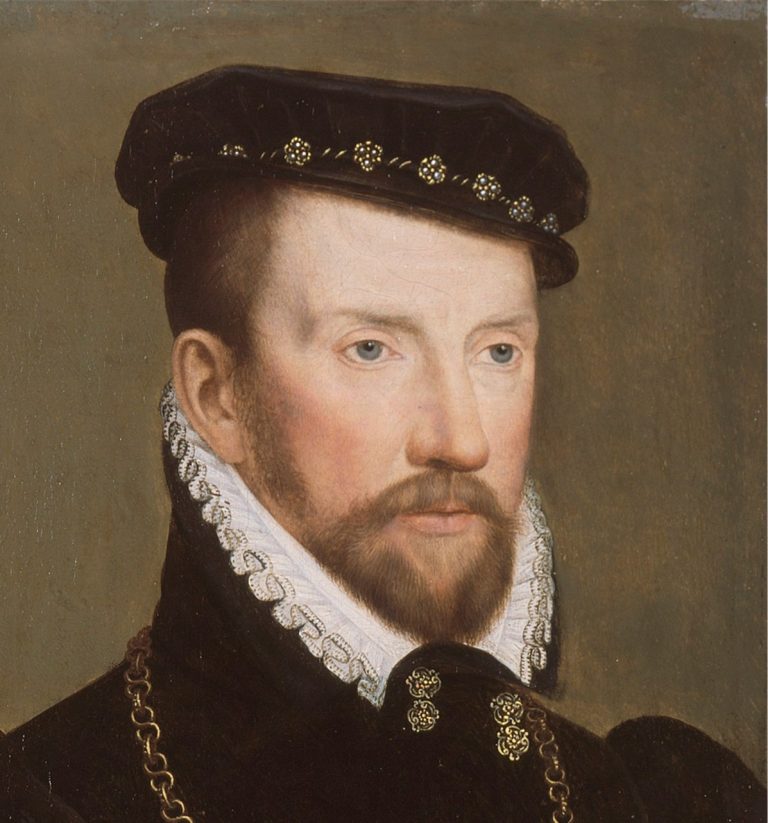
One of the first victims of the St. Bartholomew’s Day Massacre, was Gaspard de Coligny of Châtillon. His great grandson would be the King of England. Wounded in battle and later knighted, he became Colonel-General of the infantry. His brother Andelot, a recent Protestant convert, sent Coligny a devotional book that appeared to contribute to Coligny’s own conversion. Coligny’s efforts for toleration for the Huguenots (French Protestants) appeared to be rewarded in January 1562 with the Edict of Saint-Germain, however by August 24, 1572, he was assassinated.
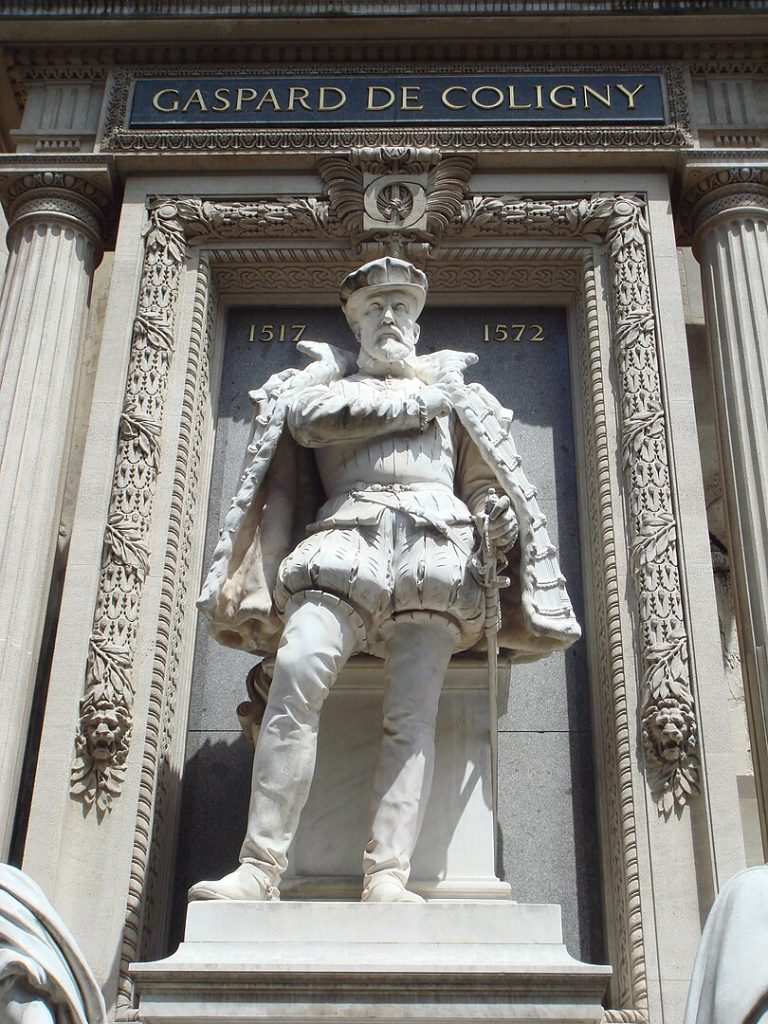
The monument is in the Oratoire du Louvre, given by Napoleon to the Protestants to replace Saint-Louis-du-Louvre, the first Protestant church building in Paris, that was torn down for the expansion of the Louvre.
♦ _____ ♦
The life of Gaspard de Coligny stands as one of the most compelling and tragic narratives of the French Wars of Religion. Born on February 16, 1519, into a noble family of Châtillon-sur-Loing, Coligny rose to prominence as both a military leader and a statesman during one of the most turbulent periods in French history.
Coligny was the son of Gaspard I de Coligny and Louise de Montmorency, and he grew up in a household closely connected to the French royal court. His early career was marked by loyal service to the crown. He distinguished himself as a soldier and was eventually appointed Admiral of France, a position of great authority. During these early years, he was a committed Roman Catholic, serving alongside other nobles in the interests of the kingdom.
A turning point in Coligny’s life came during the 1550s, when he encountered the teachings of the Protestant Reformation. Influenced in part by his brother, François de Coligny, and by the broader spread of Reformed theology, he embraced the Protestant faith and became a leading figure among the French Huguenots. His conversion was not merely personal; it placed him at the center of a growing religious conflict that would divide the nation.
As tensions escalated, Coligny emerged as one of the principal military and political leaders of the Huguenot cause. He fought in several of the early conflicts of the French Wars of Religion, demonstrating both courage and strategic skill. Yet he was also known for his moderation and his desire for peace. Unlike more extreme figures on either side, Coligny sought a stable coexistence between Catholics and Protestants within France.
Coligny’s influence extended beyond the battlefield. He became a trusted advisor to the young King Charles IX, urging policies that would strengthen France and promote religious tolerance. Among his proposals was a plan to support Protestant efforts abroad, particularly in opposition to Spanish power. His growing influence at court, however, aroused suspicion and hostility, especially from those who feared the spread of Protestantism.
These tensions reached a tragic climax during the events surrounding the St. Bartholomew’s Day Massacre. In August 1572, many Huguenot leaders had gathered in Paris for the wedding of Henry of Navarre (the future Henry IV) to Margaret of Valois, an event intended to promote reconciliation. Shortly after the celebrations, an attempt was made on Coligny’s life, leaving him wounded. Within days, violence erupted across the city.
On August 24, Coligny was murdered in his lodging, his body thrown from a window in a scene that has become emblematic of the massacre. His death marked the beginning of widespread killings that claimed thousands of Huguenot lives throughout France. The event shocked Europe and deepened the divisions that had already torn the country apart.
The legacy of Gaspard de Coligny is complex yet enduring. He is remembered as a man of conviction, who stood firmly for his faith in a time of great danger. At the same time, he is often regarded as a voice of moderation, seeking peace when others demanded conflict. His efforts to reconcile loyalty to the crown with commitment to religious reform reflect the difficult choices faced by many during the Reformation era.
In the centuries since his death, Coligny has been honored as a martyr by many Protestants, particularly within the Reformed tradition. His life serves as a reminder of the cost of religious division, but also of the enduring power of conscience and principle. In both his leadership and his sacrifice, Coligny left a lasting mark on the history of France and the broader story of the Reformation.
_____
Image Source/Credit (in order):
• François Clouet, Public domain, via Wikimedia Commons
• Jastrow, Public domain, via Wikimedia Commons
Related

Sorry, no records were found. Please adjust your search criteria and try again.
Sorry, unable to load the Maps API.