
Eric Liddell was known as the “Flying Scotsman” even though he was born in China. Yet when the 100 meter Olympic qualifying rounds were announced for Sunday, July 6th, 1924, Eric knew he could not participate in the race he was considered the clear favorite. Instead, on Sunday, July 6th, Eric preached the Sunday morning sermon at The Scots Kirk in Paris.
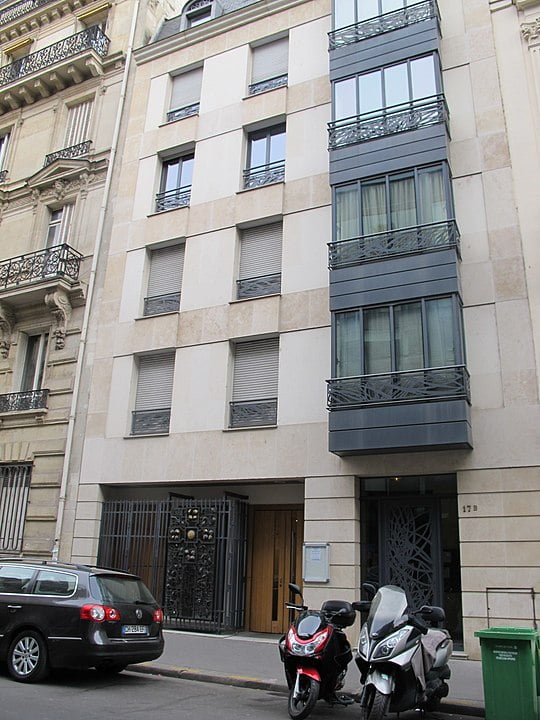
The structure was rebuilt in the 1950s and again in 2002.
♦ _____ ♦
The Scots Kirk in Paris is a historic Presbyterian church that reflects the long-standing connection between Scotland and France, as well as the enduring presence of the Scottish community in the French capital. Officially known as the Scottish Church in Paris, it has served as a place of worship, fellowship, and cultural identity for Scots living abroad and for others drawn to its distinctive heritage.
The origins of the Scots Kirk date back to the seventeenth century, when Scottish expatriates in Paris sought a place to worship according to the traditions of the Presbyterianism. This desire was rooted in the strong religious identity that had developed in Scotland following the Reformation, particularly under the influence of figures such as John Knox. As Scots traveled, studied, and conducted business across Europe, they often established congregations to maintain their religious practices.
Paris, as a major cultural and intellectual center, attracted many Scots over the centuries, including students, merchants, diplomats, and soldiers. The Scots Kirk emerged as a focal point for this community, providing not only religious services but also a sense of continuity and belonging far from home. Worship at the kirk followed the Presbyterian tradition, emphasizing the preaching of Scripture, congregational participation, and a relatively simple liturgical form.
The church’s history has not been without interruption. Periods of political and religious upheaval in France, particularly during times when Protestant worship was restricted, affected its continuity. Nevertheless, the Scots Kirk endured, reestablishing itself when conditions allowed and maintaining its connection to Scotland. Over time, it became formally linked with the Church of Scotland, ensuring its place within the wider Presbyterian family.
The current building of the Scots Kirk, located in central Paris, reflects both its historical roots and its ongoing role as an active place of worship. Architecturally, it is modest compared to many of the grand churches of Paris, yet it possesses a quiet dignity that aligns with Presbyterian values. The interior is designed to focus attention on the pulpit and the reading of Scripture, underscoring the central importance of preaching in the tradition.
Beyond its role as a church, the Scots Kirk has long served as a cultural and social hub. It hosts events that celebrate Scottish heritage, including gatherings, lectures, and commemorations. These activities help maintain a sense of identity among Scots living in France while also introducing aspects of Scottish culture to a broader audience. The kirk’s openness has made it a welcoming place not only for Scots but for people of various nationalities who appreciate its tradition and community spirit.
In the modern era, the Scots Kirk continues to adapt to the needs of an international congregation. Services are conducted in English, attracting expatriates from many countries as well as visitors to Paris. The church remains committed to its original purpose—providing worship in the Reformed tradition—while also engaging with contemporary issues and fostering a sense of community in a global city.
The legacy of the Scots Kirk lies in its ability to preserve tradition while embracing change. It stands as a testament to the enduring ties between Scotland and France, often referred to historically as the “Auld Alliance,” and to the importance of faith communities in sustaining cultural identity abroad.
In conclusion, the Scots Kirk in Paris is more than a historic building; it is a living institution that has served generations of worshippers. Through centuries of change, it has remained a place of spiritual refuge, cultural connection, and quiet continuity, reflecting both its Scottish origins and its Parisian setting.
_____
Image Source/Credit:
• Hadonos, CC BY-SA 4.0 <https://creativecommons.org/licenses/by-sa/4.0>, via Wikimedia Commons
Related
Sorry, no records were found. Please adjust your search criteria and try again.
Sorry, unable to load the Maps API.