
The Garden Tomb is one of the most visited Christian sites in Jerusalem, valued especially for its quiet setting and its association—by many Protestant believers—with the burial and resurrection of Jesus Christ. Though its identification as the actual tomb of Christ is debated, the Garden Tomb has become a place of reflection, devotion, and historical interest since the nineteenth century.
The site was first brought to wider attention in the 1800s, during a period when Western travelers and scholars were actively exploring biblical locations in the Holy Land. Interest in an alternative to the traditional site of Christ’s burial—located within the Church of the Holy Sepulchre—led some to consider this garden area just outside the ancient city walls. The Garden Tomb’s setting appeared to correspond with the biblical description found in the Gospel of John, which mentions that Jesus was buried in a garden near the place of crucifixion.
One of the most notable features near the Garden Tomb is a rocky hillside that some have identified with “Golgotha,” or the place of the skull. This interpretation was popularized by Charles Gordon in the late nineteenth century, who believed the shape of the rock face resembled a skull. His views contributed significantly to the growing interest in the site as a possible location of Christ’s crucifixion and burial.
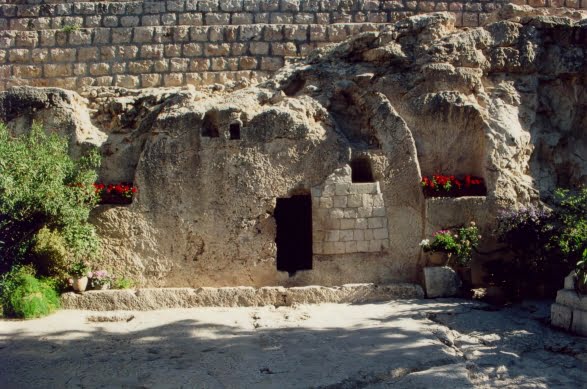
The tomb itself is a rock-cut chamber typical of ancient Jewish burial practices. It includes a low entrance and an interior space that would have held a body laid on a stone bench. Archaeological studies, however, suggest that the tomb dates to a period earlier than the time of Jesus—likely the First Temple period, several centuries before the first century. This has led many scholars to conclude that it cannot be the actual tomb described in the New Testament.
Despite this, the Garden Tomb continues to hold deep spiritual significance for many visitors. Unlike the Church of the Holy Sepulchre, which is often crowded and architecturally complex, the Garden Tomb offers a simpler and more tranquil environment. Its garden setting, with paths, flowers, and places for quiet meditation, encourages personal reflection on the events of the crucifixion and resurrection.
The site is maintained by a Christian organization known as The Garden Tomb Association, which oversees its preservation and provides guided tours. These tours typically focus on the biblical narrative of Jesus’ death and resurrection, rather than making definitive claims about the site’s authenticity. The emphasis is on the message of the gospel rather than the certainty of the location.
Visitors from around the world come to the Garden Tomb, especially during the Easter season, to remember the central events of the Christian faith. Many gather for prayer services, Scripture readings, and communion. The empty tomb serves as a symbol of the resurrection, a cornerstone of Christian belief.
The Garden Tomb also reflects the broader history of biblical archaeology and pilgrimage. It illustrates how faith, tradition, and historical investigation can intersect in complex ways. While scholars may debate its historical accuracy, its role as a place of devotion is firmly established.
In summary, the Garden Tomb in Jerusalem is both a historical site and a place of spiritual reflection. Though its claim to be the actual burial place of Christ is uncertain, its peaceful setting and strong connection to the gospel story have made it a meaningful destination for countless visitors. It stands as a reminder not only of the events it represents, but also of the enduring desire to connect physically and spiritually with the foundations of faith.
_____
Image Source/Credit:
• Phillip Benshmuel, CC BY-SA 4.0 <https://creativecommons.org/licenses/by-sa/4.0>, via Wikimedia Commons
Related
Sorry, no records were found. Please adjust your search criteria and try again.
Sorry, unable to load the Maps API.