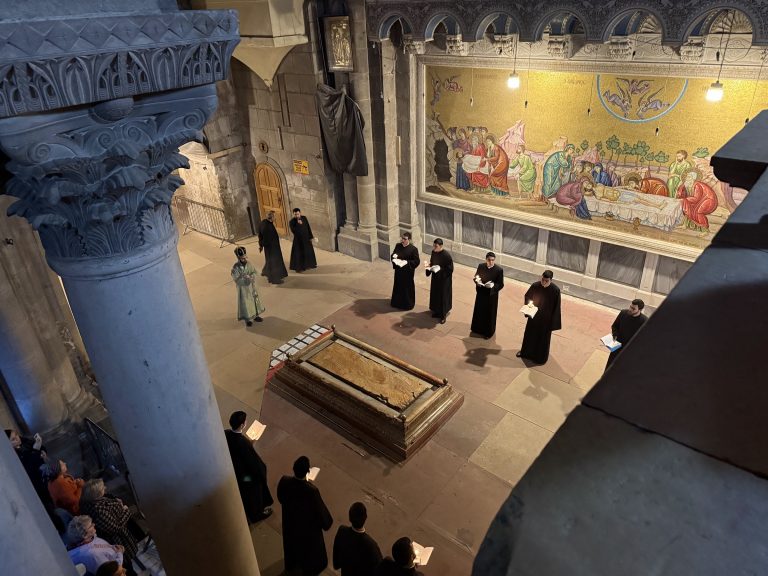
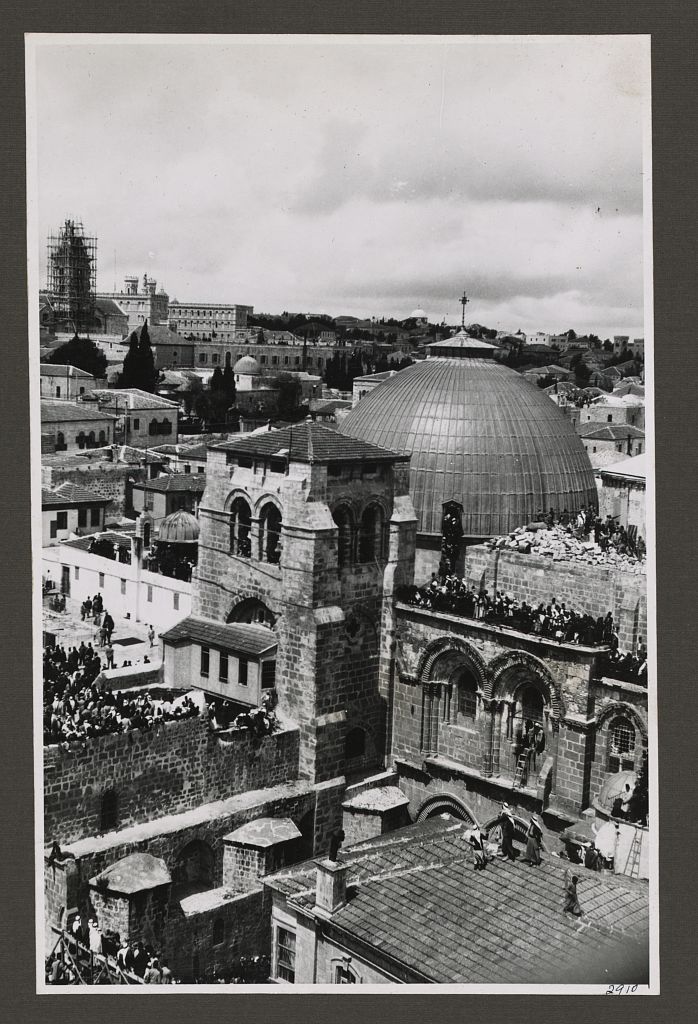
The Church of the Holy Sepulcher is the traditional site of the death, burial, and resurrection of Jesus Christ. The primary alternative site, the Garden Tomb, is preferred by evangelicals for the atmosphere but possibly predates Jesus by 5-8 centuries (Matthew 25:28 says that the tomb was a new tomb built for Joseph of Arimathea). See discussion by FIRM, and Wayne Stiles.
Following the Bar Kokhba revolts, Emperor Hadrian built a temple to Venus on the site in the 130s. Around 326, Constantine and his mother Helena identified the site as the Biblical Golgotha.
♦ _____ ♦
The Church of the Holy Sepulchre stands at the very center of Christian history and devotion. Located in the Old City of Jerusalem, it is revered as the site of the crucifixion, burial, and resurrection of Jesus Christ. Its history stretches back nearly seventeen centuries, and its legacy continues to shape Christian faith and pilgrimage to this day.
The church’s origins date to the reign of Constantine the Great in the early 4th century. After his conversion to Christianity, Constantine sought to honor the most sacred places associated with the life of Christ. His mother, Helena, journeyed to Jerusalem and identified what were believed to be the sites of Golgotha and the nearby tomb. Around AD 335, a grand church complex was completed, marking the location as a focal point of Christian worship within the Roman Empire.
From its earliest days, the Church of the Holy Sepulchre became a destination for pilgrims. Christians traveled great distances to pray at the site where they believed the central events of the Gospel had taken place. This flow of pilgrimage helped establish Jerusalem as a spiritual center for the Christian world, a role it has maintained ever since.
The church’s history, however, has not been without hardship. In 1009, it suffered extensive destruction under the Fatimid ruler al-Hakim, an event that shocked the Christian world. Subsequent rebuilding efforts, particularly during the time of the Crusaders in the 12th century, restored and expanded the structure. The present form of the church reflects these layers of history, combining elements from different periods into a single, complex whole.
One of the most notable features of the church’s history is its shared guardianship. Several Christian traditions—including Greek Orthodox, Roman Catholic, and Armenian Apostolic communities—hold rights within the building. This arrangement, known as the Status Quo, was formalized in the Ottoman period and remains in effect today. While it has occasionally led to disputes, it also serves as a unique example of coexistence centered on a common reverence for a sacred place.
The legacy of the Church of the Holy Sepulchre extends far beyond its physical structure. It has profoundly influenced Christian theology, worship, and imagination. The events commemorated within its walls—especially the resurrection—are at the heart of Christian belief. As a result, the church has inspired countless sermons, hymns, works of art, and acts of devotion throughout the centuries.
In addition, the church has played a significant role in the history of pilgrimage. For many believers, a journey to Jerusalem and the Holy Sepulchre represents a deeply personal expression of faith. Even today, pilgrims gather within its ancient walls to pray, light candles, and participate in services that connect them to a long and unbroken tradition.
Despite centuries of conflict, change, and restoration, the Church of the Holy Sepulchre endures as a powerful symbol of continuity. Its worn stones bear witness to generations of worshippers who have come seeking hope, forgiveness, and renewal. The church’s enduring presence reminds the world that faith can persist through time, bridging the past and the present.
In its history and legacy, the Church of the Holy Sepulchre stands not only as a monument of the past but as a living testimony to the enduring significance of the Christian message.
_____
Image Source/Credit (in order):
• Matson Photo Service
• Author
Related
Sorry, no records were found. Please adjust your search criteria and try again.
Sorry, unable to load the Maps API.