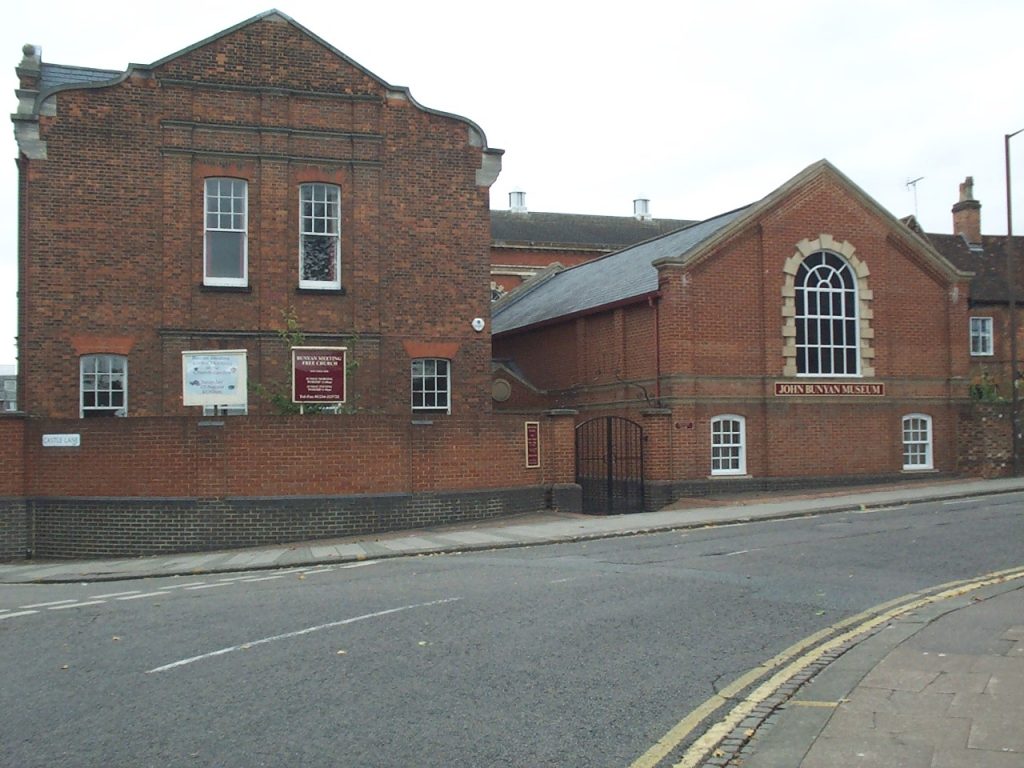
The Bunyan Meeting Free Church and the adjacent John Bunyan Museum together form one of the most important historic Nonconformist sites in Bedford. Closely associated with the life and legacy of John Bunyan, they preserve the story of a congregation shaped by religious dissent, literary achievement, and a long commitment to freedom of conscience.
The Bunyan Meeting House traces its origins to the seventeenth century, during a time when Nonconformists in England faced significant restrictions under the established Church of England. John Bunyan himself became one of the most famous voices of this movement. Born in 1628 near Bedford, Bunyan experienced a dramatic religious conversion and soon began preaching with great passion. His refusal to conform to Anglican regulations led to repeated imprisonment, most notably in Bedford jail, where he spent years writing works that would later gain worldwide recognition.
After Bunyan’s death in 1688, his followers continued to meet in Bedford, forming a congregation that would eventually become the Bunyan Meeting Free Church. The present meeting house, built in 1850, stands as a successor to these earlier gatherings. It reflects the growth and stabilization of Nonconformist worship after the passage of the Toleration Act 1689, which allowed greater freedom for Protestant dissenters.
The architecture of the Bunyan Meeting House reflects Victorian Nonconformist ideals: simplicity, dignity, and function. Unlike many Anglican churches of the period, it avoids elaborate decoration, emphasizing instead a clear and spacious interior suited for preaching and congregational worship. This design reflects the central role of the sermon in Baptist and Independent traditions, where the spoken word was considered the heart of worship.
Adjacent to the meeting house is the John Bunyan Museum, established to preserve and interpret the life and works of Bunyan and the history of the congregation. The museum contains a rich collection of artifacts, including early editions of The Pilgrim’s Progress, personal items connected to Bunyan, and historical documents related to the congregation’s development. These materials help visitors understand both the man and the movement he inspired.
One of the key strengths of the museum is its ability to connect Bunyan’s literary work with his lived experience. The Pilgrim’s Progress, written during his imprisonment, is presented not only as a literary masterpiece but also as a reflection of Bunyan’s spiritual journey and theological convictions. Exhibits explore how the allegory reflects themes of struggle, perseverance, and faith—ideas rooted in Bunyan’s own life.
The Bunyan Meeting House remains an active place of worship, continuing the tradition of the congregation that began in the seventeenth century. Services are still held, and the building functions as both a living church and a historic site. This continuity gives the location a unique character, where past and present exist side by side.
The impact of the Bunyan Meeting House and Museum lies in their preservation of both religious and literary heritage. They serve as a reminder of the struggle for religious liberty in England and of the enduring influence of Bunyan’s writings. At the same time, they highlight the importance of local congregations in shaping broader cultural and spiritual movements.
Today, visitors to Bedford can experience not only the story of John Bunyan but also the living tradition that grew from his ministry. The Bunyan Meeting House and Museum stand as enduring symbols of faith, resilience, and the power of ideas to shape generations.
_____
Image Source/Credit:
• Simon Speed, Public domain, via Wikimedia Commons
Related
Sorry, no records were found. Please adjust your search criteria and try again.
Sorry, unable to load the Maps API.