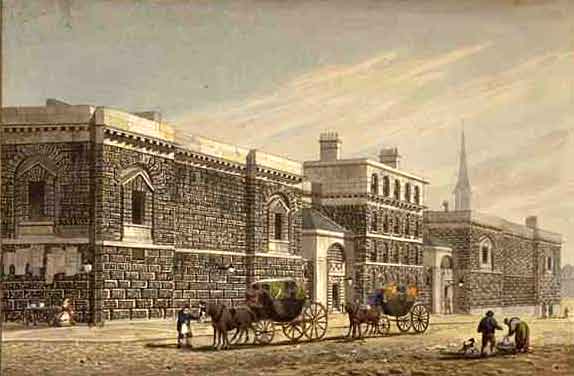
Newgate Prison was one of the most infamous prisons in London, serving as a central institution in the English system of law and punishment for over 700 years. Located near the Old Bailey, it became synonymous with crime, justice, and the harsh realities of pre-modern imprisonment.
The origins of Newgate Prison date back to the twelfth century, when it was established at the site of the New Gate, one of the main entrances through the medieval city wall of London. Its strategic location made it a convenient place for detaining prisoners awaiting trial at nearby courts. Over time, it evolved into a major holding facility for a wide range of inmates, including debtors, criminals, and political prisoners.
Throughout its long history, Newgate developed a reputation for severe and often deplorable conditions. Overcrowding was common, and prisoners were typically responsible for paying for their own food, bedding, and other necessities. Those with financial means could secure better accommodations, while the poor suffered greatly. Disease, filth, and lack of sanitation made the prison a dangerous place, where survival was never guaranteed.
Newgate was closely connected with the administration of justice in London. Prisoners held there were often brought to trial at the Old Bailey, one of England’s central criminal courts. After sentencing, those condemned to death were typically executed at Tyburn in earlier centuries and later at Newgate itself. Public executions became a spectacle, drawing large crowds and reinforcing the authority of the legal system.
The prison also played a role in England’s religious conflicts. During periods of tension, individuals who dissented from the established Church of England could be imprisoned there. Nonconformists, Catholics, and other religious figures sometimes found themselves confined within its walls for their beliefs, highlighting the intersection of law, religion, and authority in English history.
Newgate’s notoriety extended into literature and popular culture. It appeared in the works of writers such as Charles Dickens, who described the grim realities of prison life in vivid detail. These portrayals helped shape public perception of the institution and contributed to growing calls for prison reform in the nineteenth century.
Efforts to improve conditions in prisons, including Newgate, were influenced by reformers who sought more humane treatment of inmates. Despite some attempts at reform, the prison remained a symbol of an older, harsher system of justice. By the nineteenth century, changing attitudes toward punishment and incarceration led to the gradual decline of institutions like Newgate.
The prison was finally closed in 1902, and the building was later demolished. Today, the site is occupied by the Central Criminal Court, commonly known as the Old Bailey. While no physical trace of Newgate Prison remains, its history continues to be remembered as part of London’s complex past.
The impact of Newgate Prison lies in its long-standing role in the development of the English legal system and its reflection of changing attitudes toward crime and punishment. It serves as a reminder of a time when justice was often harsh and public, and when imprisonment could be as much a punishment as the sentence itself.
In retrospect, Newgate stands as both a historical landmark and a cautionary symbol. Its story illustrates the evolution of legal practices and the gradual movement toward more humane systems of incarceration. Though it no longer exists, its legacy remains embedded in the history of London and the broader development of modern justice.
♦ _____ ♦
Famous Prisoners according to Wikipedia
-
- John Bradford, religious reformer – burned at the stake at Newgate in 1555
- William Penn, religious scholar, and later the Quaker who founded the colony of Pennsylvania – held in Newgate during his 1670 trial for preaching before a gathering in the street
- John Rogers, Bible translator and religious reformer – at Newgate after conviction of heresy in 1554, and burnt at the stake in 1555[25]
_____
Image Source/Credit:
• George Shepherd (1784-1862), Public domain, via Wikimedia Commons
Related
Sorry, no records were found. Please adjust your search criteria and try again.
Sorry, unable to load the Maps API.