
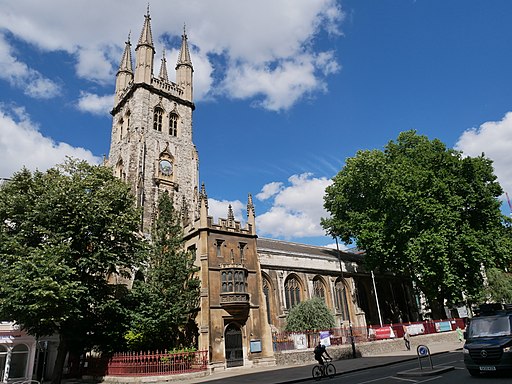
St Sepulchre-without-Newgate, often called the Church of the Holy Sepulchre without Newgate, is one of the most historically significant parish churches in London. Standing near the site of the old Newgate Prison and close to the Old Bailey, it has long been associated with the administration of justice, mercy, and the spiritual care of those facing death.
The origins of the church date back to the twelfth century, making it one of the oldest surviving churches in London. Its name reflects both its dedication to the Holy Sepulchre in Jerusalem and its location “without” (that is, outside) the former Newgate, one of the principal gates in the medieval city wall. Over the centuries, the church has undergone several rebuildings, most notably after the Great Fire of London, which destroyed much of the surrounding area. It was subsequently reconstructed under the direction of Sir Christopher Wren, though it retains elements of its earlier medieval character.
St Sepulchre’s unique role in London’s history stems largely from its close connection to Newgate Prison. For many years, the church served as the official place of worship for prisoners condemned to death. Before executions, which were often carried out at nearby Tyburn or later outside Newgate itself, prisoners were brought to the church to receive spiritual counsel. The church thus became a place where final confessions were heard and last prayers were offered.
One of the most distinctive traditions associated with St Sepulchre’s was the ringing of the “Execution Bell.” On the eve of an execution, the bellman would walk to Newgate Prison and ring the bell beneath the prisoners’ windows, reciting a solemn verse urging them to prepare for death and seek repentance. This custom, both somber and deeply symbolic, reflected the church’s role in bridging the worlds of justice and mercy.
The church also maintained a “condemned pew,” where prisoners would sit during services on the morning of their execution. From this place, they could hear sermons and prayers directed specifically toward their condition. The practice underscored the belief that even at the point of death, the opportunity for repentance and spiritual reconciliation remained open.
Beyond its connection to Newgate, St Sepulchre’s has also been linked to the musical life of London. It has long been known as the musicians’ church, with associations to the nearby Guildhall School of Music and Drama. Over time, it has hosted concerts, recitals, and memorials for those in the musical profession, adding another layer to its rich history.
Architecturally, the church is notable for its sturdy and somewhat austere design, reflecting both its medieval origins and Wren’s influence. Its interior contains monuments and memorials that speak to its long history, including tributes to individuals connected with the legal and civic life of the city.
The impact of St Sepulchre-without-Newgate lies in its unique position at the intersection of faith, justice, and society. It stands as a reminder of a time when religious institutions played a central role in public life, particularly in matters of law and punishment. Its ministry to the condemned highlights a longstanding concern for the spiritual welfare of all individuals, regardless of circumstance.
Today, the church continues as an active place of worship and a site of historical interest. Visitors are drawn to its storied past and its enduring presence in the heart of London. In its quiet way, St Sepulchre’s bears witness to centuries of human experience—marked by judgment and mercy, sorrow and hope—within the life of the city.
♦ _____ ♦
Inside the Church of St. Sepulchre without Newgate, at Holborn Viaduct, a hand bell known as the Execution Bell, resides in a glass case, situated near the entrance of a blocked-up tunnel that once connected the church with Newgate Prison. At midnight prior to execution days, the church’s bellman would walk through the tunnel and into the prison. Standing outside the cells of condemned prisoners, he would ring twelve double tolls of the bell and chant their condemnation. The church is also rich in its own history. John Rogers, once a vicar of this church, had been the first Protestant burned at the stake, during the reign of Mary Tudor. The remains of Captain John Smith, early leader at Jamestown, Virginia, lie buried in the church’s cemetery. Inside the church is a brass plaque dedicated to this famous explorer.
Copyrighted and used by permission from David Beale, Baptist History in England and America: Personalities, Positions, and Practices
_____
Image Source/Credit:
• Doyle of London, CC BY-SA 4.0 <https://creativecommons.org/licenses/by-sa/4.0>, via Wikimedia Commons
Related
Sorry, no records were found. Please adjust your search criteria and try again.
Sorry, unable to load the Maps API.