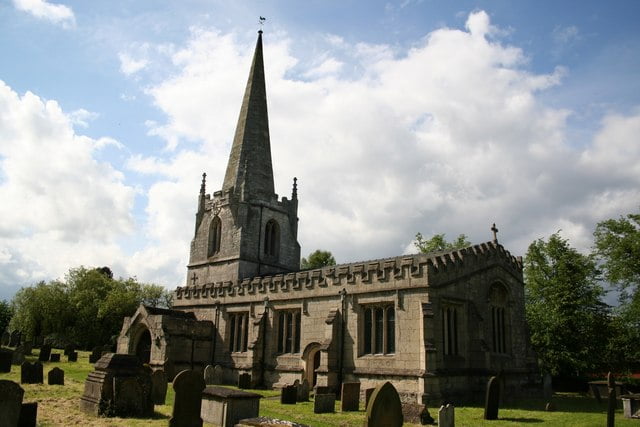
St. Wilfrid’s Church holds an important place in the early history of the English Separatist movement, from which the Pilgrims eventually emerged. Though a quiet parish church in the village of Scrooby, its story is closely connected to the struggle for religious freedom that would ultimately lead to the founding of Plymouth Colony in New England.
During the late sixteenth and early seventeenth centuries, St. Wilfrid’s Church was part of the established Church of England. Like all parish churches of the time, it operated under the authority of the crown and followed the prescribed forms of worship set out in the Book of Common Prayer. For many English believers, this structure provided stability and continuity. For others, however, it represented a system in need of reform.
Among those dissatisfied were a group of Puritans and Separatists in and around Scrooby. These individuals sought a simpler, more scriptural form of worship, free from what they viewed as lingering influences of Roman Catholic tradition. Over time, some of them came to believe that reform from within the Church of England was no longer possible. This conviction led them to separate entirely from the established church—a decision that carried serious legal and social consequences.
St. Wilfrid’s Church thus became, in a sense, the point of departure for this group. While they had once attended services there, they gradually withdrew, choosing instead to gather privately for worship. These meetings were often held in homes, most notably at Scrooby Manor, where William Brewster served as postmaster and hosted gatherings of the Separatist congregation.
Among the leaders associated with this movement were John Robinson and William Bradford. Robinson provided spiritual leadership, emphasizing the authority of Scripture and the independence of the local congregation, while Bradford would later become a key figure in the establishment of the Pilgrim colony in America. Their departure from the parish system represented a significant step toward the development of independent church life.
The separation from St. Wilfrid’s Church was not undertaken lightly. English law at the time required attendance at parish services, and those who refused could face fines, imprisonment, or worse. The decision to leave the established church was therefore both a religious and a political act, reflecting a deep commitment to conscience and conviction.
Facing increasing pressure, the Separatists eventually fled England around 1608, seeking refuge in the more tolerant climate of the Netherlands. They settled first in Amsterdam and later in Leiden, where they were able to worship freely. However, concerns about cultural assimilation and economic hardship led them to consider a further move. In 1620, a portion of the group sailed to the New World aboard the Mayflower, establishing the Plymouth Colony.
Although St. Wilfrid’s Church itself remained part of the Church of England and continued its parish life, its connection to the Pilgrims has given it lasting historical significance. It represents the starting point of a journey that would shape the development of religious liberty in America.
Today, the church stands as a reminder of the tensions and transformations of early modern England. Its quiet setting contrasts with the far-reaching consequences of the decisions made by those who once worshiped there. The story of St. Wilfrid’s Church is not one of dramatic events within its walls, but of the convictions that led people to leave them.
In this way, the church serves as a symbol of both continuity and change—rooted in the traditions of the Church of England, yet connected to a movement that helped redefine the relationship between faith and freedom.
_____
Image Source/Credit:
• Richard Croft / St.Wilfrid’s, Scrooby
Related
Sorry, no records were found. Please adjust your search criteria and try again.
Sorry, unable to load the Maps API.