
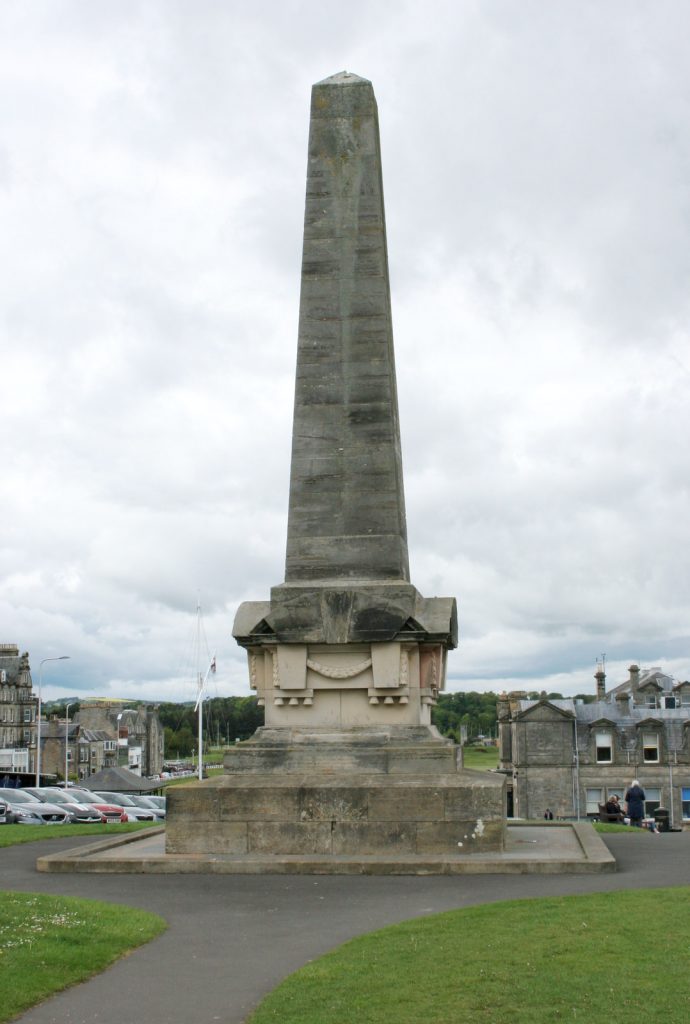
The St Andrews Martyrs’ Monument stands prominently on a cliff overlooking the North Sea in St Andrews, serving as a lasting tribute to those who suffered and died for their Protestant convictions during the Scottish Reformation. Erected in the nineteenth century, the monument commemorates several early reformers whose courage helped shape the religious identity of Scotland.
The monument is most closely associated with three key figures: Patrick Hamilton, George Wishart, and Walter Milne. Each of these men was executed in St Andrews during the sixteenth century, a time of intense religious conflict between supporters of traditional Roman Catholic authority and those advocating reform based on Scripture.
Patrick Hamilton, the earliest of the three, was burned at the stake in 1528. His execution marked the first significant martyrdom of the Scottish Reformation and had a profound effect on public opinion. George Wishart followed in 1546, preaching widely across Scotland before being arrested and executed for his teachings. Walter Milne, an elderly man at the time of his death in 1558, is often remembered as one of the last Protestant martyrs in Scotland before the Reformation took firm hold.
The idea of commemorating these men with a monument arose centuries later, during a period when there was renewed interest in preserving the memory of the Reformation. Construction of the St Andrews Martyrs’ Monument began in the 1840s and was completed in 1847. The structure was funded largely through public subscription, reflecting widespread support for honoring the legacy of these reformers.
Architecturally, the monument is striking in its simplicity and height. Rising over 150 feet, it is built in a Gothic style that was popular in the nineteenth century, particularly for structures with religious or historical significance. Its tall, narrow form draws the eye upward, symbolizing both remembrance and aspiration. The monument’s location on the cliffs adds to its dramatic presence, making it visible from a considerable distance and emphasizing its role as a landmark.
Inscriptions on the monument recount the names and sacrifices of the martyrs it honors. These inscriptions serve both as a historical record and as a reminder of the cost of religious conviction during a turbulent period in Scottish history. Visitors who climb the interior staircase are rewarded with panoramic views of St Andrews and the surrounding coastline, providing a setting for reflection on the events that took place there centuries earlier.
The monument also reflects the broader cultural and religious identity of Scotland in the nineteenth century. By this time, the Protestant Reformation was widely regarded as a defining moment in the nation’s history. The decision to build such a prominent memorial indicates the importance placed on remembering those who contributed to that transformation.
Today, the St Andrews Martyrs’ Monument remains a popular site for visitors, historians, and those interested in religious heritage. It stands not only as a tribute to individual lives but also as a symbol of the enduring influence of the Reformation in Scotland. Its presence invites contemplation of both the past and the principles that guided those who are commemorated there.
In sum, the St Andrews Martyrs’ Monument is more than a structure of stone; it is a visible expression of memory and conviction. Rising above the town and sea, it continues to bear witness to the sacrifices of those who stood firmly for their beliefs, ensuring that their stories are not forgotten.
♦ _____ ♦
From Website
Martyrs’ Monument in St Andrews, Scotland, enjoys a high-profile location adjacent to the Royal and Ancient Golf Club, overlooking the world-famous Old Course and the spectacular West Sands. It was built to commemorate a number of Protestant figures who were martyred in St Andrews between 1520 and 1560, and highlights the important role that the town played in the Reformation.
Martyrs’ Monument was built to commemorate four men executed in St Andrews during the 16th Century for their Protestant beliefs. St Andrews, which at that time had the largest cathedral in Scotland and one of the most celebrated in Europe, was, somewhat inevitably, drawn into the events leading up to the Protestant Reformation.
Patrick Hamilton was first to be burnt at the stake, in 1527, after he promoted the doctrines of Martin Luther. Henry Forest was executed in 1533 for owning a copy of the New Testament in English. George Wishart was burnt at the stake for defying the Catholic Church and Walter Myln followed in 1558, having advocated married clergy.
_____
Image Source/Credit:
• Richard Sutcliffe / The Martyrs’ Monument
Related
Sorry, no records were found. Please adjust your search criteria and try again.
Sorry, unable to load the Maps API.